
The 2026 Tour de France may be over, but the biggest conversations in professional cycling are only just beginning. This week’s edition of The Outer Line AIRmail, looks beyond Tadej Pogačar’s dominant fifth Tour victory to examine the deeper issues shaping the sport. From growing calls for ASO to modernize professional cycling’s business model and concerns over AI-generated cycling content, to sponsorship, media ratings, and even U.S. transportation policy, this week’s analysis explores the forces that will influence cycling long after the yellow jersey has been decided.
Analysis, Insight, and Reflections from The Outer Line.
# Catch up on pro cycling – and its context within the broader world of sports – with AIRmail … Analysis, Insight and Reflections from The Outer Line. You can subscribe to AIRmail here, and check out The Outer Line’s extensive library of articles on the governance and economics of cycling here. #
Key Takeaways:
● No Surprises as Tour Wraps Up
● Trump’s Sudden War on Bicycles
● AI-Generated Expert Analyses Floods Cycling
● More Calls for ASO to Modernize
● Pogačar’s Attitude on Sponsorship
● Revamp of Nielsen Ratings System
● Garmin Aquires TrainingPeaks and Training Heroic

No Surprises as Tour Wraps Up
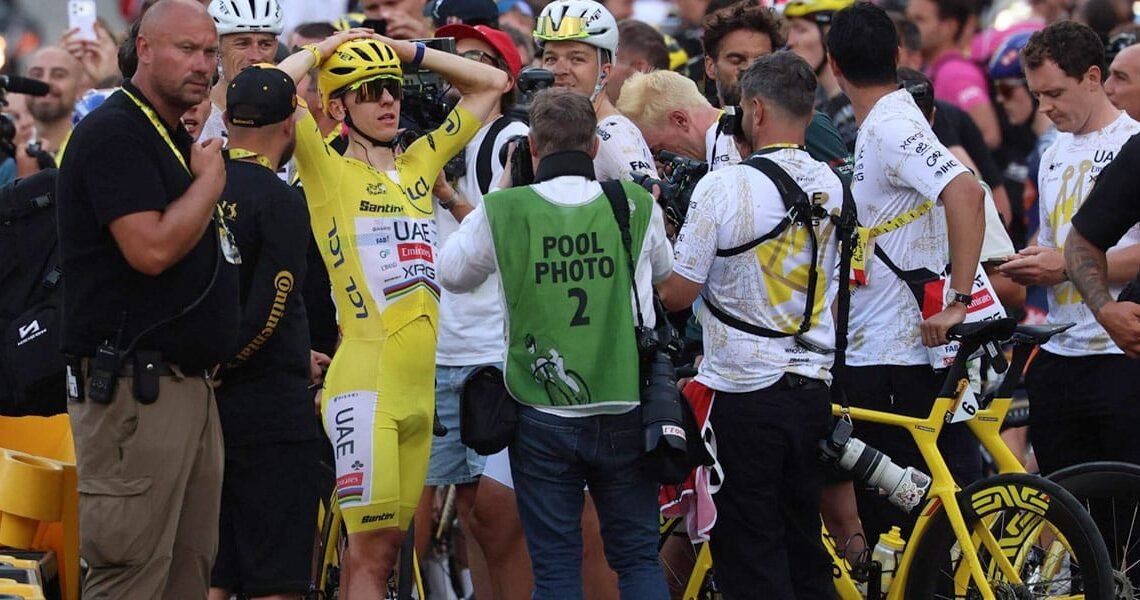
The past weekend saw Tadej Pogačar seal his fifth Tour de France with a six-plus minute winning margin, the largest of his career. Furthermore, a record-shattering ascent of Alpe d’Huez has led even more observers to grudgingly admit what is slowly becoming obvious to everyone: he is the greatest stage racer the sport has ever seen, and is somehow still improving. With chief rival Jonas Vingegaard crashing out on Stage 15, no rider offered even token resistance, and the most notable storyline behind him was generational. Remco Evenepoel rode into second, announcing himself as a legitimate top-tier Grand Tour contender, while 22-year-old Isaac del Toro and 19-year-old Paul Seixas (who redefined what a teenager can do at the sport’s biggest race) offered the first credible glimpse of a future challenge. Tellingly, Seixas was also nearly the only rider in the top five who was clearly disappointed with his result; a seemingly broad satisfaction among Pogačar’s runner-up rivals is inexorably proving to be as durable a moat as his physiology.
The deeper structural story of this Tour, however, is the striking concentration of talent at the very top. Since 2023, just five riders and three teams have won all eleven Grand Tours, and that consolidation is now trickling down to stage wins: only 12 riders and 10 teams won stages at this year’s race, almost all of them ranked among the sport’s best, with just two winners coming from outside the UCI top 40 ranked riders. Stage hunting, once the aspiration of smaller-budget teams, is also now becoming the exclusive property of the ultra-elite. The commercial implications are clear. As the pool of riders capable of winning anything at the Tour shrinks, their price will climb, and the payroll threshold for meaningful success will rise in concert. As a result, the divergence between superteams and WorldTour aspirants will only grow as the minimum budget required to net major victories accelerates skyward. All of this only underlines what we have been saying for years now: cycling desperately needs to address this growing inequitably with some kind of salary or budget cap mechanisms. We can only hope this will be a part of the UCI’s future reforms.

Trump’s Sudden War on Bicycles
The last couple it weeks it has seemed as if the Trump administration really is declaring war on the general idea of bicycles. After Transportation Secretary Sean Duffy announced an end to “DEI bike lanes” last week, now the Federal Highway Administration appears to have taken the battle further, asking staff to examine funding and remove any references to either bikes or bike lanes. The agency continues to gut bicycle safety programs and cut spending on any type of bicycle transportation infrastructure. Pointing out that 80% of the population uses cars to get to work and medical appointments, the agency noted only that it is “taking a closer look at federal guidance to ensure American families have the infrastructure they need.” And an unnamed official of the FHA, apparently revealing the agency’s underlying strategy, said this last week. “This is a common sense approach despite the Left’s belief that everyone should ride a bike to their shoebox-sized apartment to eat crickets to achieve a phony climate agenda.” It’s not clear what is driving this outburst against cycling. More concerning is that this kind of hyperbole is coming from the same person and agency which is responsible for U.S. commercial airline safety.

More Calls for ASO to Modernize
This week, even the New York Times joined the growing chorus of calls for the Amaury Sports Organization to modernize its approach, and modify its virtual lock on professional cycling. We reported last week on the paucity of prize money in the sport, and Money in Sport’s call for the Amaury family and ASO to demonstrate more interest in investing in the future of the sport. Suggesting that the race generates $170 million a year in media revenue, this article asks why the famously private and tight-lipped family refuses to share any of those monies, or reinvest anything in growing the sport. In comparison to the skyrocketing growth rates of many other sports, cycling remains an enigma, with the Amaury family seemingly content for it to remain a small niche sport. But as the Times points out, this “starves the sport of capital that could expand the fan base and leaves cycling in a precarious spot.” In the very first article ever written by The Outer Line, in 2012, we called for ASO and the cycling community to increase the size of the “pie,” but the Amaury family’s response always seems to – “no, we like the size of the pie just fine the way it is, and we like our big piece of that pie.”

AI-Generated Expert Analyses Floods Cycling
A surprising trend over the three weeks of Tour hype has been the sudden and puzzling surge in new “experts” posting about the statistics, trends, and global importance of the race – and AI may be the reason why. Eye-catching graphics and three-paragraph formulaic posts about viewership, marketing, and overall economic impacts seemed to be rocketing around social media (such as LinkedIn) and self-published (such as Substack) avenues. A few have been insightful concerning the race’s role in the regional and global sporting economy, and its untapped potential. But many more were egregious examples of casual AI use to rapidly assemble data about pro cycling to make bold assumptions and assertions using a combination of real and imagined data. Not to name any names, but a search on LinkedIn with the string “Tour de France and marketing and opportunity,” will get you started sifting through the data deluge – on just one of the online channels.
A common feature in many of these posts was ASO’s self-reported viewership data and economic impact statements without reference to the metrics observed in the real world – which led to leaps of faith and inaccurate representation the sport. Simultaneously, we and many of our colleagues in the cycling analysis space observed unusual spikes in “click” activity as AI agents rapidly scraped and assembled “new” analyses from our public content portfolios. But at least several truthful observations emerged from this eclectic mix of AI gold and AI slop: pro cycling’s struggles to build around a mid-season “Super Bowl,” in which the entirety of the financial ecosystem is constrained to a single month, is an albatross. The out-of-control spending, narrow sponsor profile, limited prize monies, and lack of serious reforms are so obvious that – literally – an AI is smart enough to deduce the bottleneck. We do not wish to diminish what the Tour is to pro cycling, but we hope momentum is building for change after an edition marked by significant challenges. ASO and the sport’s stakeholders can capitalize on the Tour’s inherent strengths to restructure a meaningful season-long calendar that promotes season-long viewing and new fan acquisition, both of which are critical to enhancing the marketing value and media rights value of a true global sport.

Pogačar’s Attitude on Sponsorship
A recent article in the New York Times Athletic questioned why Tadej Pogačar, given his record-smashing success and salary level, has not attracted a greater level of interest from external sponsors. This story made the rounds during the middle part of the Tour, and takes on greater significance now that Pogačar has joined the five-time winner’s club and has a shot at the outright ‘recognized’ six-time record. A number of reasons were cited, such as potential conflicts with existing team sponsors, the point that cycling is generally perceived as a niche and less-visible sport, and the fact that Pogačar hails from the relatively small and remote country of Slovenia. And, uncomfortably, it highlights the general lack of respect pro cycling receives from a media pool obsessed with controversial personalities and more popular sports – especially soccer during this current World Cup cycle, and the general dominance of NFL and NBA elsewhere. One might debate all of those factors, but more interesting is the fact that he apparently values his own training and/or vacation time more highly than more dollars from sponsors who will constantly be demanding his time and attention. And perhaps most interesting: to date at least, all of his sponsorship earnings have been contributed to his charitable organization which supports youth cycling in Slovenia.
Revamp of Nielsen Ratings System
Nielsen Ratings will be formally revamped ahead of the 2026-2027 NFL season to more accurately measure so-called co-viewing of events. This primarily includes private viewing parties that fall outside of the media data giant’s “out of home” metric – group viewing in sports bars, for example. This new measurement is the latest in a broad restructuring of Nielsen analytics to remedy undercounting of audiences, largely due to technology barriers and outdated methodologies. Already, pundits are estimating up to a four point increase in the viewership figures based on the size and duration of viewing parties for NFL games, which traditionally have high co-viewing trends. But could a co-viewing metric reflect positive change for cycling’s viewership in the future? Given cycling’s current demographics and status as a niche sport, probably not, but data gleaned from other sports may inform future strategies to cater to cycling’s fan base, create co-viewing opportunities, and attract new fans to the sport.
Garmin Acquires TrainingPeaks and TrainingHeroic
Garmin made a surprise announcement this week said it was acquiring TrainingPeaks and TrainingHeroic, widely-used training platforms for both athletes and coaches. TrainingPeaks’ 120 Louisville, Colorado employees will now join Garmin, originally an American company founded in Kansas, which is now legally based in Switzerland. These companies “share Garmin’s passion for empowering athletes and coaches around the world with world-class training tools, performance metrics and actionable insights,” said the CEO of Garmin. This move furthers a proxy race between device makers Garmin, Zwift, Oura, Whoop, and data giant Strava to secure consumer fitness channels inclusive of hardware, services, and online communities. The potential changes to the overall fitness ecosystem are exciting and we hope that this competition spurs forthcoming products to encourage people – for lack of a better phrase – to get out and ride.
(Note: With various summer travel plans, our own riding goals, and external commitments, the AIRmail from The Outer Line will take the next couple of weeks off and return later in August. Happy summer to all of our readers.)
Written and Edited by Steve Maxwell / Joe Harris / Spencer Martin
THE OUTER LINE
www.theouterline.com
@theouterline
Visit our website for our latest articles and commentary. And check out our extensive Article Library for hundreds of in-depth articles about the economics, governance, structure and competition of pro cycling, organized by subject. (Advisory Group: Peter Abraham, Luke Beatty, Brian Cookson OBE, Nicola Cranmer, Prof. Roger Pielke, Jr., Dr. Bill Apollo and Prof. Daam Van Reeth.)
The post Outer Line: Tour de France Analysis, ASO & AI in Cycling appeared first on PezCycling News.