
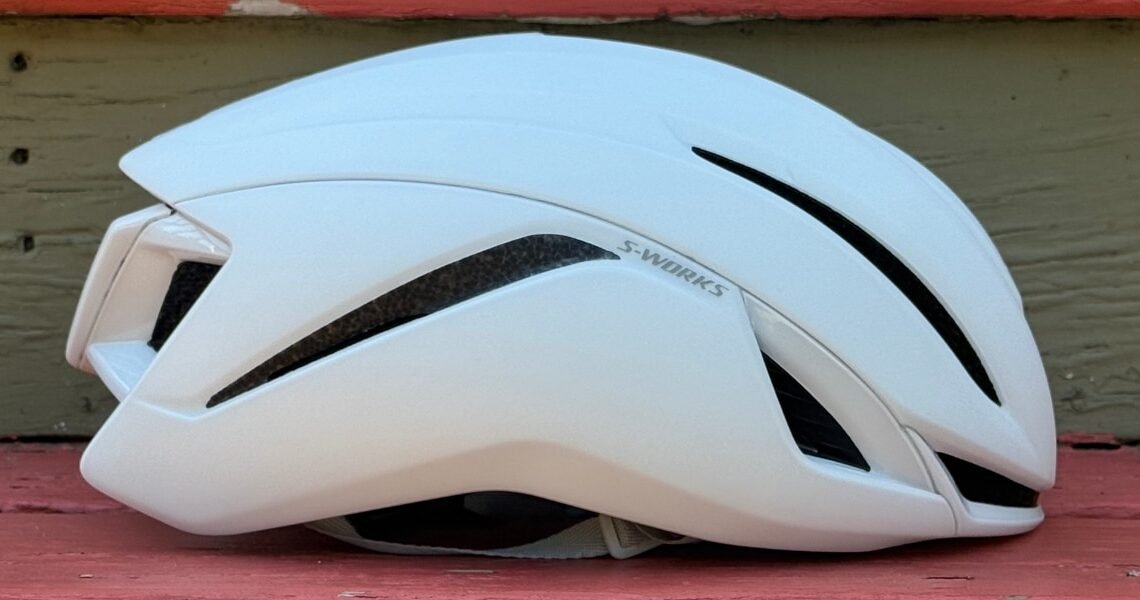

When we first introduced the S-Works Evade 4 and BOA FS2 in Gear Break back in June, the headline news was unexpected. The new Evade wasn’t slipperier than its predecessor; the real story is the all-new Fit System 2 from BOA. This collaborative integration pairs the latest aero helmet from Specialized with a new suspension and retention architecture, promising a more secure fit than ever before – and, in my opinion, helmet security has never felt better.

BOA is no stranger to helmet retention, and for their 25th anniversary, they’ve introduced the Fit System 2 (FS2). Making its debut on Specialized’s Evade 4 aero race lid, FS2 takes helmet design “beyond the vise.” You not longer have to endure tightening a semi-rigid plastic frame onto your head to keep your helmet in place.

Beyond the Vise: The Clamping Problem
To appreciate why the new BOA FS2 system is a massive leap forward, look at conventional, until now, helmet retention. Helmets have traditionally relied on what is essentially a two-dimensional clamp. Typical helmet fitting systems used a fixed brow piece usually anchored at two fixed points near the temples, that extended to a dial mechanism at the rear. Turning that rear dial simply clicks a rear cradle forward along a linear path. The action of the system meant that the two pieces were tightened on a linear axis back-to-front.
This design doesn’t actually tighten the helmet around your head. Instead, it pulls the helmet against your forehead. The clamping action compresses the scalp, restricts blood flow, can leave deep indentation marks, and can lead to uncomfortable pressure points (see the diagram below). It also traps riders in a continuous cycle of micro-adjustments: crank the dial down for security, back it off when hotspots start biting, retighten, loosen, and on and on. A loose helmet is a compromised helmet – if backed off to alleviate pressure, it can shift during a crash and expose your skull to secondary impacts.

The BOA FS2 Solution: 360-Degree Floating Retention
The BOA Fit System FS2 replaces the clamping model. Engineered at BOA’s Human Performance Fit Lab (HPFL) in Denver, it treats your skull as a three-dimensional sphere, wrapping it in an omnidirectional floating suspension.
Instead of rigid plastic bands, the FS2 uses an ultra-thin, low-friction TX1 textile lace woven from ultra-high-molecular-weight polyethylene. This zero-stretch cord routes through flexible internal guides that run around the entire 360-degree circumference of the wearer’s crown.

When you turn the rubberized FS2 dial, it pulls the continuous textile loop smoothly through its guides, drawing the internal cradle inward like a camera aperture. Tension is distributed evenly around the entire circumference of the head. This results in a 6% more secure, stable hold according to BOA’s engineering data.

This design delivers key mechanical advantages:

- Decoupled Occipital Yoke: The rear cradle is separated from the vertical perimeter headband with two contact points that float independently at the back of the skull. This allows the yoke to be securely, and comfortably, anchored below the occipital bone when the dial is turned to tighten the perimeter lace.
- Hotspot Elimination: By distributing tension perfectly across the skull rather than concentrating it into fixed contact points, localized pressure peaks are eliminated.
- Micro-Resolution Tuning: The physical dial features a bi-directional click resolution that is claimed to be 40% finer than standard helmet ratchets, allowing you to fine-tune fit down to fractions of a millimeter.

Safety is directly linked to comfort here. Because tension is uniform and pressure points are gone, you set the FS2 once and leave it locked down. There is no urge to back it off on long rides, ensuring the helmet stays exactly where it needs to be if things go sideways.
Retuning the Shell: Thermally Transformed
Because FS2 changes how a helmet interfaces with the head, Specialized re-engineered the helmet shell around it. Aerodynamic design is traditionally a game of cruel compromises: shrinking or removing vents to make a helmet slippery often traps heavy, humid air against your scalp.
With the Evade 4, Specialized spent over 100 hours in their WinTunnel focusing on internal fluid dynamics rather than chasing marginal external watt gains:
- The Forehead “MouthPort”: This prominent scoop returns to grab fresh air without an aero drag penalty.
- Deeper 4D Channels: The internal architecture pulls cool air over your brow, accelerates it across your scalp, and exhausts it out a wide rear diffuser.
- Wider Interior Headform: Specialized relaxed the narrow temple profile of the Evade 3, widening and rounding the inner shell to eliminate pressure points without altering the sleek exterior Cd.

Lab tests validated a 2.4% to 2.6% increase in internal airflow over the Evade 3, giving the Evade 4 a noticeable thermal upgrade on slow climbs.
Collaborative Design and Integration
The 360-degree cable wrap is pure BOA FS2, but its execution on the Evade 4 is a masterclass in custom integration. Rather than forcing an off-the-shelf component into the helmet, BOA tailored the FS2 to Specialized’s specific chassis requirements.

Instead of using the standard single-pivot ladder found on the baseline FS2 architecture, BOA adapted the system to match Specialized’s preferred dual-attachment, tool-free vertical interface. This preserves over a decade of Specialized design legacy and provides five tactile detent positions for height adjustment.
Crucially, this custom routing protects internal airflow. Standard. Until now, plastic band suspensions risked blocking or fouling the required deep ventilation channels for airlow. BOA routed the thin front lace cleanly outside the primary intake streams and built the dual rear ladders to clear the exhaust ports. The result is micro-tensioning that doesn’t disrupt internal airflow thus allowing maximized thermal management.
Out of the Lab, onto the Road
Engineering diagrams look great on paper, but the real truth emerges on the road. When I first put this helmet on and dialed it in, the traditional “helmet feeling” was absent. It doesn’t clamp; it feels as though it is cradling your head.
More importantly, the fit and thermal performance on the bike proved outstanding:
- Zero Wiggle: If you grab the shell and twist it, it stays put. It doesn’t bounce or rattle when grinding over teeth-chattering washboard gravel. The decoupled occipital yoke design anchored comfortably to the contours of my skull.
- The 8-Hour Test: The hotspot elimination claims are real. I tested the helmet on endurance rides and shorter gravel races. First, on back-to-back 150-mile+ (~250 km) days, eight hours plus each day, I experienced zero fit issues or discomfort. The comfort BOA promised was realized, I didn’t need to fiddle with the tension once I was locked in. While racing, I could focus on watts, not what’s digging into my forehead.
- Managing Sweat: As a high-volume sweater, my previous Evades often created a waterfall dripping down my face. The improved internal air channels of the new Evade worked. Without wide plastic bands to trap sweat against my forehead, sweat could evaporate. I wasn’t constantly wiping sweat away from my forehead and eyes every few minutes. I found this to be a massive improvement.
Small Details That Matter
Specialized also addressed several long-standing practical complaints on the exterior chassis:
- The Sunglasses Dock: Eyewear storage on the Evade 2 was notoriously loose, and the Evade 3 has spit glasses out over rough roads. The Evade 4 holds them rock-solid. I tested it with bulky Oakley Jawbreakers, and they didn’t budge over gravel sectors, no matter how rough.
- Refined Profile: Visually, Specialized narrowed the frontal profile and tucked in the rear tail. This eliminates the bulbous, mushroom-cap look and pronounced rear overhang of prior generations without compromising aero efficiency.


The Pez Verdict: Speed Without the Vise
The Specialized S-Works Evade 4 proves that aerodynamic speed doesn’t require choosing speed over comfort. By prioritizing internal fluid dynamics and partnering with BOA, Specialized has fixed the traditional flaw of aero lids: suffocating heat (and the inevitable sweat waterfalls).
More importantly, BOA’s Fit System 2 has fundamentally changed how premium helmets should fit, and function. By cradling the rider’s skull, instead of clamping, the helmet fit is comfortable almost beyond compare.
More Info & Pricing
The Specialized S-Works Evade 4 is available worldwide through local Specialized dealers and online. MSRP for standard colors is $349.99 / 329,00€ / £279.00, while Team Replica editions retail for $369.99 / 329,00€ / £279.00.
- See more on the BOA FS2 Fit System
- Find yours at Specialized.com
Note: If you have other experiences with gear or something to add, drop us a line. We don’t claim to know everything (we just imply it at times). Give us a pat on the back if you like the reviews. Or, call us out if you feel the need!
PezCycling News and the author ask that you consult the manufacturers if you have any questions about the products you see here. Only the manufacturer can provide accurate and complete information on proper/safe use, handling, maintenance, and or installation of products as well as any conditional information or product limitations.
The post Specialized S-Works Evade 4 Review: BOA FS2 Delivers Speed Without the Vise appeared first on PezCycling News.