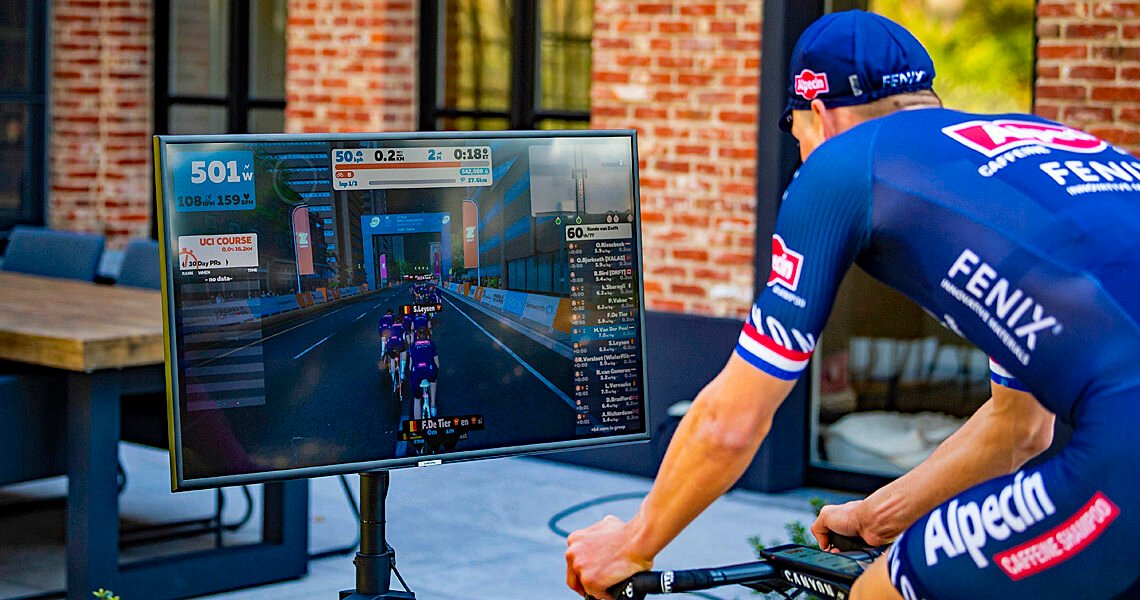
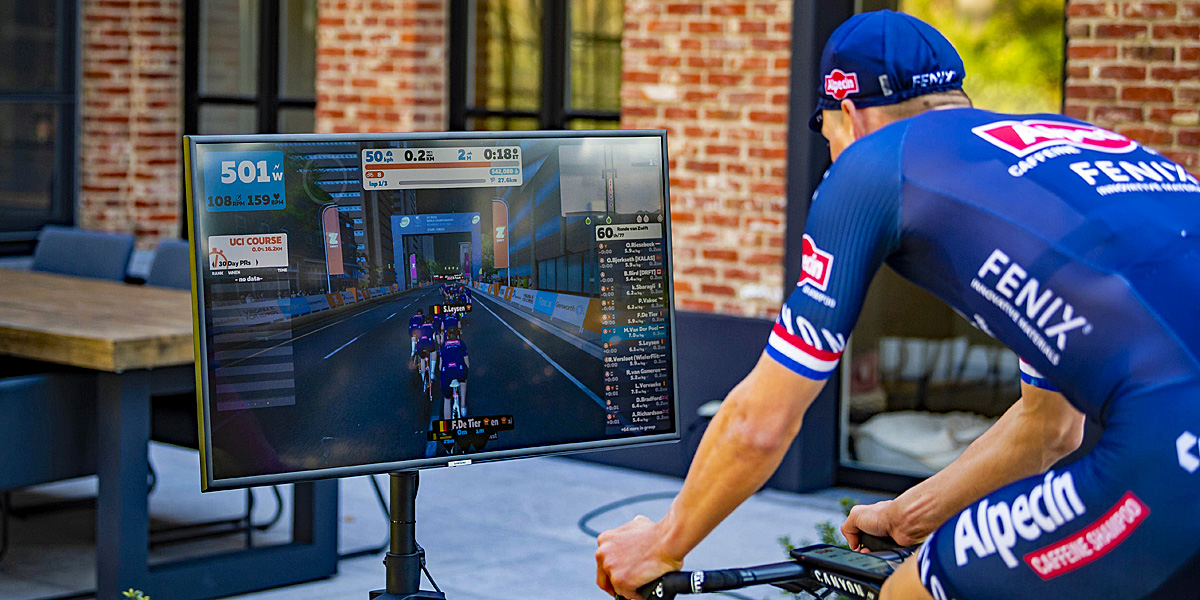
The days are starting to get shorter here in southern Ontario, the mornings are cooler, & more cyclists are thinking about dusting off the trainer & pulling the bike back into the pain cave. Indoor racing season is just around the corner, & a lot of us are about to spend the next several months doing a big chunk of our structured training indoors. Which brings up a question I’ve been meaning to dig into for a while.

If you spend any time exploring various cycling forums, you’ve probably come across the widely-held belief that indoor FTP is always lower than outdoor FTP. The typical story goes something like this: someone rides outside all summer, pushes their FTP up from consistent, outdoor riding. Then struggles to push the same power indoors & discovers they’re unable to replicate their performance from the road. Cue the confusion, the online debates, & the questions about which number is “real.”
Here’s what I always found peculiar: I’ve never really experienced this myself. My indoor & outdoor numbers have always felt pretty close, & I’ve been curious about why. Is it because I’m a lighter rider producing less absolute power & therefore less heat? Is it because I spend a decent amount of my training time indoors, so my body is better adapted to that environment? Or is it because my pain cave is set up with decent cooling? (I’ll admit – my dual fan setup is pretty amazing for staying cool.) With more of us about to head indoors for the season, this month I wanted to dig into what the research actually says about the indoor-vs-outdoor power question, & maybe figure out which of those factors matters most.
What the research actually shows
The first thing worth knowing is that the “indoor FTP is always lower” story isn’t quite as clean as it’s often presented. As always, the evidence is more nuanced than that.
A 2019 study by Jeffries & colleagues had 20 competitive male cyclists (avg VO2max of 60.4 mL/kg/min) perform 20-minute time trials both indoors on a lab ergometer & outdoors on a racing circuit. The result? No significant difference in mean power (280 W indoor vs 284 W outdoor), with a very strong correlation between the two settings (r = 0.94). What did differ significantly was variability – power output was much more variable outdoors (SD 69 W vs 33 W), which makes sense given road gradients, wind, etc.
But other studies have found meaningful differences. Lipski et al. (2022) tested 14 UCI Continental & World Tour cyclists across maximal efforts ranging from 1 to 14 minutes, & found outdoor power was consistently 4.2–8.8% higher than indoor. Further, a 2023 study from Vinetti and colleagues on junior cyclists (~16 years old) found outdoor uphill FTP (269 +/- 34 W) was significantly higher than lab-based measures of critical power (236 +/- 24 W) & 4 mM lactate threshold (233 +/- 23 W).
So which is it? The evidence suggests the answer depends on the individual & the conditions – but when there is a meaningful indoor-outdoor gap, the research points to one factor above all others: heat.
The Thermoregulation Problem
Here’s the thing many cyclists might not fully appreciate: while riding, roughly 75-80% of the energy your muscles produce comes out as heat, & only 20-25% actually becomes forward motion. In other words, for every 100 W of mechanical power you produce, you generate approximately 300-400 W of heat! That’s according to a 2021 review by Périard & colleagues on thermoregulation in exercise. Your body is essentially a not-very-efficient engine, & most of what it produces needs to go somewhere.
Outdoors, that heat is carried away primarily by convection: the moving air over your skin acts as a massive cooling system. At speeds of 25+ km/h, you’ve got the equivalent of a stiff breeze constantly stripping heat off your body. Indoors – especially without a fan – that convective cooling effectively disappears. You’re now relying almost entirely on evaporative cooling (sweat), which becomes progressively less efficient as the humidity in your pain cave climbs from your own sweat & breathing. Remember that wiping or dripping sweat doesn’t provide any cooling for you – only sweat that evaporates provides cooling!
Several peer-reviewed studies have documented what happens when you compare cycling with & without fans. Cheuvront et al. (2010) & Fernandez et al. (2023) found the same pattern: higher core temperature, higher heart rate, higher perceived exertion, & earlier onset of fatigue when cooling is inadequate. Your body doesn’t specifically care whether you’re indoors or outdoors… it cares about whether it can effectively shed heat. And when you can’t cool effectively, the evidence suggests that the body protects itself by reducing your capacity to keep working.
The practical implication is significant. If you’re testing your FTP indoors without proper cooling, you’re not really measuring your physical capacity… you’re measuring the point at which your thermoregulation gives out. That’s a legitimate measurement of your indoor performance ceiling, but it’s not comparable to outdoor efforts on a cool day with natural airflow.

Why my experience might not match everyone’s
Coming back to my own question: why haven’t I experienced the big indoor-outdoor gap? Looking at the research, a couple of things line up:
First, my (biased) opinion is that my pain cave setup is actually quite good! I’ve got an excellent dual-fan setup (Lasko blower fans are excellent!) whenever I ride the trainer. Further, my training setup is in my basement, which typically stays reasonably cool & dry. That directly addresses the convective cooling problem the research highlights.
Second, there’s an interesting finding from a 2024 study on triathletes (Kowalski et al.) that showed the relationship between indoor & outdoor performance is significantly affected by training environment history. In short, riders who train primarily indoors tend to perform relatively better indoors. Given that I do a lot of my riding and racing on the trainer, my body has probably adapted to that environment better than those that are outdoors all summer long.
What this tells me is that the popular “indoor FTP is always lower” framing isn’t so much a physiological law as it is a description of what happens to riders whose indoor setup doesn’t compensate for the loss of natural cooling. If you notice this issue for yourself: start by addressing the cooling problem & the gap tends to either shrink or disappear entirely.
What this means for your training
If you feel like your indoor watts are consistently harder than the same numbers outdoors, the evidence suggests the first thing to fix isn’t necessarily your training zones: it’s your setup. A few things worth considering, based on what the thermoregulation research points to:
- Airflow matters more than you probably think. A single small fan isn’t enough for hard efforts. Multiple fans, or one industrial-grade fan positioned to hit your torso & legs, makes a meaningful difference.
- Room temperature matters too. A cool room (below ~18°C / 65°F) buys you significant additional cooling capacity before your body starts to struggle.
- The type of workout matters. Short high-intensity intervals (5×2 min VO2max) are less affected because the effort ends before heat becomes limiting. Long threshold intervals (2×20 min at FTP) are where inadequate cooling really hurts.
If you’ve done all of that & still find your indoor numbers are meaningfully lower than outdoor, then it might be worth using slightly different training zones for the two environments. But I’d fix the cooling first & retest before assuming you need different numbers.
That’s all for this month – stay safe, ride fast, & I’ll see you next time!

References
Jeffries O, Waldron M, Patterson SD, Galna B. An Analysis of Variability in Power Output During Indoor and Outdoor Cycling Time Trials. Int J Sports Physiol Perform. 2019 Oct 1;14(9):1273-1279. doi: 10.1123/ijspp.2018-0539. PMID: 30859858.
Lipski ES, Spindler DJ, Hesselink MKC, Myers TD, Sanders D. Differences in Performance Assessments Conducted Indoors and Outdoors in Professional Cyclists. Int J Sports Physiol Perform. 2022 Mar 31;17(7):1054-1060. doi: 10.1123/ijspp.2021-0341. PMID: 35361736.
Vinetti G, Rossi H, Bruseghini P, Corti M, Ferretti G, Piva S, Taboni A, Fagoni N. Functional Threshold Power Field Test Exceeds Laboratory Performance in Junior Road Cyclists. J Strength Cond Res. 2023 Sep 1;37(9):1815-1820. doi: 10.1519/JSC.0000000000004471. Epub 2023 Feb 2. PMID: 36692223; PMCID: PMC10448799.
Périard JD, Eijsvogels TMH, Daanen HAM. Exercise under heat stress: thermoregulation, hydration, performance implications, and mitigation strategies. Physiol Rev. 2021 Oct 1;101(4):1873-1979. doi: 10.1152/physrev.00038.2020. Epub 2021 Apr 8. PMID: 33829868.
Cheuvront SN, Kenefick RW, Montain SJ, Sawka MN. Mechanisms of aerobic performance impairment with heat stress and dehydration. J Appl Physiol (1985). 2010 Dec;109(6):1989-95. doi: 10.1152/japplphysiol.00367.2010. Epub 2010 Aug 5. PMID: 20689090.
Fernandez A, Wimer GS, Culver MN, Flatt AA, Grosicki GJ. Fan Cooling Improves Submaximal Exercise Capacity in an Indoor Thermoneutral Environment. Res Q Exerc Sport. 2023 Mar;94(1):124-130. doi: 10.1080/02701367.2021.1946467. Epub 2022 Jan 13. PMID: 35025720.
Kowalski T, Sadowska D, Wiecha S. Differences between indoor and outdoor field cycling tests in triathletes are associated with training environment history and BMI: analysis and prediction formula. J Sports Med Phys Fitness. 2024 Oct;64(10):1039-1047. doi: 10.23736/S0022-4707.24.15921-X. Epub 2024 Jun 18. PMID: 38888564.
The post Indoor vs. Outdoor FTP: Why Your Power May Be Lower Inside appeared first on PezCycling News.