
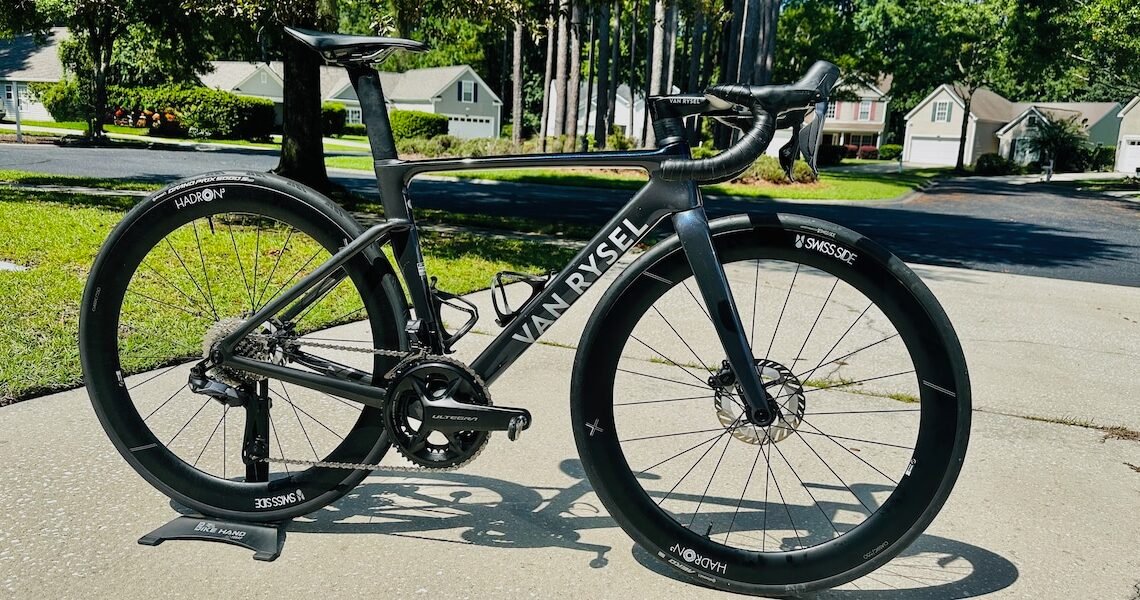

Van Rysel has moved quickly from Decathlon’s value-focused house brand to a serious presence at the sharp end of the WorldTour — and the RCR Pro is the bike leading that charge. It’s the same lightweight aero frame raced by teenage sensation Paul Seixas and the Decathlon CMA CGM Team, but our $7,499 Special Edition test bike substitutes Shimano Ultegra Di2 for the team’s SRAM RED AXS build, adding Swiss Side Hadron³ wheels, Continental’s intriguing Aero 111 front tire, and an INPEAK power meter. The result is a race-ready machine with genuine pro-level credentials — but can it make an ordinary rider feel any faster? Chuck Peña put it to the test.
VAN RYSEL RCR Pro Ultegra Di2 Special Edition – $7499
Note: Pricing is MSRP and may not reflect any discounts on offer

The same frame Paul Seixas races
The new wunderkid on the WorldTour block is Paul Seixas (see Mike’s Eurotrash for how to pronounce Seixas … it’s “SEHK-sahs”). Just 19 years young and his palmares to date include:
- 1st 2026 La Fleche-Wallonne (his time on the Mur du Huy was faster than Pog’s fastest and only 2 seconds off the record held jointly by Alejandro Valverde and Julian Alaphilippe)
- 1st 2026 Faun-Ardeche Classic
- 1st 2026 Ituzlia Basque Country (he claimed all the leaders jerseys and won 3 stages en route)
- 1st 2026 Volta ao Algarve em Bicicleta (as well as the White Jersey and a Stage 2 win)
- 2nd 2026 Liege-Bastogne-Liege (where he pushed Pog on La Redoute)
- 2nd 2026 Strade-Bianche
- 1st GC 2025 Tour de l’Avenir

I can’t guarantee you the same results, but you can ride the same frame he (and the Decathlon CMA CGM Team) rides … the VAN RYSEL RCR Pro. You’ll note that I didn’t say the same “bike” because the Decathlon rides the RCR Pro with SRAM components and PEZ tested the RCR Pro equipped with Ultegra Di2 (Special Edition no less). If you want the closest thing to a team bike, then you’ll need to pony up for the RCR Pro Red AXS.
NOTE: VAN RYSEL bills the RCR Pro as a lightweight aero bike that strikes the perfect balance of weight, stiffness, and aerodynamics. If you’re looking for a pure aero bike, then the ‘droids you’re looking for is the RCR-F.

Specs
- Frame- RCR Pro Super High Modulus Carbon
- Weight – 16.2 lbs (7.35 kg) in size M (tubeless set-up)
- Fork – RCR Pro Super High Modulus Carbon
- Handlebar – Deda VR RCR Combo
- Saddle – Fizik Antares 140 mm
- Seatpost – Van Rysel Carbon
- Shifters – Shimano Ultegra Di2
- Brakes- Shimano Ultegra calipers with Shimano RT-CL800 FREEZA rotors (160 mm front, 140 mm rear)
- Front Derailleur – Shimano Ultegra Di2
- Rear Derailleur – Shimano Ultegra Di2
- Crankset – Shimano Ultegra (52-36)
- Cassette – Shimano Ultegra (11-34)
- Hubs – Swiss Side 18 Aero
- Rims – Swiss Side Hadron³ Classic 550 (55 mm depth, 22 mm internal width)
- Tires – Continental Aero 111 29C (front), Continental Grand Prix 5000 S TR 28C (rear)


Geometry and Fit

| Geometry | XS 5’1″-5’5″ (155-166 cm) | S 5’5″-5’8″ (166-173 cm) | M 5’8″-5’11” (173-181 cm) | L 5’11”-6’1″ (181-186 cm) | XL 6’1″-6’5″ (186-196 cm) |
|---|---|---|---|---|---|
| Top Tube Length (mm) | 536.4 | 544.4 | 556.4 | 571.4 | 591.4 |
| Seat Tube Length (mm) | 463 | 473 | 483 | 513 | 543 |
| Head Tube Length (mm) | 114 | 131 | 147 | 174 | 199 |
| Fork Length (mm) | 367 | 367 | 367 | 367 | 367 |
| Fork Rake (mm) | 45 | 45 | 45 | 45 | 45 |
| Bottom Bracket Drop (mm) | 70 | 67 | 67 | 67 | 67 |
| Reach (mm) | 382.5 | 385.7 | 388.2 | 395.5 | 408.4 |
| Stack (mm) | 515 | 531 | 546 | 572 | 596.0 |
| Chainstay Length (mm) | 410 | 410 | 410 | 410 | 410 |
| Wheelbase (mm) | 978.2 | 979.1 | 986.0 | 1001.5 | 1021.7 |
| Seat Tube Angle | 74.0° | 74.0° | 73.5° | 73.5° | 73.5° |
| Head Tube Angle | 72.0° | 73.0° | 73.0° | 73.0° | 73.0° |
Chuck sez: What size did I go with? Based on my height and the RCR Pro’s stack and reach measurements, I could technically fit on a size S. But I could also fit on a size XS — in part because the reach on the XS is on the “long” side compared to many other manufacturers’ same sized frames — so decided to go the current modern “pro” route, i.e., ride the smallest frame possible,.

The only “issue” is that I knew I would be getting an OEM build and wouldn’t be able to dial my fit in (especially with a one-piece bar/stem combo). On a size XS, the stock Deda VR RCR bar/stem combo is 90 mm long and 38 cm wide. If I wanted to mimic my more “traditional,” i.e., late 80s/early 90s, position that I ride on my Felt, Colnago, and LOOK, I would go with 120 mm length bar/stem combo (what they put on an XL frame and would be 40 cm wide, which is the bar width on my other bikes). Also, the stock build on a size XS has 30 mm worth of spacers under the bar/stem and I would want to remove at least 20 mm to mimic my position on my other bikes — but that wasn’t possible because that would require cutting the steerer tube which would be a major no-no on a demo bike. Also informing my decision to go XS rather than S was that even with a totally slammed stem on a size S the stack would be 10 mm higher and an OEM size S would likely have 30 mm of spacers under the bar/stem, which would be an ungodly 40 mm higher.

If I have one criticism (not of the RCR Pro as a bike), it’s about manufacturers spec’ing integrated one-piece bar/stems. I know that’s the pro thing to do, but … If the manufacturer’s OEM choice for bar width and stem length suits your fit, then consider yourself lucky and you’re good to go. But what’s the likelihood of that? So if the bar/stem isn’t right … you’re looking at an expensive proposition to replace it, i.e., the cost of a new bar/stem (one-piece or otherwise) and LBS labor re-do/replace the brake hoses.


So my fit is about 30 mm shorter and 20 mm taller than what I ordinarily ride. But this isn’t necessarily such a bad thing. If you look at the pic below of Pog, his position is a little more forward and upright than my traditional, i.e., more 90s, “long and low” position when I’m on the hoods. (For more on Pog’s position and how it’s influencing how other pros are fitting themselves to their bikes, John Eustice’s article is a good read.) Also, the 38 cm wide bars are in keeping with being narrower for more #aero.


Some assembly required
If your LBS isn’t a VAN RYSEL dealer (VAN RYSEL has been expanding its distribution network in the United States), you can buy online at vanryselus.com. The good news is that if you have reasonably competent bike mechanic skills and a good set of bike tools, VAN RYSEL has made it relatively easy for a DIY build.


The RCR Pro comes “mostly assembled,” thanks in part to the one-piece bar/stem combo with internal routing that’s been aligned with the fork. If you want to change the fit to a different size bar/stem or remove spacers, I will tell you from personal experience that this is probably better left to a shop with an experienced/knowledgeable mechanic. All that’s really required to finish is:
- Mount the front wheel (thru-axle using a 6 mm hex wrench)
- Stuff the battery (already in a rubber sleeve) into the seat post (this actually takes some effort, which is a good indication that you don’t have to worry about the battery falling out)
- Insert the seat post into the seat tube (which had carbon paste already applied and I applied carbon paste that VAN RYSEL included to the seat post) and secure with the seat post wedge (torque’d to 6-8 Nm with 5 mm hex wrench)


All that was left for me to do:
- Attach my pedals (because the OEM build includes a power meter, I went with my non-power meter Wahoo Speedplay Zero pedals)
- Set my seat height (5 mm higher than my other bikes because the RCR Pro size XS has 165 mm cranks, which contributes to the “pro” lots of exposed seat post look) and saddle angle (-2° down)
- Attach the included out front computer mount (for whatever reason, it attached via T25 Torx screws). NOTE: The puck is set up for Garmin but can be rotated for Wahoo. VAN RYSEL also provides a Bryton puck. And they provide an action cam aka GoPro mounting point that can be attached to the underside.


Power Meter Included
I have Wahoo POWRLINK ZERO power meter pedals, but one of the attractive features of the VAN RYSEL RCR Pro is that it comes with a power meter — the INPEAK POWERCRANK-E single/left-side crankarm power meter that is both ANT+ and BLE compatible. And unlike similar power meters of old (I have an older 4iiii on my Felt), it has a rechargeable battery — with, of course, a proprietary magnetic charging cord so don’t lose it!
You’ll need to download the INPEAK Manager app (iOS or Android) to update firmware and calibrate.

I don’t have a way to measure the accuracy of the INPEAK POWERCRANK-E (the manufacturer claims +/- 2% which is pretty standard in the power meter industry). I can just say that the watts I see on my head unit and the data downloaded to Strava/Xert aren’t wildly different for the same rides/relative effort than what I see from my Wahoo POWRLINK ZERO power meter pedals.
Swiss Side/Continental’s Interesting Tire Choice

When I first looked at the wheels/tires, I thought someone made a mistake. The front and rear tires weren’t the same — they were both Continentals but different models. It turns out there is method in this madness.
The rear tire is the Continental Grand Prix 5000 S TR — the latest incarnation of the venerable Grand Prix product range that I’m sure almost all PEZ readers are familiar with. As you would expect, it uses Continental’s Black Chili compound for increased grip and reduced rolling resistance and has Vectran breaker for puncture resistance. All I can say is “thank you” that it was pre-mounted because the beads on Continental Grand Prix tires are amongst the tightest known to man (whether they’re tubeless or regular clinchers, but especially if they’re tubeless). I’ve ridden several previous versions of the Continental Grand Prix so a tire I’m more than familiar with.

The front tire is the Continental Aero 111 that was developed in conjunction with Swiss Side (who make the wheels outfitted on the RCR Pro and the wheels used by the Decathlon CMA CGM WorldTour team). What makes the Aero 111 different is that it has 48 little cavities on the surface (about where you would expect the tread pattern).
According to Swiss Side: Aero cavities in the patented tread pattern function as vortex generators, creating turbulent airflow on the surface that enables the air to stick to the rim shape of the front wheel. The result is a maximization of the sailing effect by delaying the flow separation from the rim, resulting in the ultimate aero wheel tire system.
According to the VAN RYSEL website: “We recommend converting your tires to tubeless using the included tubeless valves.” And the Swiss Side website says: “For all disc brake wheels this comes with a Continental TPU tube.” So my expectation was that the tires would come with tubes installed. But for whatever reason my wheels/tires were set up as tubeless. I suspected they were tubeless because VAN RYSEL included a bottle of tire sealant. Also, I couldn’t find any tubeless valves in the assortment of stuff included with the bike. Nevertheless, I wanted to be sure given contradictory indicators. So I pumped both tires up to max pressure. I knew (both from its reputation and prior experience) that the Grand Prix 5000 S TL rear tire would hold air even if it was tubeless, but the Aero 111 tire went noticeably soft (but not totally flat) after sitting overnight (what I would expect for a tubeless tire without sealant). Just to be double-sure, I broke the beads on both tires to confirm that there were no inner tubes. Then re-seated them, added the sealant VAN RYSEL provided, pumped them up, and spun the wheels to coat the inside of the tires with sealant and fill any gaps. Voila!


First Ride Impressions

My first ride on the RCR Pro was my usual Sunday “fast and furious” group ride. 37 flat miles of mostly hammer down pretty much from the start. And not steady state riding. Lots of jumps and accelerations. A legit race training ride — even though I’m no longer racing.

Long story short … I rode it in my fastest time (measured by minutes, not seconds). And not just by sitting in and getting towed along for the ride (although I did some of that too). Especially the second half of the ride, I did my fair share of keeping things moving closing gaps and spending time at the pointy end. For the record: My original plan was to ride more “easy” to get used to the RCR Pro, but you know what they say about the best laid plans.
Anyway, it was the same “old and slow” me but riding a different bike … you do the math.

OK, I won’t go so far to say that it was all about the bike. But if you are a student of the school of #marginalgains, the VAN RYSEL RCR Pro offers these that may have contributed to me being faster:
- The Continental Aero 111 front tire is supposed to be more aero and stable in crosswinds
- 55 mm rim depth rims are more aero (in terms of rim depth) than any of my other wheels
- Narrower 38 cm bars bring my arms and shoulders in to reduce my frontal area, i.e., more aero
- Shorter 165 mm crank arms may not provide more power output per se, but are supposed to result in higher cadences and perhaps a little more pedaling efficiency
- With the 52-36 chainrings, I was riding in bigger gears than what I normally ride that combined with being able to spin more with shorter crank arms means — at least theoretically — more speed

I’m not going to say that riding the RCR Pro would be the same for you (YMMV), but as first impressions go I was definitely impressed with the RCR Pro.

Hundreds of Happy Miles Later

I’ve subsequently logged several hundred more miles on the VAN RYSEL RCR Pro. Not all my rides have been my fastest or filled with PRs, but my first impression has been a lasting one.

One thing I can’t tell you about the RCR Pro is how well it climbs (although Paul Seixas riding it gives you a data point) because the SC Lowcountry is flat, flat, flat. The only thing resembling a climb I do is going up and over the Cross Island Bridge (in both directions) on my Sunday group ride. It’s more of a “power” climb (about a quarter mile at about 5 percent) so more suited to puncheurs than skinny guys like me. But the RCR Pro holds me in good stead pushing a big-ish gear seated to hang with the “big boys.” And it responds to getting up and out of the saddle to “power up” over the top, if needed. I haven’t ridden in the mountains with sustained uphill riding, but I’m confident any shortcomings wouldn’t be the fault of the RCR Pro.

Another thing I can’t tell you is how well the RCR Pro descends (other than me going all aero tuck on the downhill on the Cross Island Bridge where my max speed is 35+ mph). But like climbing, I don’t have any reason to believe that descending on the RCR Pro would be anything but fast and confident (again, Paul Seixas, who is considered one of the best descenders in the pro peloton, is a data point).
I’m not a sprinter (unless it’s uphill against other skinny guys), but one thing the RCR Pro has is “jump.” When I need to close down a gap or otherwise accelerate, power transfer is immediate and translated into increased and sustained forward momentum.
Some other observations beyond the RCR Pro being a fast bike:
- If you’re moving to narrower handlebars, be prepared for an adjustment period. A 2 cm (less than an inch) difference in width at the hoods may not sound like much, but I could feel it. It’s not just your arms, but your shoulders. (Having ridden 38 cm wide bars on my rental bike during my Hotel Dory bike trip in Italy, it wasn’t totally new for me.)
- Ditto for shorter cranks (again, my rental bike in Italy had shorter cranks so I had some prior experience).

- The somewhat higher and shorter bar position also required some getting used to (my rental bike in Italy prepared me for this too).
- The steering is quick/responsive and with my position and weight over the front wheel being different it felt (at least initially) almost twitchy.
- Because the geometry of my touch points is “tighter,” getting up out of the saddle (again initially) felt a little bit “off balance.”

- Having to get used to a different riding position aside, the ride of the RCR Pro was stable, sure, and composed (I’m not the most prolific no-hands rider but didn’t have any problems riding no-hands). Steering input resulted in fast changes of direction. Cornering it tracked/held the line I put it on. Plus I could add more force mid-corner to tighten my line, if needed — resulting in more lean angle but I never pushed it so far as to worry about going past the point of no return.
- A taller and shorter bar position provided #marginalgains more comfort (but still a race position). And in my case is an example of an old dog being able to learn new tricks. Shorter and taller is a position I could be talked into adopting on a new bike (but I still think I’d need to do some dialing in from the OEM spec).
- Speaking of comfort, my butt (and other important bits) was comfortable enough riding OEM Fizik Antares saddle. But saddles are a very personal choice and if if the RCR Pro was my personal bike, I’d swap the saddle out for a short nose saddle — for example, the Fizik Vento Argo 00 Adaptive 3D printed saddle that’s currently on my LOOK.

- Potential speed gains aside, the Continental Aero 111/Grand Prix 5000 S TR tire combination was comfortable to ride (I’m riding them at 70 psi). As I’ve come to expect from tubeless tires, the ride quality is very smooth (what I’ve described before as “almost like floating on tarmac.”) It’s also very “soft” going over small bumps and imperfections in the road. Plus I never felt like I was riding two different tires or giving up anything in terms of grip or handling. (NOTE: If you’re new to tubeless tires, it’s normal for them to lose a few psi just sitting overnight. So it’s always a good idea to pump them up before you go out for a ride.)
- I have previously tended to shy away from what I would call “deep dish” rims (I have three wheel sets that are 30-something mm’s and one that’s 40-something mm’s — as well as my mixed depth wheel set on my Felt that has 38 mm front and 58 mm rear) because — as a lighter weight (130 pounds) rider — I’m concerned about getting buffeted in crosswinds and the prospect of front wheel snatch. In that regard, the HADRON³ Classic 550 rims were a revelation. Wind is generally part of the equation for SC Lowcountry riding (especially when I’m on Hilton Head Island) and the 55 mm deep HADRON³ wheels have behaved themselves with impeccable manners (the Continental Aero 111 front tire may be a contributing factor). Honestly, 5 years ago I wouldn’t have ridden rims that deep for fear of being blown away (not in a good way), but Swiss Side has done their aerodynamic homework to make them both fast and stable.

Should you buy the VAN RYSEL RCR Pro?

That’s a question I can’t answer definitively because buying a bike is a very personal choice. And it’s not a totally objective decision. It’s not always just a question of weight, wheels, drivetrain. Emotion plays a part in it too. Sometimes a bike just “speaks” to you. It could be it’s heritage/lineage. It could be because your favorite pro rider races on it. It could be the color. But I’ll offer up this food for thought …

The VAN RYSEL RCR Pro is a bike that’s ridden at the WorldTour pro level. So it has cred. Retail pricing for the Ultegra Di2 Special Edition is $7,499 (the “regular” Ultegra Di2 version is $6,999). A few examples of retail pricing for comparable WorldTour-level bikes (with Shimano Ultegra Di2) from other manufacturers:
- Specialized Tarmac SL8 Pro – $8,499
- Trek Madone SLR 7 – $8,999
- Cannondale SuperSix Evo 1 SL – $8,999
These and all the other bikes ridden on the WorldTour are excellent bikes. Without saying that the VAN RYSEL RCR Pro is a better bike, I think it’s fair to say that it’s a bang-for-the-buck value proposition at a more than fair price point. (NOTE: As of this writing, the RCR Pro is on sale for $6,374 on the VAN RYSEL website — a downright bargain IMHO.)

Chuck’s bottom line: At least in the U.S., VAN RYSEL is a brand that is currently flying below the radar compared to the “big” names in the industry. But it’s a name that should be on your radar if you’re in the market for a pro-level bike that holds its own on the WorldTour stage for Paul Seixas and the Decathlon CMA CGM team and can do the same for you on your local group/shop ride.

FAQs
Is the VAN RYSEL RCR Pro the same bike raced on the WorldTour?
Yes. The RCR Pro frame is the same model raced by Paul Seixas and the Decathlon CMA CGM WorldTeam. The production Ultegra Di2 version uses Shimano instead of the team’s SRAM groupset.
Is the VAN RYSEL RCR Pro an aero bike?
The RCR Pro is designed as a lightweight aero road bike that balances weight, stiffness, and aerodynamics. Riders seeking maximum aerodynamic performance should look at the RCR-F.
Is the VAN RYSEL RCR Pro easy to assemble?
Most of the bike arrives pre-assembled. Installing the front wheel, seatpost, battery, pedals, and computer mount are straightforward for experienced home mechanics.
Is the VAN RYSEL RCR Pro good value?
Compared with similarly equipped WorldTour-level bikes from Specialized, Trek, and Cannondale, the RCR Pro offers comparable performance at a significantly lower retail price.
Olav Kooij FTW on a VAN RYSEL with Swiss Side Hadron³ wheels at Stage 5 of this year’s Tour de France:
Note: If you have other experiences with gear or something to add, drop us a line. We don’t claim to know everything (we just imply it at times). Give us a pat on the back if you like the reviews or a slap in the head if you feel the need!
PezCycling News and the author ask that you contact the manufacturers before using any products you see here. Only the manufacturer can provide accurate and complete information on proper/safe use, handling, maintenance, and or installation of products as well as any conditional information or product limitations.
The post VAN RYSEL RCR Pro Review: WorldTour Speed for Less appeared first on PezCycling News.