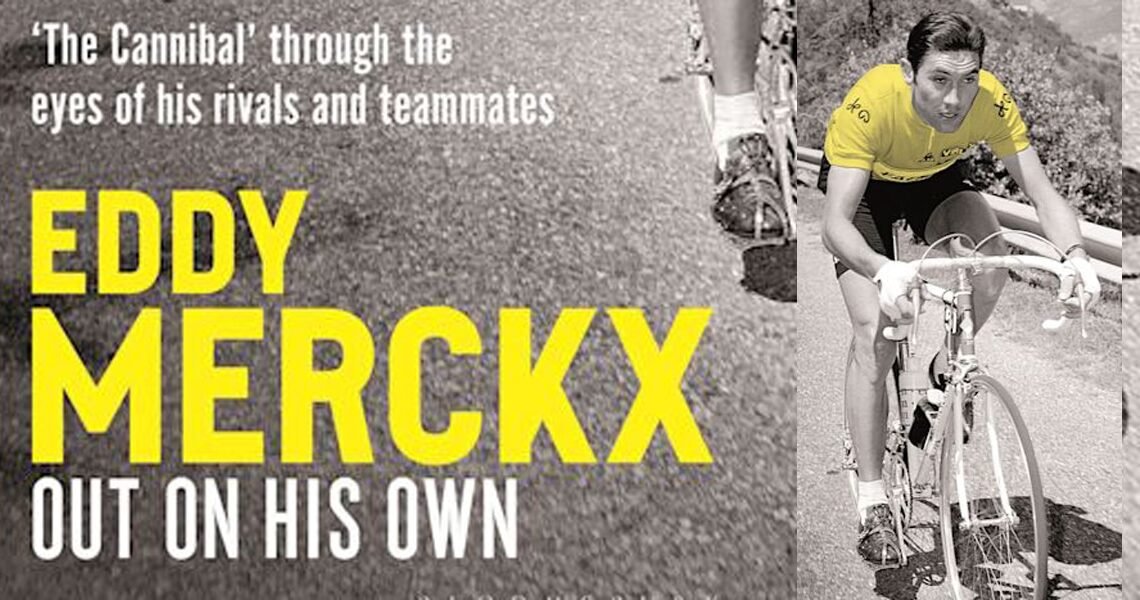

525 victories. 11 Grand Tours. 19 Monuments. 4 World Championships. The One Hour Record. “The Greatest Cyclist of the 20th Century” according to the UCI. 82 books about him in French, over 100 in Dutch. Without even writing his name you know that we can only be talking about Eddy Merckx. Given the countless books and interviews out there what is left to say? Surprisingly, there is plenty more as a new book by Guy Roger tells the story of the man they called “The Cannibal” from the perspective of his opponents and teammates.

Merckx’s career as a pro rider ran from 1965 until 1978 and he celebrated his 80th birthday last year. This means that the majority of people following cycling today never had the opportunity to see him race yet his accomplishments are such that they are still considered almost unreachable by modern riders. It is perhaps not fair to compare eras of cycling as changes in the last decade, let along half century, mean that bike racing is almost a different sport. Yet Merckx’s story remains compelling.
“Eddy Merckx Out On His Own” breaks down the rider’s career, beginning with his quiet fading away at a little race in Flanders in March 1978. Then the author turns back the clock in chapters covering the Tour de France, the Giro, the Classics, the World Championships and the Hour Record. The story is told in the voices of those who rode against him, or in support and there are threads that constantly reemerge.
Firstly, pro cycling in the 1960s and 1970s was brutally hard. There is a chart in the book showing the number of racing days Merckx did each year. In today’s world where riders might have 50 days of racing, it is amazing to see that in 1975, for example, even as he was declining as a champion, he still did 151 days of competition. Between 1970 and 1974 he averaged over 50 wins annually. And his training was so extensive that basically he had no off season, filling in the extra time by winning 22 Six Day Races as well. Merckx still feels that a bike racer should want to be racing rather than training.
One of the reasons that pro racers raced so much is that they do not seem to have been paid well at all. A favourite rider has to be Frans Verbeeck, known as “the Milkman of Wilsele.” An excellent rider, he earned so little that he gave up and bought a dairy. But he was bitten by the racing bug: getting up at four in the morning to deliver milk, he then would go on three hour training rides. Returning to the pro circuit, in his career he won 66 races, even beating Merckx in a sprint to become Champion of Belgium. But there is another side to the story that also is a recurring theme. When Verbeeck retired, he and his son started a sports clothing company and Eddy Merckx helped him by providing contacts and encouragement. Verbeeck passed away in August this year but his company, Vermarc, still flourishes. The nickname of “Cannibal” given to Merckx suggests a greediness whereas over and over in the book those interviewed mention his generosity.
Merckx’s record is so comprehensive that one realizes his opponents quoted in the book were often specialists–climbers, sprinters, time trial experts, GC men–and that Merckx could beat them all. The 1969 Tour de France is the one in which he took the Yellow Jersey for overall and the Green Jersey for points. The Polka Dot Jersey for Mountains Classification and the White Jersey for Best Young Rider were not awarded then but he took those classifications, as well as Most Combatitive Rider. And his team won Best Team, unsurprisingly.
Considering that the races took place so long ago now, the interviewees have remarkably vivid memories of them. Given the nature of competition, opinions of Merckx vary. Jan Janssen is not a friend whereas Bernard Hinault comes close to hero-worship. Rik van Looy was kind of a jerk but in the end, as with Freddy Maertens, there was a reconciliation. The book details some of Merckx’s great exploits on the road and the interviews provide the colour filling in the blank spots in the canvas. He was often out on his own, as the title suggests, but it was not because his opponents were not trying. As Andre Dierickx (second in the 1972 Tour of Flanders) revealed: “Merckx was sometimes so strong that we were relieved to see him go.”
The interviews are entertaining and often showing not only of how Merckx’s character was perceived but also revealing much about the interviewees’ own personalities. Luis Ocana, the great Spanish rider who won the 1973 Tour, was seemingly obsessed with beating the Belgian. He referred to him as “the other one.” A driven individual (he died by suicide in 1994), “Luis knew that people loved his verve, his fighting spirit, his way of making music of his words–images that only he could come up with. For example: “When I make love, I forced myself to think of Merckx in order to really get going.””
The book is full of wonderful quotes from these ageing athletes from a more colourful time. There is a chapter about modern cycling and how it would be seen by Merckx’s generation. The imposition of science and public relations and, yes, big money means that the racing of the 1970s is a foreign land to us but we are privileged to gain an insight into what it might have been like through this excellent book. It gives voices not only to the stars of the day–De Vlaeminck, Zoetemelk, Motta–but also to riders who did not make headlines but were part of the circus too.
The other theme that is constant is that Eddy Merckx garners enormous respect as a racer but also as a man from those who were in the races. He entered a race with the goal of winning it and put in the sacrifices to make it possible. He never missed a training day and in spite of a a litany of injuries in his career always aimed for the win.
One wonders if he had not had the serious crash at the track in Blois in 1969 in which his derny driver died or been punched in the kidneys by a French spectator at the Tour or had a restricted race schedule that allowed for better recovery and a longer career what would have results been? It is hard to imagine someone accomplishing even more than he did: 525 wins in 1,800 races. And from the book it is clear that he was not racing against lightweights but riders who were great athletes as well.
There is a chapter in the book with contributions by English-speaking writers, including Carlton Kirby, Ned Boulting and Phil Cavell, but it might be best to end with the Afterword, which comes from Eddy Merckx himself. Looking back he has no regrets about his career. Proud of his accomplishments, he is also happy that 50 years on rivalries have become friendships. “My fiercest rivals became my friends and my teammates have remained just that. That’s one of the great lessons life teaches us afterwards.”
He concludes: “How would I like to be remembered when I’m gone? Above all, I’d like to be seen as an example for young people. To tell them that the most important thing is to stay true to themselves even when they’re struggling.”
Originally published in French, “Eddy Merckx On His Own” might be an addition to those 81 other books about this great sportsman, but it offers a unique vantage on the man and the era. There is drama and comedy and very personal insights. A book full of life, it is highly recommended.

Author Guy Roger
“Eddy Merckx Out On His Own” by Guy Roger, with an Afterword by Eddy Merckx
Translated from the French by Roland Hall
304 pp., hardbound, with black and white illustrations
Bloomsbury Sport, London, 2026
ISBN 978-1-3994-3000-5
*** Available HERE at Amazon.com. ***
The post PEZ Bookshelf: Eddy Merkcx Out On His Own appeared first on PezCycling News.