
Aerobic capacity and anaerobic power tell us what a cyclist can do while fresh – but races are often decided after several demanding hours in the saddle. Emerging research into cycling durability examines who can preserve the most power as fatigue accumulates, why WorldTour riders appear particularly resistant to performance decline, and how the rest of us might train to finish stronger.
~ Beyond aerobic and anaerobic capacity, durability is an emerging buzzword about what determines endurance performance. What is durability, how does it differ across elite cyclists, what physiological parameters might help to predict it, and how might you train it?

Tadej Pogačar still had something left at the end of Tour’26 stage 21
Durability as a Performance Gain
Let’s face it, cycling is a tough sport. The original Tour stages were monsters at 400+ km on roughly paved or gravel roads with no external support, done on bikes with one or two gears. Today, much of cycling’s appeal still lies in its romanticization of suffering or enduring. This can be seen in the trend towards ultra-distance gravel races or bikepacking races like the TransContinental.
What does it take to succeed in endurance sports like cycling? We have seen over years and years of research that aerobic capacity is a major determinant of success. In power terms, this is often expressed as a high Threshold Power or Critical Power (CP). For making the winning breakaway, a high anaerobic capacity – scientifically quantified as W’ – is often the key determinant.
However, what truly differentiates the most elite cyclists is not solely their aerobic or anaerobic capacity when they are rested and fresh. Rather, it’s the ability to lay out really intense efforts at the end of a long race, when everyone is already in a highly fatigued state. There’s a reason why pro races are as long as they are – in such highly fit athletes, those long distances are what is ultimately required to separate out the top pros. We often see this in the difficult jump up from winning highly prestigious 200 km classics like Gent-Wevelgem to winning the 250+ km Monuments like the Tour of Flanders. The terrain, pace, and intensity may be similar, but it’s the ability to make the winning efforts with that extra hour in the legs that makes the Monuments so much harder.
We see the same trend in lower levels of racing, where amateur races often end up as a race of attrition with weaker riders falling out the back and a small pack contending for the win. Then from this select group, what separates the podium contenders is generally not absolute power or watts per kilogram when they are tested in the lab or when they are fresh. Again, it’s the ability to make the hard winning moves in the closing stages of the race.

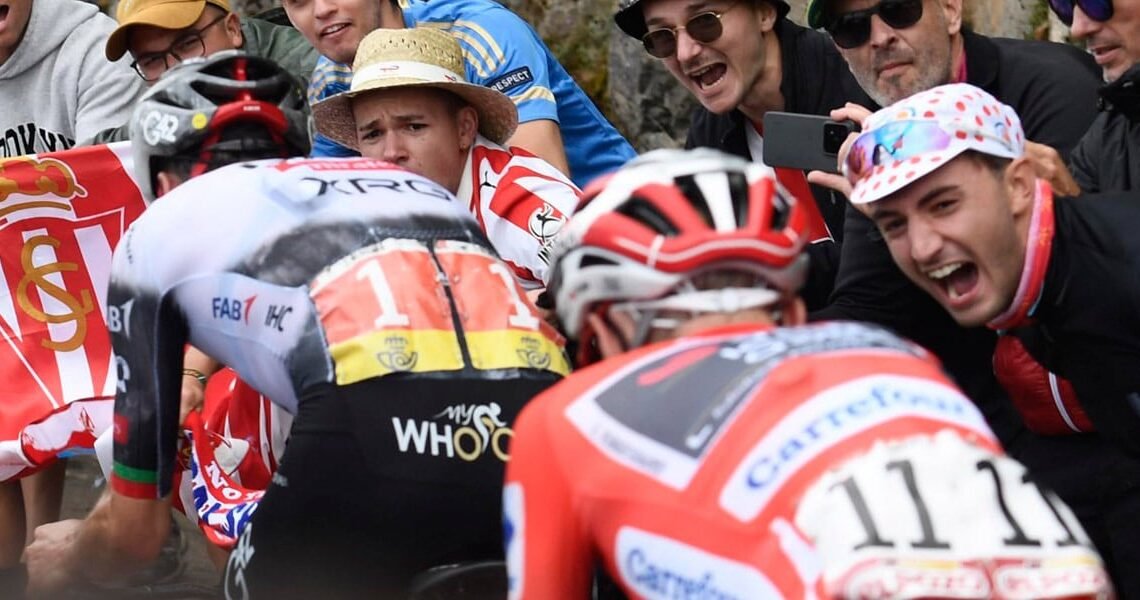
Tadej Pogačar will need durability at La Vuelta
Durability at La Vuelta
In some senses, you can say that the winners are often those who slow down the least over time. This nebulous concept of durability is starting to come into scientific focus. In 2022, a Spanish group compared the power files of 8 riders from a World Tour versus 7 riders from a second-division Pro Tour team racing in La Vuelta 2020 (Muriel et al. 2022)(NB. In this COVID year, La Vuelta ran later in the year and was also shorter at 18 stages). What they found seems to support the notion that the World Tour riders were more durable than the Pro Team riders. When tracing their Mean Maximal Power (MMP) from 5 s through to 30 min, the groups were similar in the first week of the race when fresh at the start of stages, but the Pro Team riders had lower MMPs as the weeks went on, such that they were significantly lower throughout the 5-30 min ranges over Weeks 2 and 3.
Interestingly, the difference became even more marked when the latter parts of individual stages were compared. Specifically, within individual stages, MMP was higher for World Tour riders after work of 15/25/35 kJ·kg-1 had been performed during an individual stage. This was true across all weeks, suggesting that Pro Team riders had lower durability both within a stage and also over the course of a Grand Tour.
What Predicts Durability?
The above study conforms to our expectations and passes the eye test that World Tour riders are stronger and more durable than lower-level professionals. But besides the team you ride for or the category you race in, are there other predictors for durability?
To study this, Spragg et al. (2023) had 10 professional U-23 riders (VO2max 74.4 ml·kg·min-1) perform a test to calculate CP and W’, consisting of a maximal 3 and 12 min uphill effort out on the road. This was done on two occasions. Once while fresh, and on another day after first completing a fatiguing protocol consisting of 5×8 min at 105-110% CP. So what this study was comparing was the DCP, or the CP in the fatigued state as a percentage of fresh CP, with a higher DCP a sign of greater durability.
Not surprisingly, both CP and W’ were lower in a fatigued state, at -11 W and -4.68 kJ, respectively. What was novel was the authors modeling what typical laboratory fitness parameter best predicted the magnitude of the drop. What they found was that DCP could be predicted to a very high degree, and that those riders with higher VO2max, gross economy at 200 W, and higher rates of fat oxidation at 300 W experienced lower drops in CP when fatigued. In contrast, while relationships with individual parameters were found, no strong models could be built to predict the drop in W’.
Training Durability
The presence of VO2max and gross economy in the predictive equation of Spragg suggests that higher overall fitness and training volume helps with durability. Training durability can also come through replicating the scenario of digging deep while in a state of fatigue. Some possibilities include:
- Back-load your intervals. Rather than placing your intervals in the first hour of a three-hour ride when you are fresh, place them in the final hour when you already have two hours of fatigue in your legs.
- Do your high-intensity intervals early in your ride when you are fresh. But then in the final hour, add in some 5-8 min intervals at or slightly above threshold to target the ability to both physically and mentally push at the end of a long event.
- Durability can be trained within an interval itself, as longer intervals place you in a deeper state of fatigue as it progresses if the intensity remains constant. If your goal is to be able to ride 6 minutes at 280 W, one way to structure progression is to start off with sets of 15×45 s at 280 W with a short recovery (e.g., 45 s). As you progress through several weeks, move towards 10×60 s, 6×90 s, 4×120 s, 2×240 s, and 1×360 s, all at 280 W. In this paradigm, you start with a higher overall volume at the target wattage, but this less difficult and more manageable because the duration of each effort is relatively short. However, the difficulty progresses with the longer duration efforts, as each puts you in a deeper state of fatigue.

Can Vingegaard repeat in La Vuelta’26?
Durability may be difficult to capture with a single number, but the underlying idea is straightforward: the strongest finisher is often the rider whose performance deteriorates the least. Improving aerobic fitness, cycling economy and fat oxidation may support durability, while carefully placing race-specific efforts after accumulated work can train the ability to produce power when it matters most. As always, the added fatigue must be balanced with adequate recovery – the goal is to become more resistant to fatigue, not simply more tired.
References
Muriel X, Mateo-March M, Valenzuela PL, et al (2022) Durability and repeatability of professional cyclists during a Grand Tour. Eur J Sport Sci 22:1797–1804. https://doi.org/10.1080/17461391.2021.1987528
Spragg J, Leo P, Swart J (2023) The Relationship between Physiological Characteristics and Durability in Male Professional Cyclists. Med Sci Sports Exerc 55:133–140. https://doi.org/10.1249/MSS.0000000000003024
The post Cycling Durability: How to Stay Strong When Fatigued appeared first on PezCycling News.