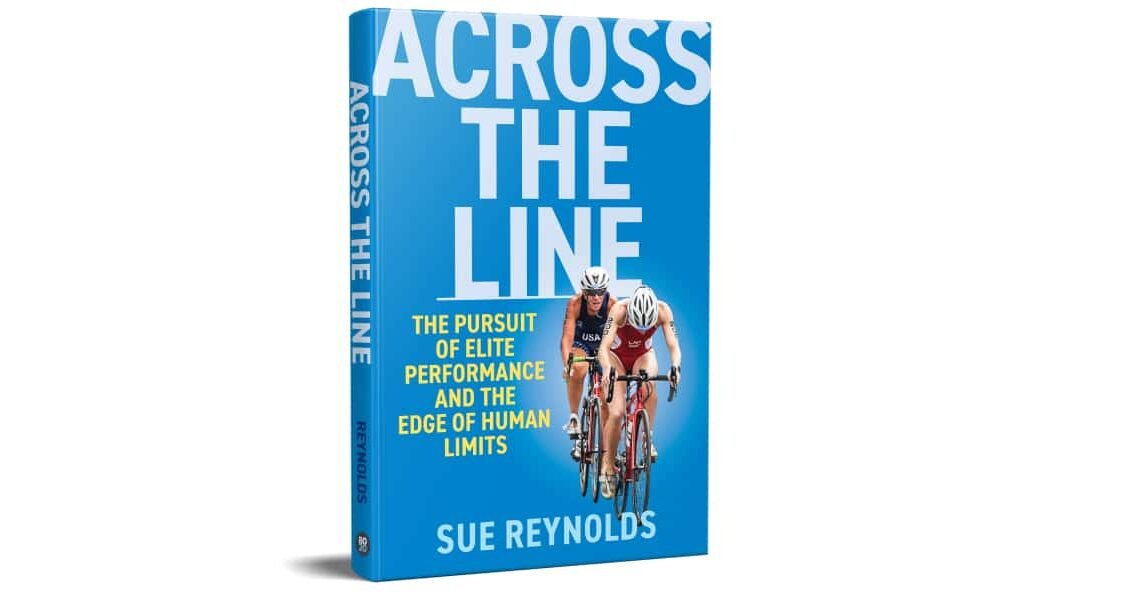

In 2020 we reviewed “The Athlete Inside” here which told the inspirational story of a morbidly obese woman who shed 200 pounds and then turned into a triathlete at age 60. She represened Team USA at international events and became a successful age-group athlete. Now her second book, “Across the Line,” continues the story. Its accurate subtitle is “The Pursuit of Elite Performance and the Edge of Human Limits” and the resulting volume is one of the most interesting books on training we have seen.

The story is from the athlete’s perspective entirely. After her initial successes, first in weight loss, then in actual sports accomplishment, Sue Reynolds made the decision that she wanted to train like an Olympian, to advance beyond what age-grouper do. To that end, the book takes the reader through her work with several different coaches, always moving to a higher level. Her impressive ambition requires serious commitment in physical effort, time devoted as well as in finances. It should also be considered that Sue Reynolds is a septuagenarian, with six grandchildren.

Triathletes, of course, need to train for three different sports and sometimes a single coach does not cover all the bases. For eight years, Sue Reynolds had trained with a local coach but then had the opportunity to also work with Bobby McGee, a Team USA Olympian run coach to up her game in that discipline. Her original coach stepped back and In 2021 another high-level Olympic coach, Jim Vance, was brought in for overall triathlon work, with McGee continuing to act as a run consultant. Vance’s workout schedule often required two sessions a day, a serious step up for an age-group athlete. Sue Reynolds seems to be someone who delights in proving that she can deal with the increased workload, which will have consequences later.
The next member of the team was Jeff Troesch, a mental performance consultant, who agreed to work with Reynolds in 2021 as well. This is a particularly interesting section of the book as Troesch remains a constant throughout. He speaks to her of the importance of “intentions” rather than “goals.” This concept really speaks to process, rather than results, and the first question Troesch would ask her after a race is “What did you learn?” not “Where did you place?” It really addresses the things that the athlete can control and execution of these satisfactorily is what really makes the race.

In 2022 Bobby McGee had to go on to other things so Jim Vancein San Diego also covered the running workouts for her. Luckily in our modern age remote coaching, via Zoom and Training Peaks, is possible. To expand her training time, Sue Reynolds and her impressively-supportive husband Brian, decampedfor Florida for half the year. She could avoid Indiana’s winter and take advantage of the triathlon National Training Center in Clermont, Florida. She had a swimming coach there who eventually becomes her overall coach as well.

Circumstances continue to change and ultimately her coach for the highest-level training wasAustralian Darren “Daz” Smith, who had coached numerous Olympic triathletes as well as Ironman multiple winners Daniela Ryf and Anne Haug. Sue Reynold’s training schedule became, to this reader, incredibly intense. She was clocking in workouts totalling 15 hours per week, far above an age-grouper’s average 6-8. Daz Smith was a coach willing to take on risk to push his athletes to their ultimate potential. He appeared to be extremely meticulous, using Google Maps to provide running routes local to Reynolds while working from his boat off the coast of Australia.

Under Smith, Sue Reynolds achieved her greatest sporting successes, representing Team USA in world-class events. She had already won a gold medal at the World Aquabike (swim, bike event) in Abu Dhabi in 2022 and now in 2023, with her new training program, she was qualified to race in Hamburg at the World Triathlon Championship, participating in a draft-legal sprint race, followed by a team relay event. Her team took gold home and soon she was preparing for the World Triathlon Olympic-Distance Championship in Spain.

A strength of the book is her telling the story of each of her big races. She covers her specific preparation to get ready before giving a detailed breakdown of what happened in each discpline as well as in the transition zones. Her preparation was enough to give her confidence in thinking clearly what to do as each race progressed. Some things are funny, some pretty stressful. Her race in Spain, which did not result in a medal, was the one she deemed her best: intention succeeded.

The level of training was for an Olympian but Daz Smith had never coached an older athlete and cracks began to appear. The ultimate result was Overtraining Syndrome (OTS) where an athlete’s level of stress is not balanced by proper recovery. The result is not only fatigue but emotional swings and other symptoms. Now unable to train, Sue Reynolds suffered from withdrawal after a decade of athletic activity. She recounts her story of how OTS affected her and how she was able to return to competition but in a different way.
The book highlights the different relationships with the various coaches (seven in all!) with whom she worked. They offered different approaches but one can see that over time her own way of addressing a coach changed significantly. At the end she had a local coach again but this time gave him a list indicating what she expected from him.
Sue Reynolds draws parallels in the book between the coaching she received and her own career in educational consulting aimed at school high performance. One can argue that this experience made her receptive to growth as an athlete. There are three Appendices in the book. The first is about OTS, the third about “Vision-Based” coaching where neither the coach nor the athlete control the process but collaborate, but the second is the one that really summarizes much of what precedes in the book.
This is “Elements of High Performance” and presents seven key ideas. These are: Core Values and Life Purpose; High Expectations; Relational Connection; Physical Development; Intellectual Development; Mental Development; and Performance Environment. Taking the last, for instance, it would include “culture, facilities, resources, physical surroundings,” as she notes: “While a champion can survive in poor conditions, a high-performance environment removes friction and provides the necessary tools and safety to acclerate development to its maximum peak.”

For someone once weighed 300 pounds and who only became a dedicated athlete at 60, the decade of lessons learned are intelligently set out in “Over the Line.” Many of the lessons, clearly appraised, are useful to anyone looking to improve their performance in whatever sphere.

It should also be noted that all proceeds from her books go to the USA Triathlon Foundation to help those with disabilities participate in sports.
“Across the Line: The Pursuit of Elite Performance and the Edge of Human Limits” by Sue Reynolds
271 pages, softbound
80/20 Publishing, Midway, Utah, 2026
ISBN: 979-8-9907958-8-4
Recommended Price: US$21.95/C$29.95
All photos courtesy of Sue Reynolds.
Available through AMAZON.COM HERE.
The post Pez Bookshelf: Across the Line appeared first on PezCycling News.