
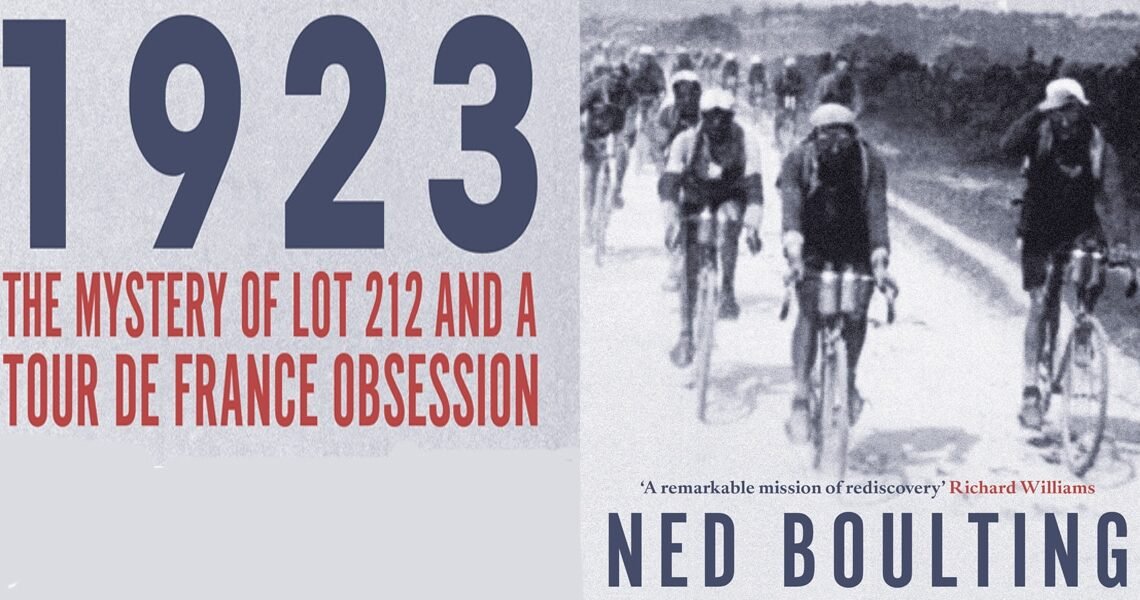

The story behind a book can originate in many ways but perhaps the most intriguing recent publication dealing with a cycling theme is Ned Boulting’s “1923,” with its somewhat ponderous but wholly accurate subtitle. A brief e-mail from a friend about an auction lot turns the author’s enforced home stay, necessitated by a serious bicycle crash and then the Covid-19 pandemic, into a remarkable bit of time travel to the world of a century ago. Focused on a single moment of a single stage of the 1923 Tour de France, the book goes down the rabbit hole of memory as it takes the reader through sports, politics, war, culture, and not a little autobiography.

Ned Boulting was UK broadcaster ITV’s cycling commentator and covered every edition of the Tour de France from 2003 to 2025. In the Autumn of 2020 he received an e-mail from a colleague about that auction lot. It was described as a “rare film reel from the Tour de France in the 1930s? Condition unknown,” not a confidence-inspiring bit of salesmanship. This might have explained the lack of interest by other bidders as Boulting’s bid of 120 GBP was the highest of only two submitted. Soon thereafter a bag arrived with the reel of very flammable cellulose nitrate film (all 2 minutes 30 seconds of it) and after a gentle look at some of the frames of the fragile object, it is sent off to specialists to attempt restoration. They return it as a digital file which you can see on YouTube, while retaining the original in cold storage. (Apparently keeping this kind of film sitting around will void your homeowner’s fire insurance policy!)
Now with the ability to examine the film minutely, the author displays impressive research skills as he launches into what is a truly obsessive pursuit. In a world so narrowed by the pandemic, his desk becomes the nerve centre of this project as he goes through the film second-by-second.
The larger questions are obvious—what does the film show? What happened? Where does it fit into greater world of that moment? Looking at the map that begins the footage, it is indeed Stage 4 of the Tour de France, a whacking big 412 km (but not unusual length of the Tour stages then) effort from the port city of Brest to the seaside resort of Les Sables-d’Olonne. But as it transpires this same Stage 4 was used in multiple Tours of the era but delving deeper satisfies the author that it is the 1923 edition. As a newspaper-sponsored event, there is a lot of documentation related to the Tour and its riders over the years and it was already well-established as a sporting (and newsworthy) event since the first edition two decades earlier. We know who the top riders were in 1923 and who won Stage 4 and who won the overall race but at this early point Boulting’s focus is on each of those old frames and from those 150 seconds builds an entire world that draws us in.

The road to Vannes
The film, which could only be shot when there was enough light for those early movie cameras to capture an image, shows five distinct scenes. A map of the stage is followed by the race going through the Lorient control point, then the peloton moving along a flat dusty road to Vannes before some action as a rider named Beckmann attacks on a bridge and then leads the race alone in front, passing crowds of spectators, before the film goes white and blank.
The author goes into minute detail of what he sees. There is a hotel/cafe in Lorient that occupies the background of the scene. He wonders about the woman in front of it (the owner?) and the man looking down at the race from the second floor balcony, the crowd gathered around as the racers get through the checkpoint. His curiosity is insatiable and armed plenty of time and with a computer and the ability to search the digital world, a portrait of June 30, 1923 emerges.

In Lorient (Desgrange with the light-coloured long coat)
Of course, the main focus is the Tour de France and its origins, personalities, history. The winner of the race in 1923 was Henri Pélissier. A rather brutal character, he was noteworthy for the strike he led with his brother and another rider in the 1924 race, dropping out on Stage 4 and giving an interview to journalist Albert Londres that became the infamous “Convicts of the Road” story about pro bike racers. Wearing the Yellow Jersey on this stage in 1923 was his teammate, Italian Ottavio Bottechia, who would go on to win the Tour in 1924 and 1925 before dying in mysterious circumstances. There are mini biographies of Tour riders, who would be made immortal for a few moments because of their Tour participation and then vanish from history.
Who was Beckmann? He was, in fact, Théophile Beeckman, a quite good Belgian rider who would ride in the Tour de France a total of six times between 1920 and 1926, winning two stages and placing 4th overall as his best result at the finish. Born in Meerbeke in Flanders in 1896, he ran a car dealership and garage after his retirement from racing. He died, aged 59, in Meerbeke and is an obscure figure today, both in sporting terms and in his hometown. However, Ned Boulting has brought him back to life as he imagines what the serious Belgian is thinking about as he launches his attack on the bridge, so far from the finish line. Beyond this, the author builds an entire post-1923 Beeckman family tree, with some false starts and dead ends, ultimately meeting with Théo’s descendants in Belgium. Along the way, he meets people who become taken up with the manifold stories unfolding and offer their help. Sometimes relying on the kindness of strangers does work…

Beeckman leading the race
Besides Beeckman, who is clearly identified (even if his name is incorrectly spelled), the author’s focus allows him to identify the other riders in the film. Henri Pélissier and his hulking brother Francis are there, and off to the left side one can make out Ottavio Bottechia as the riders on the road to Vannes wave away the camera car, which is blowing up dust. Jean Alavoine takes a moment to clown around for the movies. Have we ever seen any of these people in action before? And nine seconds into the film the author identifies Henri Desgrange himself. The founder of the Tour de France and the man who dictated it for forty years, is standing with his back to the camera as his colleague, the very tall man known as “le Grand Bob,” waves the riders through the control point at Lorient.
With access to vast digital archives, as well as fluency in French and German, the author goes into fascinating digressions about what else was happening on that day. World War I was fresh in mind in 1923 and its effects are felt in the landscape but also in politics as the French and Belgians have occupied the Ruhr industrial region of Germany, with consequences both on June 30 and to follow. We are taken on a cultural tour that leads us to the Symbolists and the Dada movement, as well as the prizefight between Georges Carpentier and the Battling Siki. There is the Lost Generation of Americans in Paris (Hemingway scraping by with dispatches to the Toronto Daily Star) and so much else that makes up history in the 20th Century. The book reaches backwards to actress Sarah Bernhardt providing aid to wounded soldiers in the Franco-Prussian War of 1871 and forwards to the ominous rise of Hitler with the Beerhall Putsch in 1923, moving to present day France and Belgium. The fragile film he bought triggers not only these stories as Boulting makes connections to connections but also memories of his own life and time in post-Berlin Wall Germany as well as his travels covering the modern Tour de France. He sees parallels in the Spanish Flu epidemic and Covid-19, as well as the pain of war, whether on the Western Front or in Ukraine.
“1923” is an exceptional book, with a story that seems to have no boundaries as it expands from that short film clip of something that happened a century ago to our modern world. A unique approach, thoughtfully and sympathetically written, and highly recommended.
“1923: The Mystery of Lot 212 and a Tour de France Obsession” by Ned Boulting
284 pp., illus., hardbound
Bloomsbury Sport, London, 2023
ISBN 978-1-399-40154-8
Suggested price: US$26/18.99 GBP/C$33.61
# You can buy “1923: The Mystery of Lot 212 and a Tour de France Obsession” by Ned Boulting from AMAZON.COM HERE. #
The post PEZ Bookshelf: “1923: The Mystery of Lot 212 and a Tour de France Obsession” appeared first on PezCycling News.