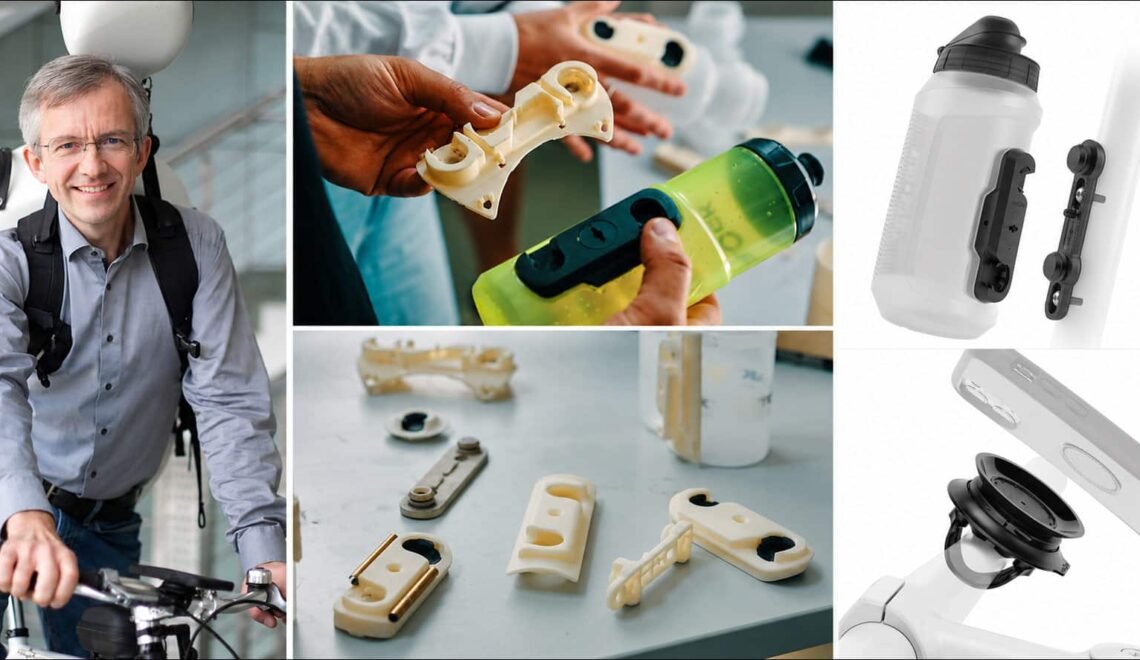

Every cyclist knows the sight: a pothole, rough road or stretch of gravel sends a bottle bouncing out of its cage. FIDLOCK TWIST approaches that problem with a cage-free bottle system combining magnetic guidance and mechanical locking. But the story behind it begins somewhere unexpected—with founder Joachim Fiedler and his cello.
Is there a better way to do this?

Interestingly, the story behind FIDLOCK didn’t begin with bicycle bottles. It began with a cello.

The Fidlock TWIST system combines magnets and engineering to hold bottles more securely than ever before.
At 16, Fiedler built a system from bicycle spokes, car seatbelts and tin cans that allowed him to carry his cello case by bike. The idea eventually became his first patent, and while studying music he began selling and installing the carrying systems himself. A later magnetic holder for a cello bow pushed him further into the world of magnetic fastening systems.
The professional musician was gradually becoming an inventor.
Magnets Meet Mechanics
It’s tempting to describe FIDLOCK products simply as magnetic, but the real trick is how the company combines magnetic forces with mechanical locking.
The magnets help guide the two pieces together. A mechanical system securely locks them in place. The result is something FIDLOCK has built its reputation around: that little “aha” moment when a product connects almost automatically but remains securely attached.

For cyclists, the most familiar example is Fidlock TWIST.
Instead of using a traditional bottle cage, the bottle attaches to a low-profile base on the frame. Bring the bottle close and the magnets guide it into place before the mechanical system secures it. To remove it, simply twist.
For road riders, it creates a clean and simple way to carry hydration. For gravel riders dealing with washboard, potholes and rough surfaces, the secure mechanical connection has an obvious appeal.

Designed to keep your bottle secure on rough roads
And because the mounting system isn’t limited to bottles, the same interface can also carry compatible storage and accessories.
More Than a Bottle Mount
That same philosophy now runs through FIDLOCK’s cycling range.
VACUUM uses magnetic force together with a suction-based system to hold a smartphone securely while still allowing it to be removed easily with one hand. PINCLIP uses magnets to guide accessories into position before a mechanical system locks them in place.

Different products, but essentially the same question:
How can we make attaching something to a bike simpler without making it less secure?
For road and gravel riders, that might mean keeping a phone accessible, carrying tools without stuffing another jersey pocket, or simply knowing that the bottle you started the ride with should still be there when you reach the café.
From Cello to Cycling
Perhaps the most interesting part of the FIDLOCK story is how little the original idea has changed.
A teenage Joachim Fiedler wanted a better way to connect his cello to his bicycle. That led to another problem, then another, and eventually to a company built around finding smarter ways of connecting things.
Today, FIDLOCK technology extends far beyond cycling, but bikes remain a natural home for the idea. The company’s products are used across mountain biking, gravel and road cycling, alongside applications in numerous other industries.
It’s a long way from carrying a cello through the streets of Germany to keeping a bottle attached on a rough gravel descent.
Then again, maybe it isn’t.
Both started with the same thought: there must be a better way to do this.
- See more and order one for yourself at the Fidlock website
The post No More Lost Bottles: The Unlikely Story Behind FIDLOCK appeared first on PezCycling News.