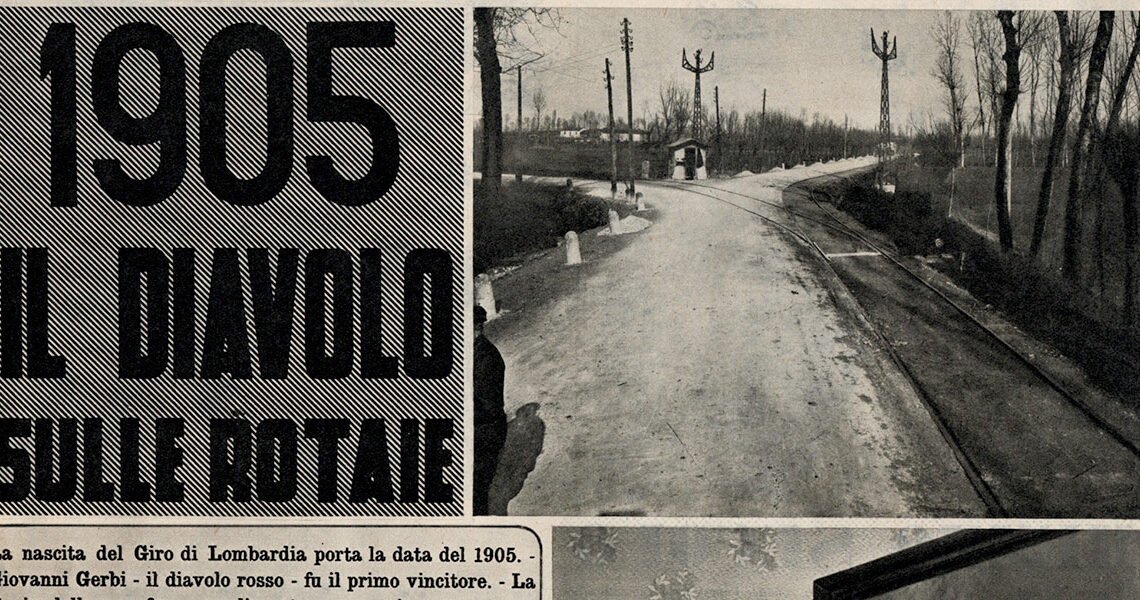

Cycling’s history is full of stories that sound almost too good to be true—and Giovanni Gerbi’s victory in the first Giro di Lombardia belongs right up there.
The year was 1905. The roads were rough, the equipment basic, and a rider’s ability to outthink his rivals could matter as much as the strength in his legs. Gerbi, known as the “Red Devil,” apparently had plenty of both.
In this vintage account taken from the 1952 official race program (See our inside look here), Italian writer Ulisse Cozzi visits the former champion in Asti and revisits his legendary tram-track escape. What follows is a glimpse into cycling’s unruly early years—and the personality of a man who still took his victories very seriously.

——–
The Giro di Lombardia was born in 1905. Giovanni Gerbi—the Red Devil—was its first winner. The story of his breakaway, prepared with a truly diabolical plan and carried out with tremendous strength, has become legend: a familiar legend with the flavour of a fairy tale, at once innocent and mischievous.
Giovanni Gerbi, the first winner of the Giro di Lombardia, raced under the devil’s unsettling banner in 1905.
Those were cycling’s heroic days. Regulations already existed, and offenders were already punished with fines and disqualifications. The principles of discipline and sporting fairness were already being asserted, and attempts were being made to give the disorderly business of bicycle racing an official framework.
But the unimaginable condition of the roads in those days, the peculiarities of the mechanical equipment, the uncertain availability of supplies during races, the officials’ inability to exercise effective control over events—and, above all, the confused feeling of being the standard-bearers of a new civilisation—often encouraged cycling’s pioneers to use whatever weapons circumstances offered them.

It was natural that, in such an environment, where cunning counted for no less than muscular strength, the devil should have a hand in things: a master of trickery embodied in the fiery figure of Giovanni Gerbi.
We place little faith, I repeat, in myths born of rhetorical and exaggerated imagery. But that Gerbi really was the devil—the famous Red Devil everyone remembers—is something that reassures us, too. This rider from Asti truly possesses all the essential qualities of a fallen angel: patient and malicious cunning; a quick temper that suddenly reveals itself and sets everything ablaze; a square jaw and subtle reasoning.
“How did I win the first Giro di Lombardia?” says Giovanni Gerbi, whose head is still shaved bare today, at the age of 67, as he exhales thick, curling clouds of smoke. “I won it the same way I won all my other races: by making use of my greatest asset. I was a tremendous rouleur. When I managed to gain two or three hundred metres on my opponents, it was always over: nobody could catch me again.

Giovanni Gerbi, the first winner of the Giro di Lombardia, is now 67 and has given up riding a bicycle. He lives alone in Asti. One large room in his home serves as a museum, containing his personal mementoes as a racing cyclist.
In the photograph above, Gerbi stands beside himself—the large framed portrait. In 1905, by placing a small pile of sand beside the tram tracks, Giovanni Gerbi caught the group in his trap at the Giro di Lombardia, launching his victorious breakaway.
“I had the race won… Naturally, though, I always needed to prepare my battle plan in minute detail. So I never started a race without first studying the route thoroughly. I always decided beforehand exactly where I would launch my breakaway, and I very rarely failed in my plan. Naturally, choosing the point of attack depended on certain calculations, certain arrangements…”
“Certain tricks…” we suggest.
Gerbi’s expression darkens. In truth, only a hypocritical moralist, thinking back over his exploits, could speak of tricks. Gerbi simply made use of that wicked, subtle ingenuity—strange to say—which belongs to the most straightforward and ancient Piedmontese and Italian tradition.
In the 1905 Giro di Lombardia, for example—and this is the celebrated incident—he decided to escape at the junction on the road to Crema where two tram lines met. He chose that junction because he had noticed that anyone riding between the rails would, on reaching the fork, be unable to continue unless he dismounted.
Can one, in good conscience, call that a trick? Or is “shrewdness” the more appropriate word?
Fifty metres before the junction, Giovanni Gerbi piled some sand against the pavement, preparing himself an escape route. Then, during the race, he moved to the front of the group and led it along the tram tracks.
At the right moment, he slipped out through his prepared passage and began pedalling furiously. The others, continuing between the rails, inevitably ended up on the ground in a thunderous heap.
Giovanni Gerbi, the ingenious devil, whizzed away so effectively that he reached the finish of the Giro di Lombardia three-quarters of an hour ahead of the runner-up.
After so many years, the old devil still tells the story of his exploit with a sense of inward satisfaction. But he does not tell it with a smile, or a wink of sly amusement. The old devil, in fact, never smiles, and he is too convinced of the value of his racing career to speak of it lightly, as though it were a game.
He is also, as we were saying, proud: not with the empty vanity of an insubstantial peacock, but with the majestic pride of someone who has weighed his own merits with precision and is convinced of his superiority.
“What do you think of the next Giro di Lombardia?” we ask him.
“Those Bartalis… those Coppis… those foreigners… those youngsters…” Gerbi says thoughtfully.
Clearly, giving an answer to a question that does not concern him personally requires a tremendous effort.
“What do you want me to say?” he suddenly adds. “Business keeps me busy.”
Giovanni Gerbi owns a small bicycle factory. He lives in Asti in a large apartment, half museum and half home, where he receives occasional visits from bishops, generals, prefects and young boys.
He is an authentic king, looking down from above upon today’s champions.
Ulisse Cozzi
The post Giro di Lombardia 1905: Giovanni Gerbi’s Devilish Victory appeared first on PezCycling News.