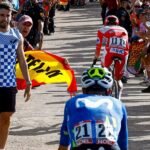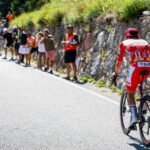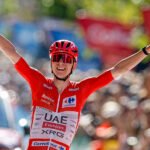
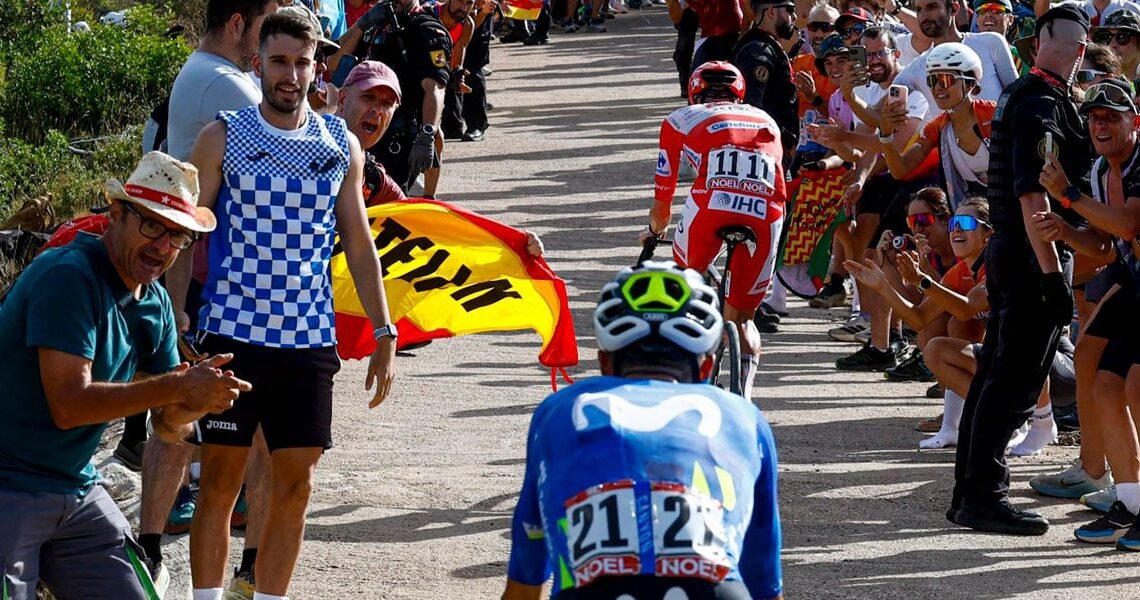

VUELTA’26 STAGE 6: Tadej Pogačar collected his third win in six stages in Castellón—but the bigger story was the rider who refused to let him disappear. After Pogačar’s 50-kilometre solo in Andorra, another disappearing act looked likely. Instead, Enric Mas clawed his way back to the Slovenian on Puerto El Bartolo’s brutal gravel slopes, grabbed the mountain points and stayed with the red jersey all the way to the finish. Pogačar had the faster legs in their two-man sprint, but this time he had company—and considerably more work than the usual victory script calls for.

A Sting in the Gravel
On paper, this looked like a day when the breakaway might finally get its reward. On the road, UAE had other ideas.
The sixth stage packed around 3,000 metres of climbing into 177.5 kilometres, with the nastiest business saved for Puerto El Bartolo. Its unpaved sector served up 3.1 kilometres at an average gradient of 10.8%. Steep enough on smooth tarmac. Add loose gravel and tired legs, and you’ve got a proper afternoon out.

After the descent, around ten flat kilometres remained to the finish in Castellón. Enough room for a chase—or a tactical headache if anyone reached the bottom with unwanted company.
Breakaway adventurers or GC heavyweights? It took almost two hours just to establish the day’s escape.
Van Aert Makes the Move—But UAE Keeps Control
A 17-rider group finally broke clear shortly before the second climb, with Wout van Aert the headline name.

There was plenty of climbing talent alongside him: Pello Bilbao and Santiago Buitrago, Thomas Gloag, Patrick Konrad, George Bennett, Andreas Kron and Urko Berrade, among others. Ramses Debruyne and Lars Craps were also there, giving the Belgian contingent more than one card to play.
A strong group, then. Unfortunately, strength means little when the peloton refuses to give you any road.

UAE kept pressing behind, using the wind to threaten splits and repeatedly turning up the pace. The break’s advantage never stretched beyond two minutes.
With that sort of leash and El Bartolo still waiting, the escapees’ chances were shrinking. Van Aert eased off early, and he wasn’t the only rider to decide this particular investment wasn’t paying dividends.
Debruyne Refuses to Give In
As the road climbed, the break began shedding riders.

Debruyne was among the most aggressive, surviving at the front with Craps, Kron, Buitrago, Gianmarco Garofoli, José Manuel Díaz, Berrade and Vincenzo Albanese.
Then the young Belgian went alone toward the gravel.
It was a committed move on a climb offering very little forgiveness. Behind him, however, the red jersey was beginning to wind things up.
And we’ve seen how that usually ends.
Pogačar Turns the Screw
Just under four kilometres from the summit, Pogačar made his move.
There was no explosive jump out of the saddle. Instead, he stayed seated and steadily increased the pace—the sort of acceleration that looks almost polite until you see what it does to everyone behind.

Oscar Onley, Felix Gall, Richard Carapaz, Enric Mas and Primož Roglič scrambled to hold his wheel.
The steepest slopes were still to come.
Once the gradient bit harder, even before the gravel began, the group unravelled. Onley resisted longest, but eventually he too had to let the Slovenian go.
Pogačar swept up Debruyne with 2.8 kilometres remaining to the summit and continued alone.
At that point, you could have been forgiven for reaching for the familiar script: Pogačar attacks, everyone disappears, another solo victory follows.
Mas hadn’t finished reading his part.
Mas Brings the Fight Back
Toward the summit, Pogačar’s progress slowed—and a rider appeared behind him.
 Enric Mas clawed his way back on Puerto El Bartolo’s brutal gravel climb, grabbed the mountain points and stayed with the red jersey all the way to Castellón.
Enric Mas.
The Movistar leader had measured his effort, fought his way back and rejoined the red jersey. After watching Pogačar ride away from the field in Andorra, this was a very different picture.
Mas wasn’t merely hanging on, either. Just before the summit, he moved ahead to collect the mountain points.
Pogačar had company, and that company was still racing.
The Slovenian responded by increasing the pace on the descent, but the move nearly cost him. He misjudged a corner and ran onto the verge, a moment that encouraged a more measured approach to the remaining downhill kilometres.
Even for Pogačar, there are limits to what you can ask of a corner.
The Chasers Keep It Close
The hesitation up front kept the chase alive.
At the bottom of the descent, Gall, Roglič and the remarkably persistent Debruyne were only a little more than ten seconds behind. Carapaz and Harold Tejada followed farther back.
Those two chasing groups eventually joined forces, but closing the final gap to Pogačar and Mas proved another matter.
For Sepp Kuss and Onley, the damage was considerably worse. Fourth and fifth overall coming into the stage, they lost much more ground—a costly afternoon in the fight for the GC places.
Onley had been one of the last riders able to follow Pogačar’s climbing tempo. By the finish, that resistance had brought him no reward.
Two Riders, One Clear Sprint Favourite
Pogačar and Mas held off the pursuit to reach Castellón together.

Mas had answered the climbing challenge, but beating the Slovenian in a two-man sprint was a different assignment.
Pogačar was comfortably the faster finisher, taking another stage victory after a day that had demanded more than his usual disappearing act.
Mas had to settle for second, but his ride supplied something this Vuelta badly needed: a rival who could watch Pogačar ride away, refuse to accept it and come back.

PEZ Take: A Contest, After All
After Andorra, it was tempting to start writing the rest of this Vuelta as a procession. Mas gave us a reason to put that draft aside.
He didn’t beat Pogačar, and one climb doesn’t overturn the Slovenian’s overall advantage. But he did show that an attack from the red jersey doesn’t automatically end the discussion. Riding back to Pogačar on that gravel climb was the day’s most encouraging performance from a challenger.
Pogačar still leaves with the win. His rivals, though, leave with evidence that he can be brought back—and that pushing for more on a descent carries risks even for the race favourite.
Behind them, the battle for the podium got sharper. Kuss and Onley lost ground while Mas, Gall and Roglič came through the finale better placed.
The red jersey remains firmly on Pogačar’s shoulders. At least today, someone made him work to keep the spotlight.
La Vuelta a Espana 2026 Stage 6 Results
Read our complete Vuelta a España 2026 preview here
The post Vuelta’26 Stage 6: Pogačar Wins, But Mas Makes Him Work! appeared first on PezCycling News.