
Review: Zwift Ride with KICKR Core 2: A Bike for the Whole Household — but for the Masses?
I’m an extremely avid cyclist, hitting over 700 hours annually. My wife is a fit, recreational rider who’s on her bike 1-2 times a week. I started this review wondering whether the Zwift Ride could be the right solution for both of us; now I’m wondering: Can it be an indoor bike for everyone?

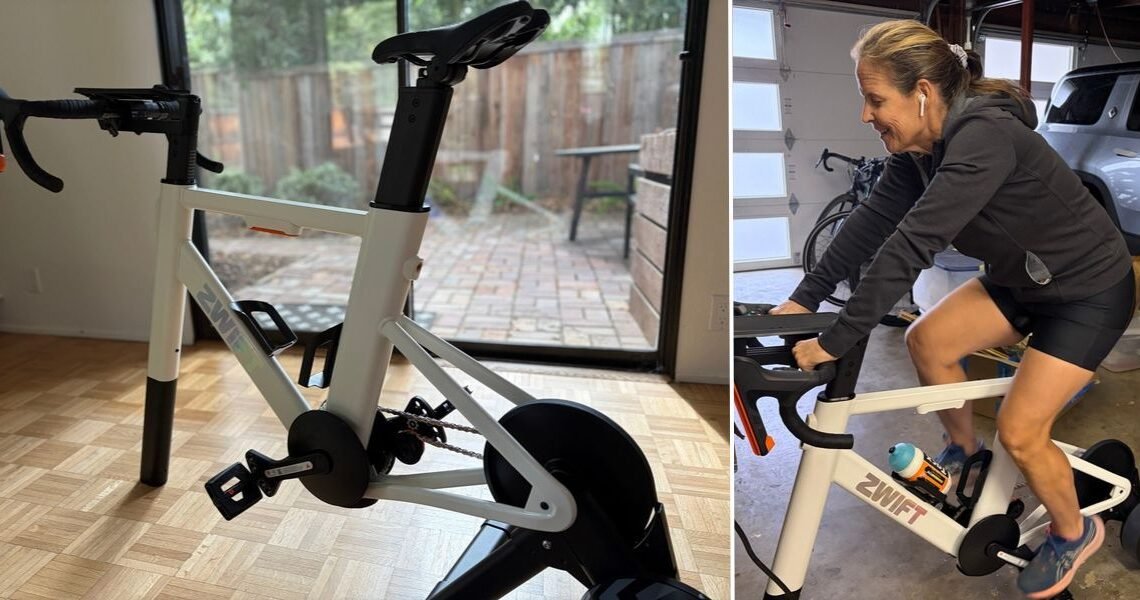
The Zwift Ride is essentially a trainer-only bike frame, primarily intended to be mounted on a Wahoo KICKR Core, though usable with other models and brands. I reviewed it having already owned the KICKR Core 2, which I reviewed earlier this year.
The Ride’s premise: a single, easy-to-use indoor bike that adapts to riders of different sizes and abilities and that doesn’t require mounting a different bike for each rider. I set out to test whether this was indeed the case by putting it through its paces myself — and then by tapping my wife’s perspective as well.
Versatility and Fit

Since the Zwift Ride is built around the idea that one machine should serve several riders, I figured that one key question is how easy it is to adjust its size. We’re all used to gym exercise bikes, the kind you use in a pinch; if nothing else, they’re quick to adjust. Would the Ride be that easy?
In a word, yes — and not only that easy, but much more versatile: adjustable features include saddle height, of course, as well as saddle fore-aft, handlebar height and fore-aft, and even crank length. It’s all quite ingenious, especially the crank-length variations: Not only can we easily accommodate our different heights (She’s 5’2″; I’m 6’1″), but I can get on the shorter-cranks bandwagon. Check out who’s riding 165s — me and Tadej! (Note: the Ride comes with flat, sandpaper-like pedals that worked quite well, though of course aren’t what a real roadie wants; changing out the pedals is no harder than on a typical bike, but Karen rides SPDs and I ride Keos, so we need to swap them every time we ride. Something to consider.)

The Ride comes with a fit card that I see as a double-edged piece of information: On one hand, great to provide guidance to less-informed riders about where to position the saddle and bars. On the other hand, considering the exacting measures an avid rider will take to ensure that their fit is just right, determining fit just by height seems simplistic. Fellow hardcores will match their Ride’s fit to their outdoor bike’s (or bikes’, likely); less avid riders would do well to start with the fit card’s suggestions, and then allow comfort to guide fine tuning; I’d hate to hear about lower back pain or behind-the-knee discomfort, owing to simply abiding by the fit card’s rough guidance.

The Zwift Key

“One Allen key for every bolt? How can that make sense?” says the hard-o who carries a torque wrench and has a special tool the bike shops haven’t even seen. (I’m looking at you, Canyon headsets.) But remember: the Zwift bike can work for a WorldTour wannabe, but isn’t only for us more intense types.
The Zwift key, the universal, 6 mm Allen that lives magnetically under the top tube, is thus ingenious, indeed fitting virtually every bolt for every fit element on the bike. For two riders who adjust the bike regularly, this is a real convenience. It sounds minor until you’ve spent twenty minutes digging through a toolbox. (That said, using the same tool for every bolt, and using it every time you swap between riders, is going to wear it down. Keep an eye on that Zwift key…A stripped wrench leads to a stripped bolt, which leads to a real pain in the ass.)
Setup and Packaging

Setup was relatively easy, though I’d like it to be easier still for the normies who might purchase the Ride. The bike arrived in three boxes (the smart frame, the handlebars with controllers, and the KICKR Core 2 trainer) and the whole thing came together without drama. My one complaint is the guide’s treatment of the dropout spacers. It wasn’t clear whether I should use them or which ones, and I had to dig around online to get a clear answer. It’s a small flaw in an otherwise smooth process, and a clearer line or two in the guide would fix it.
I also appreciated that the packaging was mostly environmentally friendly, recyclable material. Equipment this size generates a lot of cardboard and filler, and I was glad to see that it could go straight into the recycling bin rather than the trash. Every little bit helps!
Comfort
The Ride is comfortable, and the saddle is a big part of why. It’s a 160 mm by 245 mm unisex Zwift saddle, and it’s a lot cushier than a typical racing-style saddle. My wife Karen told me she appreciated the extra padding! Meanwhile, the handlebars are relatively large in diameter, which I found easier on my hands over long sessions. A pad that lays over the handlebars cradles your phone; I plan to purchase a laptop rack, since that’s the view I like to use on Zwift.

I found the controllers to be very cleverly designed. Everything is integrated and easy to reach. The shifters are right where you’re used to them being — if the Ride had brakes, they’d be brifters — and the buttons to steer (You can steer on Zwift now!), turn around, click on something on screen and generally navigate Zwift are right at your finger- and thumbtips.
Out on the Virtual Road

After assembly and some fit tweaks, I put the Ride through a range of sessions. I started with steady pedaling in Watopia. From there I moved on to structured workouts, including an interval session, and finally a race.
Coupled with the KICKR Core 2, the Zwift Ride handled all of it well. I felt stable on the bike; I was initially surprised at how much it moved under me when I stood on the pedals, but realize that it has to have some give to remain solid. Shifting using the internal Zwift hub meant never hearing or feeling the rattles I’ve gotten when toggling my bike between the road and a trainer. In general, the ride feel is smooth and natural, and in fact feels more “real” than on the many bike-mounted trainers I’ve used.
The race was the real test. When I stood to sprint at the finish, the Ride felt more stable than my road bike on a trainer. Which brings up something I still wonder about: whether clamping a bike into a stationary trainer is possibly damaging over a lot of hard riding, with that rigidity around the dropout (and all that sweat…so much sweat, no matter how many fans and towels I deploy). The Ride lets me skip that concern entirely.
The Verdict — for Me, Karen, and Everyone
Being as clear and straightforward as possible here: I don’t need the Zwift Ride just for me. In this NorCal climate, with my preference for riding outside, I’m comfortable putting my bike on the KICKR Core. In fact, I’m fortunate enough to have a dedicated trainer bike. (Eye roll…)
But being able to share the Ride, as it were, puts it over: Karen just walked in from her workout and said she’d adjusted it back to my settings. She did that because she loves her husband, but…also because the Ride makes it so easy. As winter kicks in I’ll appreciate this convenience even more. Plus, like I wrote, we’ll leave our road bikes untouched, potentially prolonging their useful lives. (Meanwhile, Zwift’s business model seems to be working: Karen enjoys riding it enough that she’s about to become a Zwift subscriber.)

So it’s good for me, great for me and Karen (and, when our kids visit over the Holidays, for all of us) — but is it right for everyone? I assume that the good folks at Zwift want the Ride to be a viable, cheaper alternative to a Peloton. Is that in the cards?
As a cyclist, there’s no question which platform I prefer. Having ridden Pelotons at many a hotel gym, I vastly prefer the ease of use, feel, and experience of riding Zwift on the Ride to following a “class” on a Peloton. Whether Zwift can compete is the open question. It’s a virtual-reality world of racing, group rides and exploration versus instructor-led workouts. I’m biased, but I hope to start seeing Zwift Rides in my non-cycling friends’ homes. (Especially because its sleek design and muted color scheme looks great; I nearly have Karen convinced that it should live in our living room, not our garage.)
The Zwift Ride with KICKR CORE 2 is available at zwift.com for $1,299.99 and is eligible for purchase with some HSA or FSA plans.
The post The Zwift Ride: One Size Fits…All? appeared first on PezCycling News.