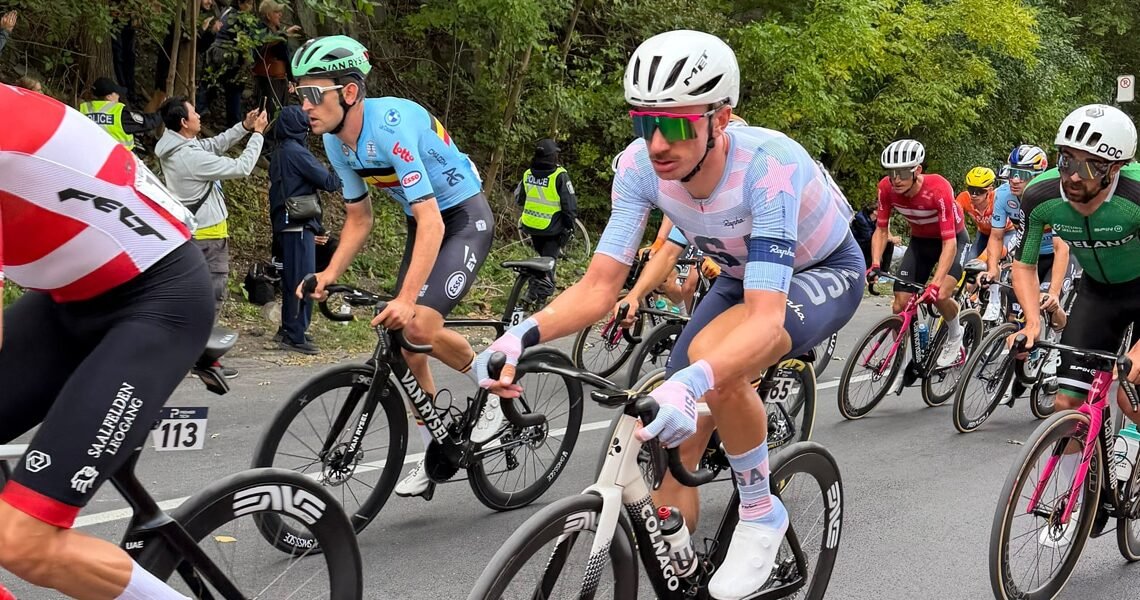

This September, I did something I’d somehow never done before: watched a professional bike race in person. And not just any race – the elite men’s World Championships in Montreal. I was beyond excited to personally witness all the top cyclists in the world battle for the rainbow jersey! I arrived hours early and claimed a spot on the punishing Camillien-Houde climb for 10 of the 12 laps. Then I hustled to Avenue du Parc to watch Brandon McNulty ride home alone for the rainbow jersey… the first American world champion in my lifetime.
Having watched plenty of racing on television, I thought I knew what to expect. I didn’t. The pros flew up this climb, which averages close to 8%, at roughly 24 km/h, making it look almost flat. Then they came around and did it again. And again. Twelve times, after 116 km of racing just to reach the circuit!
As the breakaway dwindled and the peloton gradually shrank, I found myself wondering: how much power can these riders still produce after hours of racing?
The Real Test: Power When You’re Tired
Durability is the ability to maintain performance as fatigue accumulates. Plenty of riders can produce impressive power when fresh. Far fewer can repeat those efforts after three, four, or six hours in the saddle.
In his Toolbox article on cycling durability and endurance, Stephen Cheung explored how researchers investigate this quality in controlled settings. But professional racing presents a different challenge: nobody controls the workload, and riders rarely get to choose when they need to go hard.
So how can we measure durability in the real world?
Measuring Power When Fatigued
A 2021 study by Peter Leo and colleagues examined power profiles and race performance in U23 and professional cyclists competing in the five-day Tour of the Alps. The researchers compared riders’ best power outputs with their best efforts after accumulating 1,000, 2,000 and 3,000 kilojoules (kJ) of work.

Figure 1. Mean maximal power (MMP) profiles for professional (A) and U23 (B) cyclists when fresh and after accumulating increasing amounts of work during the Tour of the Alps. While the groups show broadly similar fresh power profiles, the U23 riders exhibit a greater decline in power as accumulated work increases, particularly after 2,000-3,000 kJ. In contrast, the professionals maintain power closer to their fresh levels, illustrating the importance of durability in multi-stage racing. Taken from Leo et al. (2021).
Why kilojoules rather than hours? Because time alone doesn’t tell the whole story. Obviously two hours sheltered in the bunch can demand very different amounts of work from two hours spent pulling at the front.
The researchers found that professional riders generally maintained higher relative power outputs after accumulating substantial work than their U23 counterparts. Their findings suggested that power profiling under fatigue could help distinguish riders’ capabilities and potentially inform decisions about progression to the professional ranks.
The takeaway is simple: your fresh power profile only tells part of the story. What matters in a long race is how much of that performance remains when you need it most.
Quinn Simmons: a day at the office
Conveniently, American Quinn Simmons (fourth at the Worlds and an important contributor to McNulty’s victory) shared his power file publicly on Strava under the name Ricky Bobby. I analyzed his best five-minute power at different points in the ride, based on accumulated work.
The scale of the effort was astonishing. Simmons recorded approximately 6,714 kJ over 6 hours and 24 minutes, averaging around 292 W. Even the ride into the city circuit cost roughly 2,030 kJ, averaging 218 W, before the repeated climbs and tactical battles truly began.
His best five-minute power for the day was 504 W, recorded shortly before the circuit racing began. Here’s how his best five-minute effort compared as the accumulated work increased:

Figure 2. Simmons’ best five-minute power at progressively higher accumulated-work thresholds, calculated from his public race file.
After 5,000 kJ, Simmons could still produce 473 W for five minutes – just 6% below his best of the day. Even more remarkably, his best one-minute power, 659 W, came after accumulating more than 4,000 kJ.
That is an extraordinary ability to produce power deep into a long day of racing!
Did He Crack at the End?
The drop from 473 W after 5,000 kJ to 412 W after 6,000 kJ looks dramatic. But did Simmons suddenly run out of gas?
Not necessarily. By the final stages, his American teammate McNulty had established a decisive breakaway. Simmons had less reason to contribute to a chase, and his heart rate also fell on the final climbs. That’s consistent with reduced effort, although neither heart rate nor power alone can tell us exactly what he was capable of producing.
This does bring up an important limitation of analysing real race files: the best power an athlete produces isn’t necessarily the best power they can produce. Tactics, terrain and team duties all influence the numbers.
What About the Rest of Us?
Will I personally worry about my durability this winter? Probably not too much. My focus will move towards shorter Zwift Ladder Racing events, most of which finish in under 45 minutes. For these races, fresh power and the ability to repeat short, hard efforts may be more immediately relevant.
But for multi-hour road races, fondos, and gravel events next season, durability likely deserves some attention.
If you’re interested, try this simple experiment: during your next long ride, include a few harder efforts in the final hour. These could be sustained climbs, five-minute intervals, or a handful of shorter, punchier efforts. The goal is to see how much power you can still put down after accumulating a few hours of work. The more power you can produce late in a ride relative to your fresh capabilities, the better your durability is likely to be. Repeat the experiment under similar conditions to track your progress over time.
And don’t forget fueling! Starting carbohydrate intake early and consuming enough throughout a long ride can help support performance as fatigue accumulates. You might never need to produce 473 W five hours into a race. But learning to preserve more of your own power when tired could make all the difference when the decisive climb arrives.
Stay safe, ride fast, and see you next time!

References
- Leo P, et al. (2021). Power profiling, workload characteristics, and race performance of U23 and professional cyclists during the multistage race Tour of the Alps. International Journal of Sports Physiology and Performance. doi.org/10.1123/ijspp.2020-0381
- Quinn Simmons’ Worlds race file: public Strava upload: https://www.strava.com/activities/20357105010
The post How Durable Is a World-Class Road Racer? appeared first on PezCycling News.