
Pez friends, welcome to Thursday — aka Friday Eve. My favorite day of the week, for all it portends.
This week we present a Thursday Three that includes two topics we’re all talking about — next-gen riders showing out, and Mas’ Vuelta showing an asterisk — and one we’re oddly not: Chris Froome nearly dying, and then just…fading away. Plus I pose a semi-solution to the threat of climate change to the health of cycling, and of cyclists.
Worlds are around the corner. I just wish I were joining Richard in Montréal!
THE THURSDAY THREE
- Rise of the Youngs
- A Vuelta with an Asterisk
- Chris Froome: the Non-Topic
AND…WHAT’S ON MIKE’S MIND
- Our Mistimed Grand Tours
MIKE’S RIDE OF THE WEEK
- Kaiser Pass
VIDEO
- Richard and PEZ Are Headed to Worlds!

TOPIC #1: RISE OF THE YOUNGS

The closing kilometers of the Grand Prix de Montréal served up a glimpse into the future — though in some ways the present.
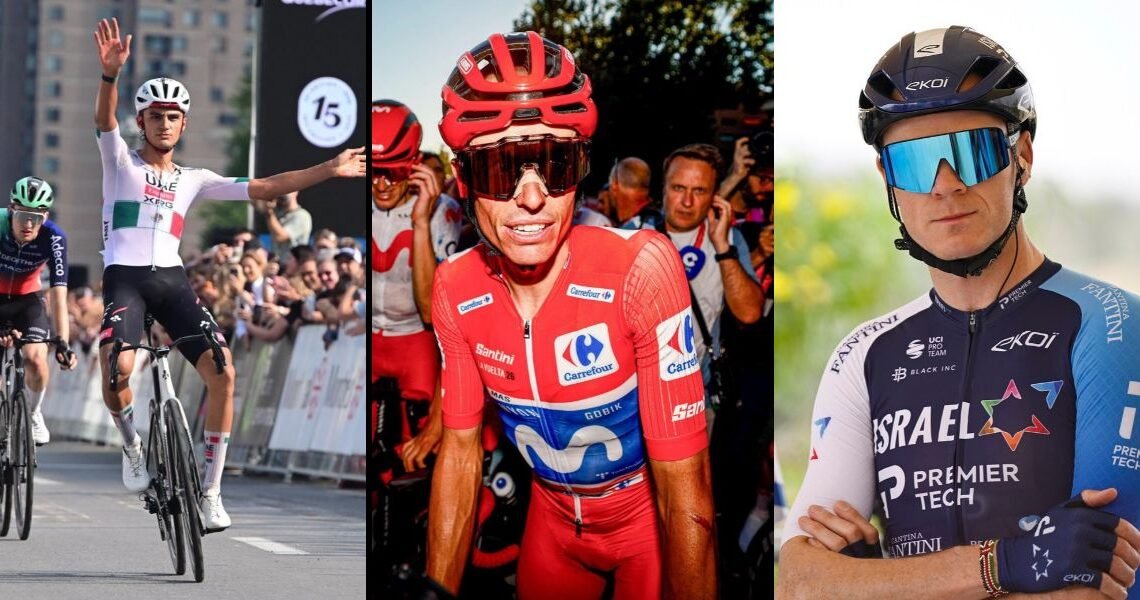
There was Isaac del Toro, all of 22 years old, outsprinting Paul Seixas, still not 20 years of age. Though their rivals, including Remco Evenepoel, offered the legitimate excuse of having raced furiously just a couple of days earlier at the Grand Prix Cycliste de Québec, the picture was nonetheless striking: a generational shift.
No grand conversation about cycling can omit Tadej Pogačar, of course; the relative veteran will surely be back, and will likely be dominant once again. Still, the youthful tide is rising ever more rapidly, and may well overcome Pogačar and his contemporaries sooner than we once might have thought.
Over in the Vuelta, we learned to keep an eye on a couple more riders previously unknown to all but the most avid of aficionados: Slovenian Jakob Omrzel, 20 years old, took a stage and landed in the 7th spot overall, while Belgian Jarno Widar, also 20, seemed consistently to be at the pointy end of the race, despite insisting that he’s no GC contender. And of course, twenty-one year old Matthew Brennan racked up win after win.

And these are just the whippersnappers earning results at the WorldTour level: Italian Lorenzo Finn is taking the traditional route, snapping up wins in the Junior and U23 ranks before reaching the Bigs.

Yes, Pogačar will be back — but these guys are waiting in the wings.
TOPIC #2: A VUELTA WITH AN ASTERISK?

It’s a harsh judgment, but demarcating any result or record with an asterisk, even an invisible, mentally noted one, is sometimes inevitable.
Not the kind of asterisk next to so many Tour wins from the early 2000s, mind you. This kind serves as a reminder: the win was legitimate, but something happened along the way, and in fans’ esteem, if not in the books, the result doesn’t stand on the level of non-asterisked wins.
Enric Mas’s Vuelta victory is the latest to earn one. He inherited red only after Pogačar’s crash forced him out, and while Mas acquitted himself admirably, genuinely distancing Roglič and Gall rather than just sitting on the jersey, the “what if” will follow him regardless.
The most obvious parallel is Vincenzo Nibali’s 2014 Tour de France. Chris Froome crashed out on stage 5, Alberto Contador abandoned on stage 10, and Nibali spent the next two weeks riding largely unchallenged to Paris. Nibali’s Tour, like Mas’ Vuelta, wasn’t a gift; he won stages outright and was demonstrably the strongest rider left standing. But two decades of “What if Froome and Contador had stayed upright?” chatter still trail the result.
 Contador’s own 2010 Tour carries a different flavor of asterisk: not a rival’s crash, but the Chaingate controversy with Andy Schleck, a result technically clean but perpetually re-litigated. Mas’s win sits closer to Nibali’s: earned, but permanently paired with a caveat.
TOPIC #3: CHRIS FROOME: THE NON-TOPIC TOPIC

Chris Froome nearly died last August. He said as much himself this week, in the kind of interview that should have stopped the cycling world for a day: a ruptured pericardium, his heart exposed, ribs that imploded into his chest cavity and had to be held together with metal plates. Paramedics reached him within eight minutes. Any longer, he says, and he wouldn’t be here to tell it.
And yet the story landed, received a minimal scroll of shares, and moved on within a news cycle. No retrospectives. No “cycling mourns the end of an era” think-pieces. Barely a ripple on the forums that spent much of September dissecting whether Enric Mas’s Vuelta deserves an asterisk. (See above.)
That’s the strange part. This is a man who won four Tours de France and was closing in on a fifth, a mark that would have tied him with Anquetil, Merckx, Hinault, and Indurain, arguably the most exclusive club the sport has. For half a decade, Froome wasn’t just good; he was the sport’s central, occasionally tedious, difficult to watch, yet gravitational force. Love him or not, you talked about him.

Now he’s a footnote to his own comeback. Partly that’s the news cycle’s fault: a Grand Tour just finished, Worlds are days away, and grief for a dominant reign doesn’t compete well against live GC drama, or against “What if?” conjecture about the status of Tadej Pogačar, the rider who may well assume the greatest-ever mantle. But partly it’s that Froome’s ending arrived quietly, almost accidentally, buried under other riders’ crashes and comebacks all season.
He nearly died on a bike, after mustering a truly remarkable career. We should talk about that more than we are.
AND…WHAT’S ON MIKE’S MIND:
OUR MISTIMED GRAND TOURS

Back when I used to run(!), I twice joined teams for the Cascade Lakes Relay: 200+ miles through Central Oregon’s scenic high desert with 11 of your closest friends. Two vans, 24+ hours. Cramped, cold, then hot, exhausted…A total blast, but definitely Type 2 fun.
The Relay’s organizers saw that rising temps and more-frequent fires made their annual mid-July date untenable. So they moved it up; the event now takes place in June.
This is not to suggest that a Grand Tour is anything like a running relay in rural Oregon. But it is to say that necessity should be the mother of invention, and of considering new conventions.
Much of this year’s Tour de France and Vuelta a España ran amid dangerously high temperatures. Already Grand Tour riders are asked to muster absurd levels of exertion; now we normally ask them to do so in 100+ degree heat.
The Grand Tour’s “solution”? Shorten a stage or two, and push start times…later in the day?
It’s time for some inventive, creative solutions.
First, switch the Giro and the Vuelta. Italy is certainly subject to soaring late-summer temperatures as well, but routes can be run at the northern end of the Boot, far less susceptible to heat waves than, say, Southern Spain. Consider this September temperatures comparison:

Second, shorten stages, and start them earlier. Several times during all three Grand Tours I heard and read fans and pundits remark that shorter stages — such as Vuelta Stage 15, won heroically by Wout van Aert — make for better racing. Virtually every stage runs through the hottest part of the day; start an intense, 80-mile stage at 8:00 a.m. and they’ll be done well before noon.
How un-Spanish! (See above: switch the Giro and the Vuelta.)
And how not conducive to generating TV ratings in the U.S., especially on the West Coast. But are enough of us watching live (vs. recording) on the West Coast that it’s worth risking riders’ health?
Which leads me to a final, radical suggestion: Maybe we abandon the Vuelta altogether at this point. With Worlds rising in esteem, riders evidently exhausted to the point of abandoning the Spanish race, and cycling on the verge of becoming a year-round sport, a little less racing — whether over shorter stages, or with fewer racing days, or both — might make for even better racing.
Especially now that Enric Mas has his Grand Tour win.
MIKE’S RIDE OF THE WEEK: KAISER PASS

Several highways and even interstate run over California’s Sierras, ranging from I-80, which crests at Donner Pass, to CA-120, which runs through Yosemite. These are well-maintained, mostly smoothly-paved roads (though 120 closes in winter).
CA-168 was once to be the next major pass, connecting the burgeoning cities of Fresno and Clovis to the eastern side of the state, and on to Nevada. Fresno to Vegas!
But this construction project didn’t happen, so while 168 expands to four lanes below Shaver Lake, it then narrows, eventually becoming a narrow, potholed, steep climb to Kaiser Pass, summiting at about 9,100′. It’s also one of my favorite climbs.
This ascent is the final one in the Climb to Kaiser, an absolute brute of an organized ride that I’ve taken on several times, but that I’ve shied away from recently. This year I rode up to Kaiser with my son, wife, and brother-in-law, more taking in views than taking on competition.

VIDEO
- Richard and PEZ Are Headed to Worlds!
- Got a comment, thought or suggestion? Drop us a line at: Content@PezCyclingNews.com
- See PEZ FACEBOOK here
- Check out PEZ INSTAGRAM here
- And watch ALL of PEZ videos on our YouTube channel
The post The EUROTRASH Thursday 3: Next-Gen Riders, Mas’ Vuelta, and Froome’s Swan Song appeared first on PezCycling News.