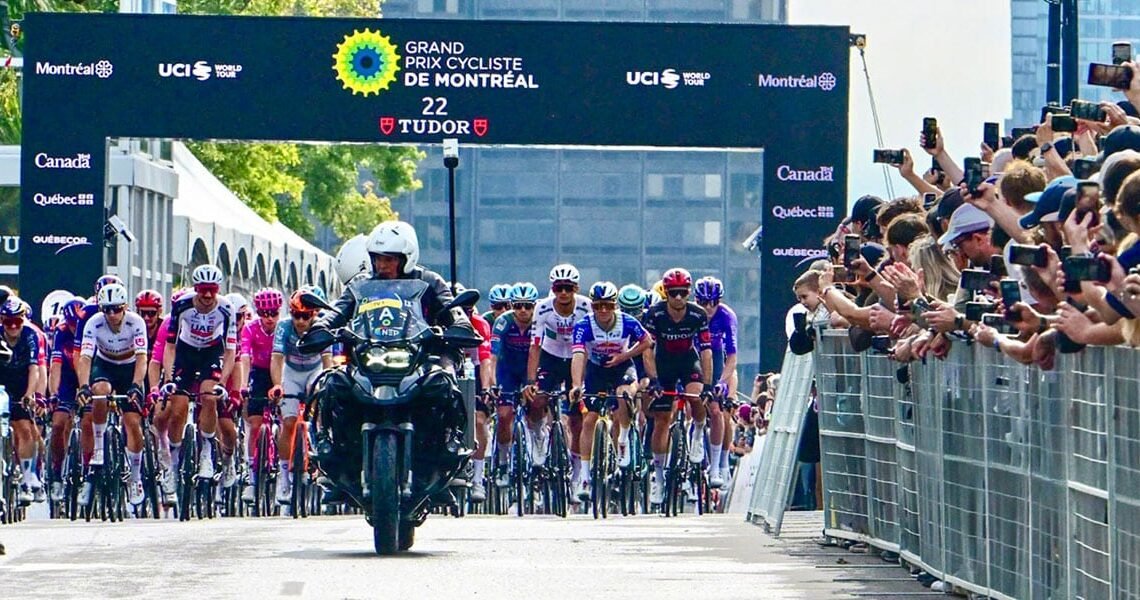

OUTER LINE: With the World Road Championships set for Montréal next weekend, the Grand Prix Cycliste de Québec and Montréal offered the clearest preview yet of who is ready to fight for the rainbow jersey. Remco Evenepoel struck first in Québec, beating Giulio Ciccone in a two-man sprint, before Isaac del Toro delivered an emphatic victory on the Worlds course in Montréal. Paul Seixas’s impressive second place only added to the sense that cycling’s young stars are arriving in Canada ready to challenge the established order.
The Canadian races also created a striking contrast with the final weekend of the Vuelta a España. While veteran Enric Mas completed a surprise Grand Tour victory for Movistar, Del Toro and Seixas were ripping clear of a chase group containing Evenepoel and Tom Pidcock in Montréal. With many top riders choosing Canada as their final preparation for the Worlds, the action in Québec and Montréal appeared to offer a stronger indication of the form—and riders—that could shape next weekend’s championship.
This week, The Outer Line examines the lessons from the Canadian WorldTour races, the Vuelta’s difficult position on the calendar, Movistar and Uno-X’s growing sponsorship value, and the wider business battles reshaping professional sport.
Analysis, Insight, and Reflections from The Outer Line.
# Catch up on pro cycling – and its context within the broader world of sports – with AIRmail … Analysis, Insight and Reflections from The Outer Line. You can subscribe to AIRmail here, and check out The Outer Line’s extensive library of articles on the governance and economics of cycling here. #
Key Takeaways:
● Vuelta Wraps Up …
● … With Success For Smaller Teams …
● … And Older Riders
● Team Sponsorship Battles Heat Up
● Continuing Chaos in College Sports
● New Success Stories in Women’s Sports

The Vuelta a España wrapped up on Sunday with veteran Spanish rider Enric Mas delivering a shock victory for his Movistar team. It was the team’s first Grand Tour win since 2019 and Mas became the first “home” rider to win a grand tour in a decade. The victory offered a timely rebuttal to the sport’s super-team, super-rider narrative. Movistar, a squad with a fraction of the budget of the WorldTour’s dominant teams, inherited the red jersey when Tadej Pogačar had to abandon on Stage 8, but they seized the opportunity as anything but a gift. The Spanish team ably defended red for 13 stages, with Mas punctuating his leadership via an emphatic mountain win on Stage 9. The biggest victory of Mas’s career will redefine the narrative around him as a perpetual “runner-up” and may even help to save the team, which faces an uncertain future as Movistar will be leaving as the title sponsor when its contract ends in 2029. More on that in a moment.

The Vuelta’s other big team development was Uno-X Mobility rising to fourth place in terms of grand tour stage wins in 2026, a significant achievement for the small Norwegian-sponsored group. Tobias Johannessen’s final day stage win in Granada, coming just a day after finishing second on the Queen stage to Collado del Alguacil, capped a run in which the team’s management has shown an almost manic, organization-wide obsession with hunting stage wins at the sport’s biggest races. Taken together with Movistar’s tenacious rally with Mas, we have an interesting conclusion: in an era where a handful of super-teams can dictate outcomes on paper, pro cycling is still an uncertain sport. Injuries, unexpected opportunities and pure chance indicate that there is still a path for lower-budget riders and squads to “play money-ball” with the calendar – identifying exactly which days and stages are winnable and building a plan around them – and successfully go up against the sport’s usually unbeatable giants.

The other surprising Vuelta trend that seems to buck modern norms is that in an era of youth domination, the veterans reigned supreme in Spain. The 31-year-old Mas became just the third rider over 30 to win a Grand Tour in the last 11 editions; 36-year-old Mikel Landa won the Queen Stage; and only a single rider under 30 finished in the overall top five (28-year-old Félix Gall). This was a palate cleanser for many fans who yearned to see their favorite riders make one more run at glory. Then again, the race’s final weekend clashed with the Canadian one-day Grand Prix races. Those critical pre-World Championship races drew deep and talented fields, depriving the Vuelta of some star power, with many riders hoping to achieve medals in Montreal next weekend. Once again, this highlighted the Vuelta’s challenging spot in the calendar.

The sight of the sport’s two biggest young stars, Paul Seixas and Isaac del Toro, ripping clear of a chase group including Remco Evenepoel and Tom Pidcock in Montreal, just a few hours after the Vuelta wrapped up on Sunday, injected a sense that we were watching the top talents of the sport in Canada, not in Spain. The unfortunate abandonment of Pogačar mid-race certainly didn’t help, but the contrast was still stark.

Speaking of those important Canadian races, Evenepoel took the Grand Prix Cycliste race in Quebec, winning in a two-man sprint over Guilio Ciccone, while little-known Anthon Charmig of Uno-X Mobility took third. Two days later in Montréal, on the same course which will be featured in the World Championships road race, del Toro made a convincing case to be one of the favorites for the rainbow jersey. As we head toward the end of the season, and with the only major race, Il Lombardia remaining after the Worlds next week, both races seem wide open with a good deal more uncertainty than we have been used to the last few years. Meanwhile, Pogačar had been expected to make a low-key visit to Montreal to support his partner Urksa Zigart and the Slovenian men’s team, but Zigart also crashed hard over the weekend, reinjuring her jaw, and may also be out for the season.
Between the finish of the Vuelta and the conclusion of the World Championships, WorldTour and Pro level teams will be hard at work convincing existing sponsors to reinvest and renew commitments, and many will be making pitches for their next big patron. A trickle of rider transfers will become a deluge as some teams pare down due to funding considerations and other teams optimistically reshuffle rosters. But the key for all of these teams is to strike while the iron is hot, and no teams have a hotter profile right now than Movistar and Uno-X. While other teams may see their stock rise after next weekend’s Worlds – Red Bull-Bora-Hansgrohe with Evenepoel and UAE with Del Toro come to mind – Movistar’s management team has the unique advantage of pivoting off of a grand tour win to make a nearly bulletproof pitch to potential title sponsors. Arguably, not since CSC’s 2008 Tour de France win locked down its title sponsor change to Saxo Bank has a team held that strong a position. According to cycling insider Daniel Benson’s reporting today, Decathlon CMA CGM just lost two key riders in Felix Gall and Gregor Mühlberger, and thus must now press hard to find the capital to retain generational talent Paul Seixas. By placing second at Montréal on Sunday, Seixas is also a legitimate rainbow challenger. Lastly, Uno-X’s rising stock as one of the sport’s most aggressive breakaway gamblers could pay off in terms of additional long-term support, and potentially the reserves to land the right GT contender into its ranks.
Chaos continues to be the norm in college football. Controversy surrounding the Louisiana State University football team’s attempt to field two players who had previously signed for the NFL refuses to die down. While LSU ultimately did not suit up the two athletes for its season-opening game, the situation is still fraught, as the SEC conference amended a federal lawsuit that might establish a legal route for it to expel the school. Although this outcome is highly unlikely, the battle bolsters an on-going athletes’ rights challenge already in motion. Prior to the earlier House v. NCAA settlement, which established collegiate athletes as paid professionals, university-level conference sports were considered the “elite” level just below the pro leagues. Now, athletes “commit” to their schools, contractually guaranteeing remuneration often into the millions of dollars, including lucrative NIL deals. However, their limited eligibility (four seasons of play over a five year period) means that athletes have huge incentives to seek the best deal each season, jumping between schools, in a virtual collegiate “free agency” system. The two LSU players were unable to make the final rosters in their initial NFL deals, but have a legal right to complete their collegiate eligibility, essentially jumping from one pro league to another, which demonstrates the NCAA’s confusing and chaotic new reality.
The supplanting of “elite” with “professional” in the NCAA context may soon present the Olympic governance model with a major headache. By most definitions, big-time NCAA sports (primarily football and basketball) have essentially become pro leagues; the same is true to a lesser extent for “meet-level” traditional Olympic sports like swimming, gymnastics, and track and field. Revenues are being shared with the athletes, something which the IOC has refused to take up in policy despite it controlling the image of all athletes appearing in its Games. The question of what the athletes are worth to the IOC is unequivocal, and identical to all other sports including “pro” cycling: there is no competition without the athletes. As the NCAA’s impasse with LSU and its conference rivals shows, athletes have an innate right to seek opportunity and fair compensation for their services, so long as they meet the eligibility requirements. The IOC, which is financially dependent on sponsorship, advertising, and broadcast agreements, may simply be running out of room. When Toyota ended its marketing association with the IOC after Paris, its chairman’s message was clear: “I’ve wondered for a while now whether the event is truly putting athletes first.”
Women’s sports like cycling have fueled some of the fastest growing segments in audience growth, and hockey might be its next big breakthrough. The Professional Women’s Hockey League (PWHL) recently secured a TV broadcast distribution deal in the all-important U.S. market for its 2026-’27 season. Games will run over the Scripps Sports national affiliates, as well as ION for a Saturday weekly-featured exclusive match; ION already hosts nationally televised NWSL and WNBA games during the summer season. This new distribution deal is perceived to be a crucial turning point for the new league; it has various national-rights agreements in Canada, but the PWHL could pick up lucrative eyes and broader fan exposure as it dovetails the popular NHL schedule, with the women’s league opening night in late November/early December this year. Spare a thought for the women’s WorldTour on that note, because should it be able to gain a future foothold with a national broadcaster like ION that focuses on and delivers market value on women’s sports, it could turn a similar corner.
But even as women’s hockey turns the corner toward broader success, there are growing pains even for established women’s pro sports like tennis. The WTA, according to multiple sources, is dangerously close to the red and may run out of operating capital by the close of 2027. At a board meeting earlier this year, financial records and modeling reportedly concluded that the organization will have only $15 million in cash by the end of this year. One of the primary reasons for this downturn was the premature end to the WTA’s association with the Saudi Arabian public investment funded Tennis Federation (STF) to host the tournament finale in Riyadh. That cancellation came in the wake of many other PIF sports sponsorship realignments due to conflict in the Middle East, and specifically between Saudi Arabia and Houthi militants. But a separate private equity deal with CVC Capital is also coming due in 2027, which will siphon approximately $30 million USD from the WTA’s profits. Analysts point out that the sport itself is wildly successful from a competitive and broadcast standpoint. However, much like pro cycling’s overspending conundrum, the business behind the scenes, including pay scale for prize money and production costs, is in disarray. If and how the WTA rights its ship will make for a great sports business storyline throughout 2027.
Written and Edited by Steve Maxwell / Joe Harris / Spencer Martin
THE OUTER LINE
www.theouterline.com
@theouterline
Visit our website for our latest articles and commentary. And check out our extensive Article Library for hundreds of in-depth articles about the economics, governance, structure and competition of pro cycling, organized by subject. (Advisory Group: Peter Abraham, Luke Beatty, Brian Cookson OBE, Nicola Cranmer, Prof. Roger Pielke, Jr., Dr. Bill Apollo and Prof. Daam Van Reeth.)
The post OUTERLINE: More Mas Vuelta, Montreal Worlds and Lessons From Bigger Sports appeared first on PezCycling News.