
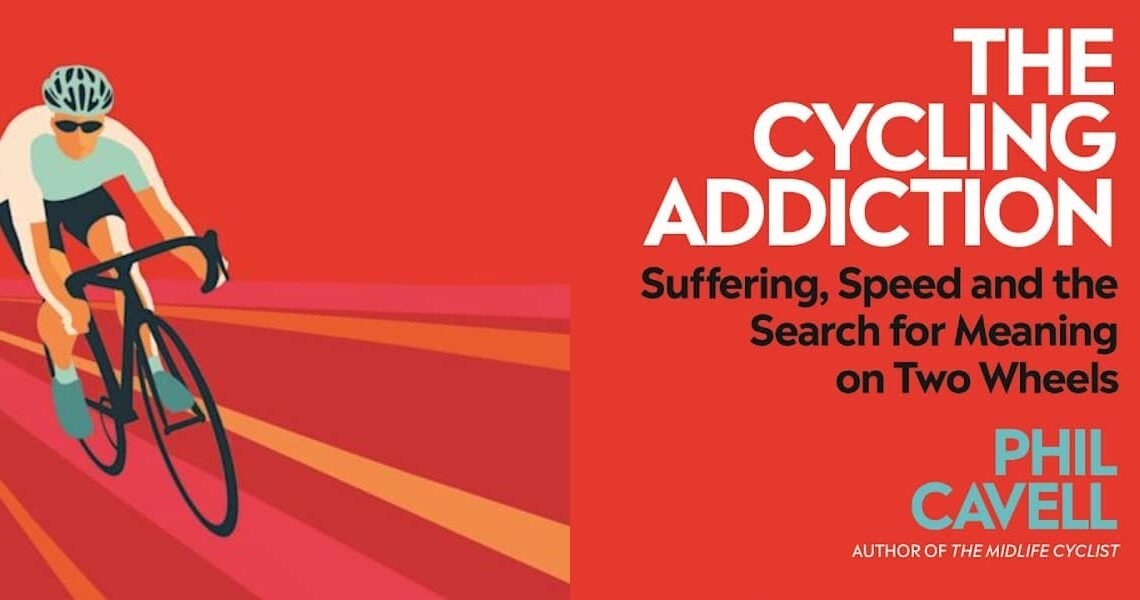

In 2021 author and bike fitter Phil Cavell wrote a book examining the physiological aspects of cycling. We reviewed “The Midlife Cyclist” here and this excellent book has now been followed by a kind-of-sequel. “The Cycling Addiction” is about the psychological elements behind this athletic activity we all love so much. The subtitle, “Suffering, Speed and the Search for Meaning on Two Wheels,” suggests some high ambition on the author’s part. The reader does need to be prepared for quite a journey here, both external and probably internal as well.

Phil Cavell begins the book by setting out some hard questions, trying to find a resolution to “why some of us lose any concept of restraint once we find cycling…” He asks: “Why am I like this? Where does my compulsion to ride come from? Am I fundamentally different to other people for whom a bicycle is merely a medium of transport or a piece of exercise equipment (surely some form of blasphemy)?” Readers are invited to reflect on how the answers (or potential solutions) apply to themselves. The author believes that for us “gaining fundamental understanding needn’t require that we lose the love, and I promise that we won’t.”
“The Rider,” the famous novel about a bike race by Tim Krabbe, is one of the keys to understanding. In that book, the protaganist’s stream-of-consciousness internal dialogue includes the sentiment that pain is no signal to stop. One would imagine that to normal people it would indeed be a signal to stop but why do cyclists press on, seeking the outer margins of performance? What is happening in the Cyclist’s Brain?
The Cyclist’s Brain, or “the Thing,” is the subject of the book’s first chapter. It is an attempt to understand the human mind, the most powerful cycling muscle, in order to take advantage of its (somewhat) trainability. This neurobiology lesson covers twenty rather dense pages and worth reading carefully. Among other concepts is the idea that our brains evolved from the more primitive limbic brain functions to the higher-level cortex ones, with rapid reaction on one side and reasoning on the other. The author notes: “The cycling brain and genotype evolved to survive an ancestral environment of around 50,000 years ago. The environment today is dissimilar to 50,000 years ago and this may have the potential to cause us some problems.”
For those who were previously unaware of serotonin, norepinephrine or dopamine’s functions, as well as the fascinating (to me, anyway) Opponent Process Theory that seeks equilibrium beween pain and pleasure, the chapter has a succinct section of notes at the end summarizing what you have just read. So now that we have the mind machinery in place, where does this take us?
There is a lot about pain in the next chapter, suggesting that bike racers are built a bit differently. “We transact pain like it is the unchallenged currency of the sport. We measure, apportion and inflict pain without regard or reserve. It’s rational to inflict significant pain upon myself if I believe that it is causing you more pain than it is me, and therefore increasing my chances of winning a race.” The author calls upon experts in psychiatry to determine if exercise addiction is different from other forms of dependence, such as on alcohol or drugs. An obvious difference is that exercise is something that improves health (within limits) but characteristically “people who are vulnerable to exercise addiction are typically good at delaying gratification and tolerating pain and get a huge hit of dopamine from physical exertion.”
There follows a very informative chapter on how “metrification,” through the tools of heart rate monitors and power meters, coupled with the concept of Functional Threshold Power (FTP) changed the sport of cycling from a fusty traditional one to one the is science-obsessed and number-driven. And the tools that allowed that change have been taken up by amateurs after the successes recorded by the likes of Chris Boardman and Team Sky. With sometimes unexpected outcomes.
There is a suggestion in “The Cycling Addiction” that the sport can be attractive to the neurodiverse, that is people whose minds function differently from the norm. Phil Cavell has himself been diagnosed with ADHD (attention deficit hyperactivity disorder) and one of the strengths of this remarkable book is in linking scientific ideas with his personal experiences. Whether participating in a race or making his way through daily life, his explanation of the effects of ADHD (disorganization, poor concentration) is contrasted with ASD (autism spectrum disorder), the indicators of which include a need for structure and obsession with details. There can be overlap between the two and Cavell sees how bike racers can use these traits to positive effect in racing.
There is a lot of great stuff to consider here, such as the Black Box idea, wherein there are visible inputs fed in and results that come out but the process that makes those results, the algorithm so to speak, is invisible. And perhaps the most entertaining part of the book is the author’s examination of two big events in pro cycling–the 1986 Tour de France and the 1987 Giro d’Italia–where racers broke (or tried to break) the Unbreakable Rule of Bike Racing by attacking their own team leaders. The personalities involved–Bernard Hinault and Greg Lemond in the first case and Stephen Roche and Roberto Visentini in the other–brings together much of what we have taken onboard about The Thing, its functioning and where that can lead.
The book ends with rolling up of all the concepts discussed into Six Steps meant to “escape the algorithm” and improve cycling performance by understanding the biology of the brain (more cortex, less limbic), becoming more relaxed about numbers, recognizing the need for sleep, and the role of luck. And if not improving cycling performance, at least allowing the reader a meaningful scope for self-examination. Perhaps it goes some way to telling us why riding our bikes is as important to many of us as our career and marriage.
From the foregoing one can be forgiven for believing that “The Cycling Addiction” is not the easiest book to read. For this reader, it introduced a whole raft of new ideas, whether in neurobiology, social interaction or cycling history. The author describes himself as a conduit for an impressive number of experts in the book (as well, of course, for Tim Krabbe!) but his own experiences are highly illustrative and entertaining. For someone with ADHD he has an excellent management of detail but even better for us a delightful ability for a writer to match complex ideas with some considerable wry humour. All in all, “The Cycling Addiction” is a dazzling book.

“The Cycling Addiction: Suffering, Speed and the Search for Meaning on Two Wheels” by Phil Cavell
319 pp., softbound
Bloomsbury Sport, London, 2026
ISBN 978-1-3994-1917-8
Suggested Price: US$24/C$32/GBP 18.99
*** “The Cycling Addiction: Suffering, Speed and the Search for Meaning on Two Wheels” by Phil Cavell is available from AMAZON.COM HERE. ***
The post Pez Bookshelf: The Cycling Addiction appeared first on PezCycling News.