
Here’s a bit of commentary from Mike — perhaps not entirely revelatory for our most pro racing-informed readers, but hopefully cause for consideration of the question on every fan’s mind: Just how seriously should we be taking Paul Seixas’ rise?
In 2020, Tadej Pogačar, who had been on no one’s short list to win the Tour de France, did just that: He resoundingly beat his compatriot Primož Roglič on the penultimate stage, a mostly-uphill time trial, winning by a wide enough margin to earn him the overall Tour victory. Roglič appeared stunned, his helmet riding embarrassingly high on his forehead; after the stage he appeared stunned, as if he knew was witnessing not only his own disappointment, but something grander.

Indeed, it was the dawn of a new world: Tadej’s world. And we cycling fans, as they say, have since been living in it.

Pogačar’s reign hasn’t been without its wobbles: He twice failed to win the Tour de France, finishing second to Jonas Vingegaard in 2022 and 2023. But his hold on professional cycling has since been virtually blemish-free; in a sport where 150 riders start a single event, and where chance peril can befall any one of them in the form of illness, injury, or just an poorly-timed flat tire, he’s won most races that he’s entered, losing virtually only on terrain that’s ill-suited to his lithe climber’s frame.
Last weekend, however, we fans noticed that the sun over Tadej’s world may have just crested.
Not that he lost Liège-Bastogne-Liège, one of cycling’s true classics (which, at least in the U.S., only real aficionados are aware of); he won with a margin of nearly a minute, escaping in typical fashion on one of the course’s steep, differentiating climbs, and maintaining his gap until the finish.

Indeed, a casual viewing indicated classic Tadej — but watch just a bit closer and you notice: That separating ascent came later in the race than usual; in fact, one rider clung to Pogačar up the entire Col de la Redoute, the earlier, punishingly steep climb where Tadej typically plunges the race-ending dagger; that rival kept pace despite Pogačar’s having ridden up that hill faster than anyone in the history of the 132 year-old race. Yes, Tadej broke his own record by a shattering seven seconds — and another rider kept up with him.

That rider? He’s nineteen years old.
And he’s French.
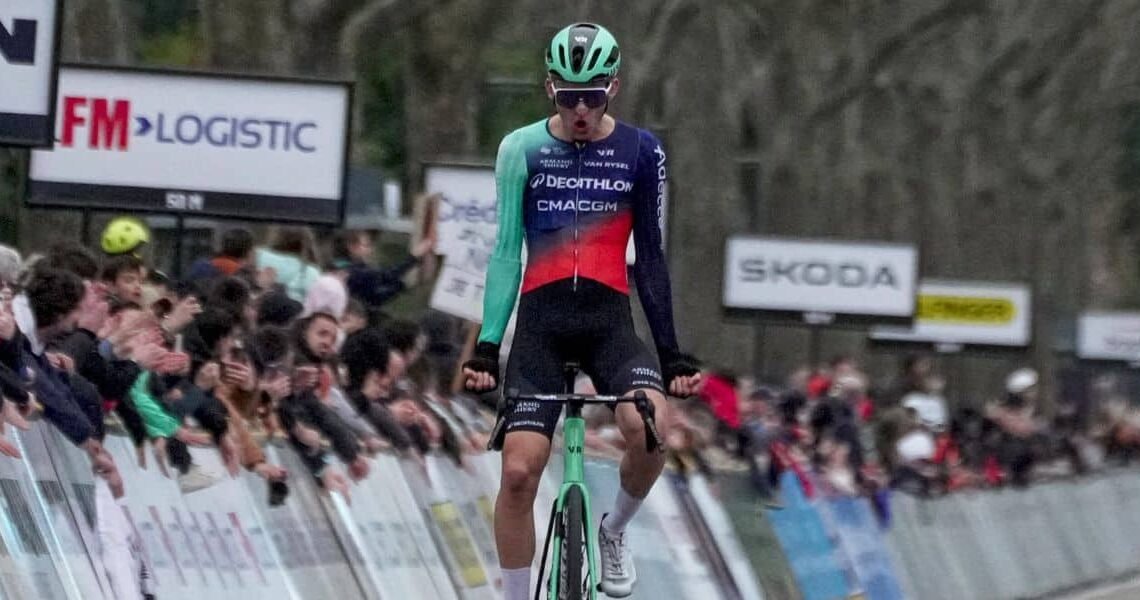
His name is Paul Seixas, and his ascent has been so rapid — as it were — that even I, steeped sheepishly deeply in pro cycling, learned of him just last fall. Since then we’ve seen him vanquish veteran rivals, and win races for which he’d only recently qualified. He thrives in the mountains, it seems, but can also muster a blistering, brief effort — like on the Redoute — and even flies downhill comfortably. He is absurdly thin — he’s my height but twenty-five pounds lighter (and I’m pretty thin) — yet sits solidly on the bike, unlike some tiny climbers who appear as if a stiff breeze might buffet them right off of the road.
As to his Frenchness: I’m surprised; I assumed that Pogačar’s eventual eclipse would occur in the shadow of a Latin American rider, or perhaps a cyclist from the U.S., with its vast resources (and population). France is home to the Grand Boucle, the one race that even the unaware can usually name, and to several of the sport’s real icons. But it’s been since 1985 that a French rider — Bernard Hinault, one such icon — kept the Yellow Jersey in France; indeed, no Frenchman has really come close. French teams tend to perform poorly; French bicycle brands are sorely outnumbered in the pro peloton (though Seixas’ Decathlon team rides French bikes); and Dutch, Basque, and even American fans outnumber locals among Tour-viewing throngs. When I speak with French friends, it’s clear: Soccer matters in France. Cycling? That’s a yesteryear sport.
Yet cycling’s dauphin appears, indeed, to be French. We should all get used to saying it: pōl sehks-ahs.

Tadej Pogačar’s dominance has been as enjoyable as sport dominance can be: He’s likable, funny, and game to take on a host of challenges; he rides with panache, a quality that cycling fans adore: He’s bold in his attacks, and looks graceful on the bike (whereas Seixas’ form is far from artistry). He launched a well-intentioned foundation, raising money in clever ways, such as auctioning off the jersey he was wearing when he crashed in last month’s Milan-Sanremo (which he went on to win). He’s respectful, even deferential to his rivals — even as he remains dogged in pursuit of victory after victory.
Yet I look forward to ever-more competitive encounters between Pogačar and Seixas. Dynasties are fun for the dynastic, and for their hometown supporters; the rest of us — maybe even the French…We just want to watch a good bike race.
The post Paul Seixas: Pogačar’s Heir Apparent? (Commentary by eTrashMike) appeared first on PezCycling News.