
The Tour de France may be heading into its final week, but there’s still plenty happening both inside and outside the race. Today’s EuroTrash rounds up the latest Tour talking points, including the fallout from Jonas Vingegaard’s crash, Remco Evenepoel’s stage win and Tadej Pogačar’s increasingly firm grip on yellow. We also look at cycling’s embarrassingly low prize money, the debate around late-night anti-doping controls, the growing opportunity for the Tour de France Femmes, the controversy surrounding the Enhanced Games and fresh concerns over bike infrastructure in the United States. Plus, Mike tackles the Bend Dirt Fest gravel race, and Richard revisits his bold prediction that Pogačar will win this Tour by eight minutes.
TOP STORY
- PEZ-Fans – Mike asked to step into the driver’s seat for today’s ET – due to his day job gettin’ in the way – so while I’ve been holding the down the fort with our daily Tour de France race reports, for today I’m going with a slightly different presentation of the weeks’ hot topics in cycling – sharing some features from our good friends of at The Outer Line – you’ll see those below.
TEAM, RIDER AND CYCLING NEWS
- Special Guest Features from THE OUTER LINE AIRmail Weekly Newsletter
MIKE’S RIDE OF THE WEEK
- Bend Dirt Fest Gravel Race
VIDEO
- Richard Pez Sez…Tadej Will Win by EIGHT Minutes
TEAM, RIDER AND CYCLING NEWS
Special Guest Features from THE OUTER LINE AIRmail Weekly Newsletter
Analysis, Insight, and Reflections from The Outer Line.
# Catch up on pro cycling – and its context within the broader world of sports – with AIRmail … Analysis, Insight and Reflections from The Outer Line. You can subscribe to AIRmail here, and check out The Outer Line’s extensive library of articles on the governance and economics of cycling here. #
● Cycling’s Prize Money is an Embarrassment to the Sport
● Was Vingegaard Spooked by Midnight Doping Test?
● TdF Femmes Can Seize the Sporting Moment
● Bookending the Enhanced Games
● U.S. Government “DEI” Bike Lanes

● Cycling’s Prize Money is an Embarrassment to the Sport
A report this week from the Money in Sport newsletter highlighted the embarrassing allocations of prize money in pro cycling. Noting the annual revenues and profits for the three grand tours, the article pointed out that ASO is far more profitable than the others, at a 36% margin. Further analysis of the allocations at each event showed that the Tour offers well under one percent of its revenue in rider prizes; the Giro and Vuelta aren’t much higher. Making it worse, prizes on offer have been flat despite consistently rising event revenues, with the Tour’s prize money remaining fixed for ten years. (As we pointed out earlier this year, some participatory regional events like Levi’s GranFondo actually offer more prize money than top pro events like Paris-Roubaix.) Finally, the article also underlined the great disparity between men’s and women’s prize monies on offer from the major events. Meanwhile, athletes in other sports like tennis are demanding a greater percentage of the event revenue to be distributed to athletes as prize money. If those percentages were applied to cycling, Tour prize monies would be 30 to 40 times higher than they are currently. And the four major American franchise sports leagues share approximately half of their revenues with the players. “If ASO is genuinely interested in the future of cycling, it would be ploughing back more of the huge profits it earns from TDF into the sport than it is now.”

The overnight anti-doping sweep at the Tour de France on Saturday night by the ITA focused on Jonas Vingegaard and race leader Tadej Pogačar – and made waves for both the right and wrong reasons. The ITA claimed that the tests were part of its overall approach to safeguarding the integrity of cycling, following on from the tone of the organization’s press release prior to the start in Barcelona two weeks ago. At the same time, the timing of the testing – and its potential impact on Vingegaard’s sleep and state of mind that could have contributed to his race-ending crash later that day – underlines a persistent duality in cycling’s anti-doping narrative: the burden of on-demand testing and availability that falls on the riders, and the lingering mistrust of pro cycling’s integrity. Anti-doping tests after 11 PM and prior to 6 AM are rare unless “the UCI … has a serious and specific suspicion that the Rider may be engaged in doping.”
Here’s the UCI statement issued July 22 in response to the criticisms they received:
 |
| 22 juil. 2026 |
| UCI statement on anti-doping controls conducted during the Tour de France |
| Following a number of reactions in recent days to unannounced anti-doping controls carried out by the International Testing Agency (ITA) during the Tour de France – in particular following the statement issued by the association of professional riders (CPA) – the Union Cycliste Internationale (UCI) wishes to respond and to reaffirm that the fight against doping is an absolute priority.
The UCI of course acknowledges that night-time testing can disrupt riders’ rest and recovery, and wishes to reiterate that carrying out such controls outside normal hours remains an exceptional measure, reserved for limited and justified circumstances. While fully aware of how onerous such a measure is for riders, the UCI nevertheless underscores that these controls serve an overriding interest: the fight against doping. In 2021, the UCI entrusted the ITA with the management of its anti-doping programme – including the planning and execution of controls – in order to guarantee its independence and maximise its effectiveness. With this in mind, the UCI fully supports the ITA’s use of every means at its disposal to carry out its mission as effectively as possible, in compliance, naturally, with the World Anti-Doping Code of the World Anti-Doping Agency (WADA), UCI Regulations, and legislation applicable in each country for the conduct of controls (as in the present case, with the approval of the competent judge) and/or the gathering of intelligence. The UCI considers it essential that all stakeholders unite and support the anti-doping programme in place in cycling, which is now recognised by the relevant sporting authorities as a benchmark in this field. The requirement for independence, rigour and effectiveness in its anti-doping programme comes at a cost to cycling, one borne collectively by all of its stakeholders: every year, more than €10 million is invested in the collection, analysis and re-analysis of samples, as well as in intelligence-gathering, across events falling within the UCI’s regulatory remit, including the Tour de France. This investment reflects the UCI’s determination to protect riders who respect the rules, and to relentlessly pursue the reinforcemnt of its arsenal against those who cheat. The UCI will continue to support the ITA in carrying out its mission, in full and complete respect for its independence, in the service of a cleaner and more credible sport of cycling. |
However, the surprise tests were not unusual in the larger view of anti-doping strategy and are an absolute necessity for reducing micro-dosing blind spots. On one hand, the ITA or UCI may have received specific intelligence that led to the test, or they were simply taking extreme and very public measures to demonstrate that they are serious about clean sport. Either stance means that the ITA had enough information to take the initiative, and while the optics can seem negative, the goal to reinforce sporting authenticity is positive – pun partially intended. On the other hand, the riders’ ordeal may provide further impetus for pro cyclists to eventually unionize and strike a collective bargaining agreement. One aspect of a stronger agreement would be clarifying the anti-doping oversight within a larger framework of athlete rights – one of the reforms pro cycling needs if it is to continue evolving as a modern sport. For contrast, imagine what would have transpired had Spain’s World Cup team been roused for doping tests in the middle of Saturday night before the championship finale.
We would dedicate more time to the race analysis up front, but as a result of Vingegaard’s unfortunate crash, Pogačar’s grip on the Tour de France only tightened; he now sits a full five minutes in front of Remco Evenepoel, who edged him for the stage victory on Sunday. In third is Pog’s teammate Isaac Del Toro, back another minute. The race is effectively over with a week to go (barring any other unfortunate accidents) and two dominant tracks will likely emerge. First, the tactics are likely to regress into breakaway raids by teams which desperately need stage wins for their sponsors. While it will inject excitement into the day-to-day narrative, Team UAE can play a conservative hand and even force teams who are not adequately represented in the inevitable breaks to do the chasing for them. And second – quite literally – the race for second place will go nuclear amongst the next tier of contenders like Red Bull teammates Florian Lipowitz and Remco Evenepoel, Lidl’s Juan Ayuso, and Decathlon wunderkind Paul Seixas. UAE’s foil Isaac del Toro is the likely third place, given that he will be doing a lot of the hard work to defend Pogačar’s interests but can still follow others’ wheels.
It would not be surprising to see Pogačar stretch his margin of victory further as the key mountain stages unfold this week. And that is the true measure of Vingegaard’s absence; the Visma rider may have been beating his head against the brick wall of Pogačar’s superior July form, but he was not strictly racing for second place. His willingness to take the initiative to attack Pogačar despite being flicked off the UAE star’s wheel on the counter move will be missed. What remains is how much initiative the other stars within the five-and-a-half minutes of Evenepoel (2nd through 10th, as of stage 15) will take to earn the other two podium places. And the apparent civil war in Red Bull between Remco and Florian may be absolute gold for ASO to keep fans engaged and boost flagging viewership.

● TdF Femmes Can Seize the Sporting Moment
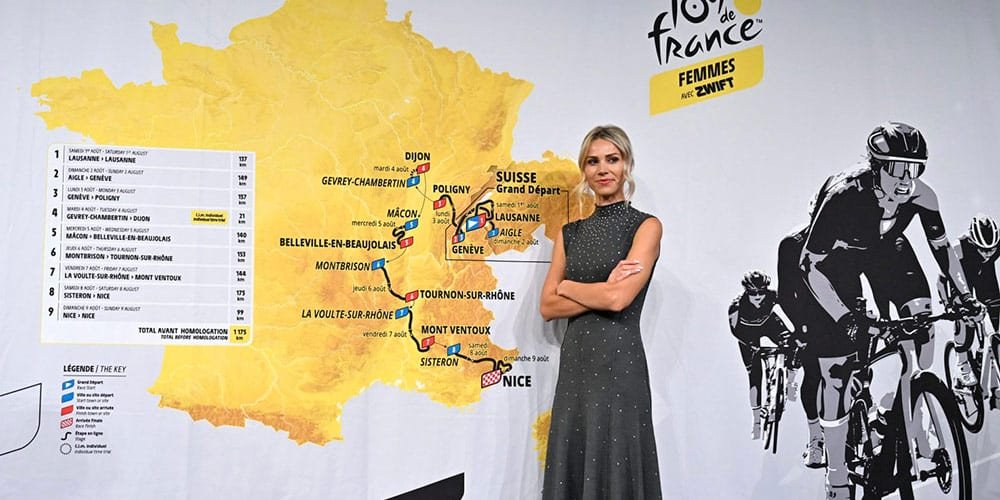
With the Tour de France Femmes just around the corner, it’s an opportune time to remind everyone how women’s sports have been rewriting marketing, viewership, and economic narratives over the last decade. Deloitte’s annual report on women’s sports (April 2026) predicted sharp upticks in several key categories this year, with revenues estimated to reach $3 billion this year, underscored by ticket sales ($911 million) and commercial licensing ($1.4 billion). As many noted at the time of the report, cycling plays only a tiny part of that activity, due to the outsized effects of professional U.S. and European women’s soccer and basketball leagues. However, the fan and viewership behaviors underscore the market engagement and monetization capabilities that women’s cycling can tap into. A new report by UK think-tank, the Women’s Sport Foundation, has translated Deloitte’s predictions into real-world observations. Explosive growth in digital content – particularly for athlete-produced content and short-form competition summaries – has been a key driver in fan engagement; the most telling figure was a 27-minute increase over 2025 in the total time fans stay engaged in live sports broadcasts. This uptick beat the previous record consumption figure (2023) by 13 minutes. Given the myriad problems of delivering a consistent broadcast experience in the ongoing men’s Tour de France, including dissatisfaction with broadcast personalities, confusing data positioning, and inconsistent camera work, it will be interesting to see if and how ASO adjusts to deliver a world-class race in just a few short weeks. Can the TdFF unlock its potential with a growing women’s sports market? Or will it be another cut and paste visual letdown that turns off fans and fails to capitalize on the emergent opportunities?

● Bookending the Enhanced Games
We’ve commented extensively on the recent Enhanced Games, but The New Yorker managed to compile the most comprehensive review of the event to date. The recent article cut multiple topics about the games to the bone, including its heretofore under-discussed transhumanist philosophy underpinnings, sources of its legitimate and sketchy capital investment, and its nearly cult-like obsession with “looksmaxxing” and cheating death via hacking human biology by any means necessary. Among the key points made about the competition and its commercial enterprise (for selling products and arranging/managing treatments) are the backstory of the two founders and their relationship to controversial financier Peter Thiel, several personal anecdotes from Enhanced Games athletes on why they chose to participate, and the strange stance the event takes regarding transgender participation in sport. On that point, co-founding billionaire Christian Angermayer wrote a manifesto during the event lead-up which credited transgender activism as an inspiration: “The trans movement will ultimately extend to the ability to shape and enhance one’s own body and mind according to individual desires and aspirations.” And finally, in perhaps the most bombastic and over-exaggerated comment, co-founder Aron D’Souza said “the end conclusion of this project may be that Enhanced becomes the definitional regulator of what it means to be human.”
One consequence of Enhanced’s unfettered commercialization of controversial treatments and related products – which have scarce long-term clinical safety data – is the potential impact on public health. And a recent case in Germany may portend the future. Participants and consumers in the Enhanced competitive and medical treatment programs use the services voluntarily – and this limits the liability of the organization by placing “choice” squarely on those individuals. In the bigger picture, the effects of doping are often long term, with complications appearing years later after consistent use of the products, especially if the products are novel or experimental. Thus, the impacts to healthcare systems when cardiovascular, muscular, and endocrine issues manifest later cannot be ignored. Recently, German lawmakers took up this topic while evaluating support for former DDR (East German) athletes who were doped by state authorities in the pursuit of international glory. A sobering statistic is that by 1989, up to 15,000 young athletes had been systematically dosed with PEDs (mostly anabolic steroids) without full disclosure or consent, and many of these athletes were only 13 years old. Documentation of the long-term health effects gives some insight into the potential and myriad health issues associated with the practices, particularly the rebound effects of when the doping stops and the body’s internal systems cannot reset to a prior baseline.

Last week Sean Duffy, the U.S. Secretary of Transportation, announced that $1.7 billion in “DEI bike lanes” were being canceled. What he meant by that phrasing wasn’t exactly clear, but it’s increasingly clear that the current administration has decided to declare war on bicycle transportation and safer streets for cycling. There is widespread anger and bewilderment in the bicycle industry about a combination of obstacles and road blocks that have been put in place recently: (1) trade tariffs that increase the cost of bicycles (and many other goods); (2) massive cuts in the size of national parks, monuments and public lands used for recreation; (3) a foreign war that has increased other energy and transportation costs; (4) legislative and executive changes that roll back industrial pollution legislation, likely contributing to climate change, and; (5) cutting bike infrastructure and construction projects intended to make streets safe for cyclists – commuters, enthusiasts and professionals alike. Without safe places to ride, the bike industry and bike racing will continue to struggle economically. These challenges make it harder for all types of bike businesses to thrive, and will lead to a weaker industry. Ultimately, this will reduce sponsorship in teams, athletes and events by major bicycle manufacturers and suppliers.
MIKE’S RIDE OF THE WEEK:
THE BEND DIRT FEST GRAVEL RACE

“Dirt Fest” suggests a family-focused affair, or maybe a downhill mountain bike race, but the Bend Dirt Fest, comprised of a mountain bike race, a gravel race, and a half-marathon trail run (all simultaneous; you picked just one) was legitimately painful.
The gravel race was just about 50 miles, about 40 of them off-road, with plenty of climbing — and plenty of climbing (and descending) on severely washboarded roads, not to mention some very deep and soft dirt. There were stretches where I was moving so slowly that I surely would have walked faster.
Still, it was an exhilarating day out, through lush forest west of Bend. The air was mercifully clear — not a certainty in this age of frequent forest fires — and the temps only got toasty over the last few miles. I was busy racing so didn’t snap photos; the ones featured here come courtesy of my wife Karen. (Yes, I wore a Pantone-themed skinsuit.)

Painful as some of those climbs were, I count myself as profoundly fortunate to be able to take part in rides like this one.

For a more personal view into this race, check out this Substack post.
VIDEO
A few days makes a big difference: Is Richard still insisting that Pogačar will win this Tour by eight minutes?
Check out all of PEZ Tour coverage, including…
- Vingegaard’s Crash and Evenepoel’s Win on Stage 15
- PEZ Bookshelf: The Yellow Jersey/Le Maillot Jaune
- Tour de Pez: The Good, the Bad and the Ugly Tour
Gotta Comment, thought or suggestion? Drop us a line at Content@PezCyclingNews.comSee PEZ FACEBOOK here
The post EuroTrash: Tour Fallout, TdFF Opportunity & Cycling’s Biggest Talking Points appeared first on PezCycling News.