
The Spring Classics always seem to pass in a blur—but Liège-Bastogne-Liège, the oldest Monument of them all, has a way of slowing things down just enough to reveal the truth. For some it’s satisfaction – the legs don’t lie here. Form doesn’t hide. And in 2026, it told us two things: Tadej Pogačar is still the king of the Ardennes—and there’s a new name we’ll be talking about for a long time.
PEZ SEz: Stay tuned – I’m editing more photos while you read this…

Pogačar took his fourth victory in La Doyenne, but it wasn’t the routine demolition we’ve seen in recent years. A wild early race, a reshuffled script, and a fearless young Frenchman made sure of that over 259.5km of the lumpiest racing of the Spring Classics.


A Monument That Refused to Follow the Script
Early hours in Liège are usually a slow burn—an early break, a steady chase, the inevitable reset. Not this time.
After an early crash unsettled the bunch, the race exploded into life with a huge peloton-sized breakaway—fifty riders strong—ripping clear. And right there in the thick of it? Remco Evenepoel.
It was a new race.
Suddenly, UAE Emirates and Decathlon-CMA CGM weren’t just managing the race—they were chasing it. With their leaders, Pogačar and Paul Seixas, caught behind, the gap stretched dangerously toward three minutes. The race was on a knife edge far earlier than anyone expected.
Big Engines, Bigger Pressure
The break smelled opportunity. Teams like INEOS Grenadiers and Red Bull-BORA-hansgrohe drove the pace, pushing the advantage higher while the peloton scrambled to reorganize.
UAE played its cards—sending riders like Tim Wellens back from the break to help tow Pogačar into contention. It was a gamble, and not an easy one to execute.
Behind, the chase began to take shape. Decathlon had no choice but to contribute—Seixas had no representation up front, and the gap had to come down.
Slowly, painfully, it did.
With 120 kilometers still to race, the deficit dropped back toward two minutes. The elastic hadn’t snapped—but it was stretched to its limit.
Cracks in the Break, Calm Before the Storm
As the kilometers ticked down, the massive break began to fracture—too many riders, too many agendas, not enough cooperation.
A smaller group pressed on—Eenkhoorn, Leemreize, Kamp and others—but the writing was already on the wall. Behind, the peloton—what was left of it—was gathering momentum.
By the time the race hit the Côte de Wanne, the reset was underway. Evenepoel, after spending bullets in the break, was brought back to reality as the favorites took control.
The real race was about to begin.

La Redoute: The First Blow
If Liège has a heartbeat, it’s La Redoute.
And once again, it was Pogačar who pressed the button.
The Slovenian surged—hard, sharp, decisive. In previous years, that was enough. Rivals cracked, the race ended, and the script wrote itself.
But not this time.

This time, Paul Seixas was still there.
The 19-year-old Frenchman didn’t just follow—he fought. Every acceleration from Pogačar was matched, every surge absorbed with visible effort but undeniable resilience.
Evenepoel? Gone. The Belgian couldn’t hold the wheel and was left chasing, his earlier aggression now exacting its price.
Two Riders, One Question
Over the top of La Redoute, the race was distilled to its purest form:
- The reigning king
- The rising challenger
Behind them, the gap grew. Ahead, the road tilted upward once more.
Was this the moment cycling found its next great rivalry?
Roche-aux-Faucons: Where It Broke
On the Côte de la Roche-aux-Faucons, the final answer came.
Pogačar attacked again—early, violent, unmistakable.
Seixas responded. Briefly.
Then came the moment every rider knows too well—the legs say no.
The elastic snapped.
Within seconds, the gap opened. Within a minute, it was decisive. The young Frenchman had reached his limit, and Pogačar was gone—once again alone at the front of a Monument.
The Final Kilometers: A Familiar Sight
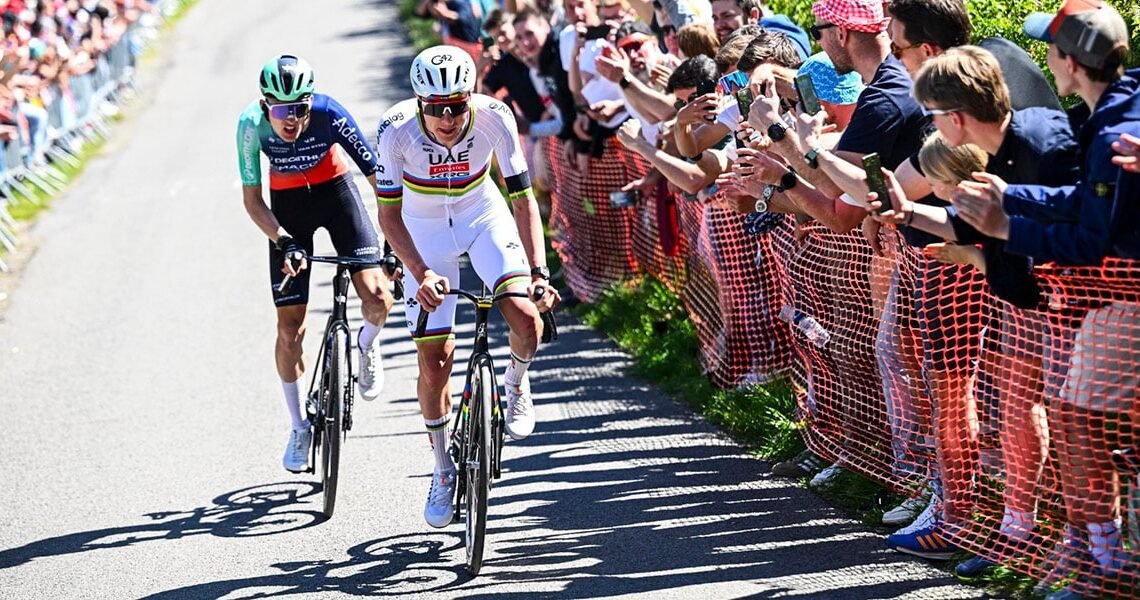
From there to Liège, it was a familiar image: Pogačar in full flight, smooth and relentless, stretching his advantage kilometer by kilometer.
Behind, Seixas rode brilliantly to hold second—clear of the chasers, clear of doubt.
Evenepoel battled on for third, but the damage had been done earlier in the day.
 Four Wins—and Counting
At the finish, Pogačar had time to sit up, celebrate, and reflect.
Four victories now in Liège-Bastogne-Liège.
One more, and he matches Eddy Merckx’s record.
 Huge and valiant ride for Paul Seixas
For now, he joins the ranks of four-time winners alongside Moreno Argentin and Alejandro Valverde—a reminder that we’re watching history unfold in real time.
In a quiet moment after the line, Pogačar pointed to the sky—an emotional tribute to his late former teammate Cristian Camilo Muñoz.
 Remco Evenepoel leading in the chase for 3rd place
PEZ Take
Pogačar still owns the Ardennes—but this wasn’t just another win.
This was the day Paul Seixas proved he belongs.
And if Liège showed us anything, it’s that the future isn’t coming.
It’s already here.
2026 » 112th Liège-Bastogne-Liège (1.UWT)
The post Liege ’26: Pogačar Rules Liège Again – Seixas Shines, Evenepoel Fades appeared first on PezCycling News.