
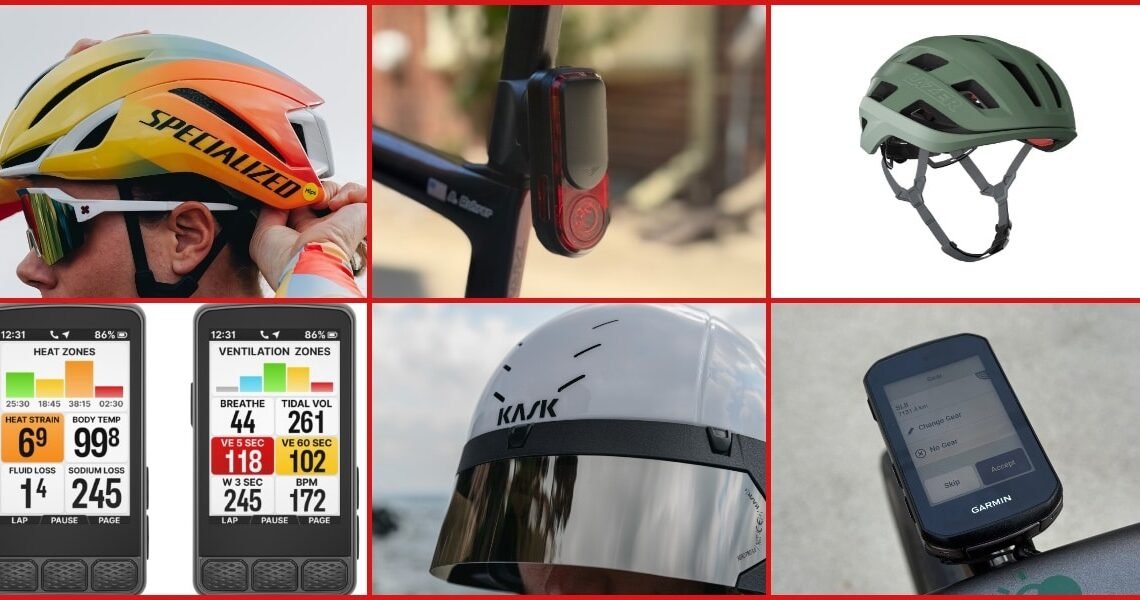

We are marking D-Day 2026 at Gear Break with an invasion of digital wonders and increased safety (and comfort). We have radar, helmets, and new features to keep you safe, cool, and protected. First up, we’ve got Andy’s test and review of the Garmin Varia RearVue 820 review followed by his first impressions of the new Specialized Evade 4 aero road helmet with a neat retention system from BOA. Following up, we’ve got new feature and integration updates from Wahoo and Garmin unlocking greater potential for your existing head units. Sticking with our secondary theme of safety, we’ve got the new Lazer Blade Kintecore helmet, with nifty LED light integration, and last up the new Kask Mistral 3.0 time-trialing helmet.
Garmin Varia RearVue 820
Review: hi-def situational awareness
It took Garmin six years to follow up on the class-defining RTL515 radar taillight with the new Varia RearVue 820. The new unit is far more than an incremental facelift. It is a massive leap from being a proximity warning system. The Varia RearVue 820 is a high-resolution, situational awareness powerhouse.
Unboxing and Physical Form Factor
Straight out of the box, Garmin provides a clean, updated package. Inside, you will find the RearVue 820 unit, a native USB-C charging cable (thankfully retiring the ancient micro-USB standard), a newly revised, beefed-up stock seatpost strap mount with protective shims for both round and aero posts, and the standard quick-start manual.

Physically, the RearVue 820 alters its proportions compared to the slender RTL515. To house the upgraded 60° radar array and more robust internal processing, it gains a little bit of girth-standing slightly wider and deeper, though trimmed down in total height.

On the scale, the 820 comes in at 87 (90 according to Garmin) grams. That minor 17-gram increase over the 70-gram RTL515 isn’t a penalty given the massive safety improvement from the RearVue 820 features.

Mounting & Forward Compatibility
Good news for current Varia users involves the mounting tabs. While Garmin revised the stock rubber strap assembly, the physical quarter-turn engagement interface on the back of the device body is completely unchanged from the RTL515. If you have invested in clean, elegant additive-manufactured (3D-printed) custom mounts to fit your specific aero frame or dedicated gravel seatposts, you can breathe easy. The 820 attaches directly to your existing setup without skipping a beat.

Real-World Placement & Optics Warning
Because of the internal redesign, the built-in day flash LED is now located at the bottom of the chassis rather than directly behind the mounting tabs. If you have a compact frame setup and previously pushed your radar mount to the absolute base of your seatpost, this means the repositioned lens will sit lower, creating the potential for the light to be hidden by your rear tire at certain angles. Garmin claims the light is visible from up to 2km away; while I didn’t test that exact distance, it is plenty bright and the distinct flash patterns will absolutely catch a driver’s eye.
The flip side of this new form factor is excellent news for the tech stack: the radar array itself now sits higher on the unit. As a result, the radar sensors are actually less likely to be blocked or impeded by your frame or tire. I run my own mount slammed, and the tire has never once interfered with or blocked the radar from tracking vehicles. Because drivers at a distance are looking at a shallow approaching angle, standard geometry dictates they will still catch the lower flash anyway, but if you want to guarantee a totally visible 220° beam path for the light, simply shift your mount up the seatpost by an inch or two.

Enhancing Situational Awareness on the Road
On course, the 820 dramatically upgrades how you perceive traffic. Dare I say, it gives you a hi-def view of the world behind you when you’re on the road. It delivers improved detection, reduced false positives, size classification of approaching vehicles, and lateral lane tracking. Most importantly, it will warn you when a vehicle is ‘pacing’ you.
The older RTL515 never failed to detect a legitimate target, but it did throw false positives. The RearVue 820 has completely erased those ghost echoes. While you should still do a shoulder check, in my experience: if the unit warns of an approaching vehicle, there is an approaching vehicle.
The range tracking is equally enhanced. Officially, Garmin rates the max detection range at 175 meters, but in wide-open road scenarios, the hardware comfortably acquires and tracks approaching targets over 200 meters. Early release firmware had a math ceiling bug that caused the system to stumble when processing initial handshakes beyond 196 meters, falsely compressing a car’s position on your head unit before snapping back to real-time distance as it crossed closer. Garmin has since resolved this bug entirely, meaning targets track fluidly from the initial handshake.
The new size classification feature uses an expanded 60° beam width to segregate approaching profiles into distinct icons representing small (motorcycles), medium (passenger cars), or large (commercial trucks) vehicles. It isn’t flawless, but fortunately, it always errs “big.” It will never mistake a massive tractor-trailer or an Suburban being driven by a soccer mom for a motorcycle. The only real quirk is that it occasionally misclassifies your riding buddy drafting on your wheel as an approaching car.
Head Unit Ecosystems & Compatibility
To unlock the full feature list you must pair it using Bluetooth with a current Garmin Edge x40/x50 series head unit. Without that connection, the approaching targets will be represented as dots and lateral lane tracking will not display on your screen.
However, do not panic if you are not ready to upgrade your computer. The RearVue 820 is fully backward compatible. When paired with an older Edge series computer, or any other head unit capable of pairing with radar, it still performs exceptionally well.
In terms of wireless protocols, the device broadcasts over both ANT+ and Bluetooth. Bluetooth handles smartphone app integration and connection to the newest Garmin Edge units for the full feature set. ANT+ can be used with any computer capable of handshaking for radars and smart lights. It should be noted the Bluetooth connection used by the RearVue 820 when communicating with an Edge x40/x50 is proprietary to Garmin. The advanced features it provides are not available on other manufacturers’ head units even if they do have Bluetooth.
I have only used the Bluetooth connection. In retrospect, I should have tested it with ANT+ but I never felt safe riding around in standard definition situational awareness after my newfound comfort, Fair to say, over the Bluetooth connection it easily outpaces the previous RTL515 by delivering faster, smoother target tracking, zero false alerts, significantly better range, and massively optimized battery life (jumping to 24 hours on day flash and 30 hours in radar-only mode). Not to mention, it just gives the added security of “seeing” traffic behind me with a better understanding of where it is in relationship to me.
Features & Technical Specifications
Advanced Target Analytics
- Size Classification: differentiates vehicle sizes, occasionally over-classifies smaller targets or cycling companions as larger vehicles (x40/x50 series exclusive).
- Lateral Lane Tracking: tracks lane shifts in real time over secure Bluetooth, indicating if a vehicle is pulling wide or occupying an adjacent shoulder (x40/x50 series exclusive).
- Same-Speed Monitoring: holds steady-state tracking on vehicles matching your pacing speed until they make a decisive turn.
- Auto Brake Light: the unit will also signal when you’re slowing. While I couldn’t observe it directly, my riding partners noted that it was sensitive enough to note when I was slowing/braking as opposed to just coasting down. And it gives off a lighting pattern that draws the human eye…when you get run over by a driver, they clearly weren’t paying attention to the road.
Light Modes, Outputs, Battery life
- Day Flash: 100 Lumens (Up to 24 Hours battery)
- Night Flash: 40 Lumens (Up to 10 Hours battery)
- Solid: 25 Lumens (Up to 10 Hours battery)
- Peloton: 8 Lumens (Up to 15 Hours battery; dimmed to protect drafting riders)
- Radar-Only Mode: Light off (Up to 30 Hours battery)
System Architecture Specs
| Specification Metric | Factory Standard |
|---|---|
| Physical Dimensions | 3.9” x 1.0” x 1.7″ (98.9 x 25.9 x 43.2 mm) |
| Weight | 3.2 oz (90 grams) |
| Hardware Charging | Native USB-C Port |
| Radar Beam Width | 60 Degrees |
| Target Acquisition Range | 175 Meters (Official) / >200 Meters (Actual) |
| Wireless Protocols | ANT+ & Secure Bluetooth Low Energy (BLE) |
| Water Proofing | IPX7 Rating |
| Integrated Deceleration | Dynamic Brake Light Flash Pattern |
The Pez Verdict
Andy sez: “It’s pricey. At three bills, it’s a serious investment. $299.99 / 299,99€ / £259.99 for peace of mind, or at least some seriously early detection, is worth it to me. If you are seeking the absolute pinnacle of situational awareness on the road or gravel right now, this is hands down the most advanced, best radar unit on the market. While it can’t protect you from being rear ended, at least you won’t be surprised by approaching vehicles. The RearVue 820 is eyes in the back of your head.”
Taking advantage of the advanced target analytics in the Garmin Varia RearVue 820 requires the newest Edge x50 head units. But the massively increased sensitivity, lack of false positives, and motion-sensor triggered brake light can all be had by any ANT+ capable head unit that is compatible.
You can order direct from Garmin or check your favorite retailer/stockist.
Specialized S-Works Evade 4
First impressions: a better fit
Specialized has rolled out the latest iteration of its flagship lid, the Evade 4. And in doing so they’ve combined style cues from the prior three generations, going all the way back to 2013. In the process, the helmet is no slipperier than its predecessor, but it is claimed to be a cooler helmet-by 2.4%-on course.

Given that the Evade 3 was already universally recognized as one of the absolute slipperiest lids in the peloton, chasing marginal drag reduction in the wind tunnel wasn’t the goal here. Instead, Specialized focused heavily on refining the internal architecture, fit, and ventilation, choosing this helmet to debut a brand-new standard in retention technology. Did I mention that the new Evade 4 is claimed to be 2.4% cooler than the Evade 3? How do they even measure that?
The “head”-line: BOA’s all-new FS2 Fit System
The big story here, however isn’t the cooling. It’s the global introduction of the BOA FS2 Fit System, a next-generation dial based retention and fit structure making its global premiere on the Evade 4. The FS2 system introduces Dynamic360 wrapping, a lace system that completely wraps around the head, rather than tightening exclusively at the back of the skull to pull the helmet back against the forehead.

- Submillimeter Precision: The low-friction, textile lace-based system wraps completely around the head, offering a massive 40% finer adjustment resolution than standard helmet dials. This allows for submillimeter on-the-fly micro-adjustments.
- More Secure, Less Pressure: Lab results from BOA’s Human Performance Fit Lab reveal that by distributing tension evenly, the FS2 system reduces peak pressure points while generating a 6% stronger hold relative to legacy standard systems.
- Customized Cradle: It features a split yoke and forehead guide design specifically engineered to lock in the occipital bone and stabilize the sides of the head across a wide range of skull shapes, rounded out with vertical adjustment points.
- Integrated Safety: Tucked cleanly inside that revamped system is an updated MIPS technology package seamlessly embedded right into the pad liner to handle rotational impacts without choking off the airflow.

Fit & Retention Impressions
I received the Evade 4 for review earlier this week, and my initial impressions after several rides of varying intensity totaling about eight hours are that the new internal architecture and retention system completely redefines how a high-end helmet anchors to your skull.
To be fair, the older Evade 3 was a highly capable, comfortable helmet. However, its “Mindset” FS3 cradle suffered from the fundamental limitation of traditional retention designs. (Note: despite naming similarity, is not serial with the BOA FS2.) If you cinched it down tightly for a fast descent or a rough sector, it acted as a linear clamp-pulling the brow pads straight back against your forehead and occasionally creating sharp, localized pressure points on the sides of the brow.

The BOA FS2 system alters that feel entirely. Because the lace manages tension around the head by pulling the yoke evenly, the helmet doesn’t feel like it is being jammed onto your skull. It sits naturally and wraps completely around the contours of your head. The resulting fit is secure and prevents hot spots, proving that an already excellent lid can be made noticeably more luxurious.
The “Cooling” Claim & The Sweat Test
Specialized claims a 2.4% increase in cooling efficiency with the Evade 4. They achieved this by redesigning the vents and the MouthPort and paired with a redesigned internal channel for better airflow. While discerning a precise 2.4% thermal delta out on the road is nearly impossible, the internal channeling does feel airy for a dedicated aero helmet.

Anyone who rode the Evade 3 is likely familiar with its most notorious quirk: the brow-pad saturation that resulted in a sudden “sweat waterfall” pouring down the inside of your sunglasses the moment you tilted your head sideways to get a look behind, and then once started would just continue for the rest of the ride. With the Evade 4, that design flaw has been mitigated. The front padding seems to do a better job of managing moisture and directing pooling sweat away from your sunnies. For a heavy sweater, like me, it isn’t a total miracle cure-on warmer, humid days, the sweat still pools because it has to go somewhere, and it simply accumulates faster than it can evaporate.
The Pez Verdict
Andy sez:
“My initial rides took place in temperatures ranging from 70–80°F (21–27°C), which provided an immediate test for Specialized’s redesigned cooling system and pad construction. Impressively, during longer duration tempo efforts instead of the sweaty torrent off my brow, it’s now just an annoying drip. A highly welcome development for long days in the saddle.
“As for the fit? Supreme! Honestly, I wasn’t bothered by the prior version of this helmet, until I wore this. The fit and retention system just feels better. It feels more secure, more comfortable, more je ne sais quoi. It doesn’t cause any hot spots or discomfort, and more importantly, I realized I am not making various adjustments throughout a ride once I get it set.”
The Evade is pricey at $350, a $50 bump from its predecessor. But, it is Specialized’s premium helmet offering, and Big S is banking that the improved fit and retention offered by the BOA FS2 system and the improved cooling and sweat management make the increased asking worth it to buyers. Based on my initial test, the improvements are noticeable but marginal, and without a slipperier shell, there may not be a rush on the shops because the hiked pricing offers no marginal gain.

Pricing & Availability
The helmet MSRP in various markets lists at $349.99 / 329,00€ / £279.00. For full details on the Specialized Evade 4, and to purchase, head over to www.specialized.com. For a full explainer with video on the new FS2 Fit system, visit www.boafit.com.
Wahoo ELEMNT Sensor Integrations
Gamechangers

Wahoo Fitness has unveiled a series of innovative sensor integrations for its ELEMNT bike computers. This update sees native integrations with not one, but four next-generation sensors. Riders will have access to elite-level metrics while on course. These updates are driven by customer feedback and evolving user requirements, representing another significant step forward in enhancing the cycling experience for Wahooligans.
The Sensors
CORE Body Temperature Sensor
This sensor gives endurance athletes continuous, non-invasive core body temperature readings. It does this in real time, helping optimize pacing, cooling, and heat training strategies. Used by elite cyclists, runners, and triathletes, CORE delivers advanced thermal performance insights previously reserved for the lab.

FLOWBIO
A sensor measuring fluid and sodium loss continuously during exercise, streams readings in real time to the rider’s Wahoo device. Adopted by World Tour teams, PTO athletes and world-leading performance centres such as Red Bull High Performance in Salzburg, it can be worn on the arm or clipped onto a standard heart rate chest strap, seamlessly fitting within existing athlete setups. Sensor output feeds into FLOWBIO’s Advanced Hydration Intelligence (AHi) platform. This platform covers every phase of training, from pre-session planning and in-ride adjustments to a structured post-session recovery plan. Accuracy has been independently validated by Europe’s leading heat research university, with the full methodology and dataset publicly available.

hDrop
Providing real-time sweat analysis, this sensor monitors the athlete’s hydration and electrolyte loss during training and racing. By translating sweat composition data into actionable insights, hDrop enables riders to develop more precise hydration strategies.

Tymewear
This is the first wearable that brings performance-lab personalization to everyday training. VitalPro measures breathing within 97% of laboratory testing to identify each athlete’s ventilatory thresholds (VT1 and VT2), then builds training zones, workouts, and plans around them. No lab visit required.

Breathing becomes a source of truth that athletes train against, instead of generic targets. The research is clear: across dozens of trials comparing individual threshold-based training to standard heart-rate or power-based zones, it improves 100% of athletes and delivers more than 2x the fitness gain.
Taking The Lab Outside
From respiratory metrics provided by Tymewear, to hydration insights from FLOWBIO and hDrop, these integrations bring lab-grade physiological monitoring directly to the bike, highlighting Wahoo’s ongoing commitment to deliver added value to customers through regular updates. With the data now sitting alongside figures like power and heart rate on ELEMNT computers, the update will enable athletes to make more informed decisions around pacing, hydration, cooling, and energy management during the session rather than deconstructing them afterwards.
Rollout
The CORE integration update went live on June 2nd. FLOWBIO, Tymewear and hDrop integrations are scheduled to go live later in June.
If you are interested in purchasing one of the ELEMNT family to gain integration of these products, the MSRPs are below, and can be ordered direct from Wahoo.
- ELEMNT BOLT 3 – USD $349.99 / CA $549.99 / UK £299.99 / EU €329,99
- ELEMNT ROAM 3 – USD $464.99 / CA $699.99 / UK £399.99 / EU €449,99
- ELEMNT ACE – USD $499.99 / CA $679.99 / UK £449.99 / EU €479,99
Garmin Cycling Computer Feature Updates
Same devices, more power

Garmin is pushing out its latest free software update over the coming weeks. If you want to grab these features automatically, ensure your device has automatic updates toggled on. Key highlights for road and gravel riders include on-device gear lifetime tracking and direct wireless integration with Bosch Smart System eBikes to display metrics like smart travel range, battery status, power, and cadence.
On-Device Gear Tracking
For those who want to keep a meticulous eye on component wear without digging through smartphone apps post-ride, Garmin is moving gear management directly to your handlebars.
 Real-Time Lifecycle Metrics: You can now assign and track individual components or “gear collections” right on your Edge device.
- Granular Tracking: This covers everything from your primary drivetrain parts (chains and cassettes) to wheels, tires, and down to the specific cleats on your cycling shoes.
- Proactive Maintenance: Clear on-device progress bars show wear metrics, and the Garmin Connect app will throw you a notification when a component is actively approaching its end of life.
Bosch Smart System eBike Integration
If your stable features an eBike run by a Bosch Smart System, your Edge head unit just got a lot smarter.
- Seamless Connectivity: Your Edge now links wirelessly to pull real-time eBike data directly onto your data screens.
- Dynamic Routing: It populates live metrics like exact battery status and Bosch’s “smart travel range” routing.
- Performance Analysis: It synchronizes your power output and cadence straight into your ride profile.
How to get it?
Users of Garmin Edge MTB and all Garmin x40 and x50 devices will get the updates pushed over the next few weeks. Just ensure that you have enabled automatic updates and your devices will be updated soon.
Lazer Blade Kineticore Helmet
A helmet made for exploring, from road to paths
Lazer has dropped the Blade KinetiCore, a helmet made for riders who chase quiet roads, dusty paths, and the feeling of getting wonderfully lost.

From road to dust
Built for the moments when the route shifts from road to gravel, Blade KinetiCore pairs a sleek, streamlined profile with a distinctive dual‑shell construction. The pronounced line where both shells meet adds visual tension, giving the helmet a sharp, dynamic character.
Inside, soft, dense padding delivers lasting comfort from the first hour to the final stretch. While the fit system fine‑tunes effortlessly for a smooth, pressure‑free feel. Perfect for riders who chase long horizons. Whether you’re searching out quiet roads or getting lost on new terrain, the Blade KinetiCore is ready for every turn.

Focused on the adventure, not the gear
Lazer’s Advanced TurnSys system offers a precise, easily adjustable fit with both horizontal and vertical tuning. A brand-new strap divider allows further refinement, keeping the straps consistently positioned for stable, all‑ride comfort. Integrated eyewear docking ensures glasses stay secure when they’re not in use.

Engineered with Lazer’s KinetiCore rotational impact technology, crumple zones redirect impact energy away from the head offering advanced protection. KinetiCore is built directly into the helmet’s internal structure. This integrated approach reduces material use, making the helmet lighter and improves ventilation without compromising safety.
Visibility can be enhanced by attaching the Universal Lazer LED to the rear of the helmet via the built‑in Direct Mount, making it easier to stand out in low‑light conditions. The Blade KinetiCore is lightweight, sleek, and ready for long days outside, it keeps you focused on the adventure, not the gear.

Specs & Pricing
- Sizes: S/M/L
- Weight: 250g for M Helmet
- Colors: Flash Orange, Matte Black, Matte Clay, Matte Cobalt Blue, Matte Deep Grey, Matte Sage Green, White
- Universal LED compatibility
- Pricing: 99,99 € / $99.99 US
Kask Mistral 3.0
A new era for aero efficiency

KASK, this week, launched the Mistral 3.0. Engineered to meet the evolving demands of elite time-trialists and triathletes, the Mistral 3.0 represents a significant leap forward in aerodynamic management and compliance.
While retaining the proven shell geometry and high-performance materials of its predecessor, the Mistral 3.0 introduces a refined aesthetic and a radical leap in optical technology: the Aero Pro Visor 3.0.

Optimized for the “Extreme” Position
The modern aerodynamic silhouette has changed. With athletes adopting increasingly aggressive “head-down” positions, where the face is often partially shielded by the hands and forearms, managing airflow around the lower face and shoulders has become the new frontier of speed.
The Mistral 3.0 addresses this via a widened, cylindrical profile of the visor that minimizes turbulence in these critical zones. To ensure stability at high speeds, the chassis features three new lateral magnets integrated into the shell to secure the new Aero Pro Visor 3.0.
The Aero Pro Visor 3.0: Engineering Watts
The heart of the Mistral 3.0 is the all-new Aero Pro Visor 3.0. Developed and validated in a virtual environment and a physical wind tunnel with INEOS Grenadiers’ Filippo Ganna-and fresh off his dominant time-trial victory at the Giro d’Italia-the visor is a masterclass in marginal gains.
Constructed with a 3D-printed Nylon frame and a Polycarbonate lens, the entire assembly weighs just 70 grams, offering significant power savings over a standard visor:
- 6 watts saved at 45 km/h
- 8 watts saved at 50 km/h
- 11 watts saved at 55 km/h
Design Without Compromise
The Mistral 3.0 debuts with a bold, refreshed graphic identity. Featuring prominent KASK branding on both flanks, the helmet is available in two timeless colorways: Black and White.

Marco Galli, KASK Marketing director, sez: “The Mistral 3.0 is not just a refinement; it is a tactical response to the current racing landscape. By optimizing the interaction between the rider’s position and the air flowing toward the shoulders, we’ve managed to find speed where others see obstacles.”
The Aero Pro Visor 3.0 features an increased offset from the rider’s face, promoting airflow to eliminate condensation without sacrificing the laminar flow across the helmet’s surface. This ensures that even under maximum physical exertion, vision remains sharp and unobstructed.
Technical Specifications
Shell features & specs
- Inner padding material: Polyester
- Chinstrap material: Faux Leather
- Shell finish: Shiny
- Safety Standard: CPSC 1203
- Weight: 400g

Visor Features
- Antifog: Yes
- Visor color: Clear (w/ helmet) or Silver Mirror
- Visor material: Polycarbonate
The Aero Pro Visor 3.0 is exclusive to the Mistral 3.0 and is not compatible with previous Mistral iterations). Spare/replacement clear visors and silver mirror may be purchased separately.
Pricing & Availability
Mistral 3.0 (Includes Clear Visor): 700€ / $800 / £600
Spare Clear Aero Pro Visor 3.0: 370€ / $430 USD / £330
Spare Silver Mirror Aero Pro Visor 3.0: 390€ / $450 USD / £350
To get the full details and purchase, head over to kask.com.
Note: If you have other experiences with gear or something to add, drop us a line. We don’t claim to know everything (we just imply it at times). Give us a pat on the back if you like the reviews. Or, call us out if you feel the need!
PezCycling News and the author ask that you consult the manufacturers if you have any questions about the products you see here. Only the manufacturer can provide accurate and complete information on proper/safe use, handling, maintenance, and or installation of products as well as any conditional information or product limitations.
The post Gear Break: D-Day – Garmin Varia RearVue 820, Wahoo Element Integration, Garmin Edge feature updates, Lazer Blade Kineticore, appeared first on PezCycling News.