
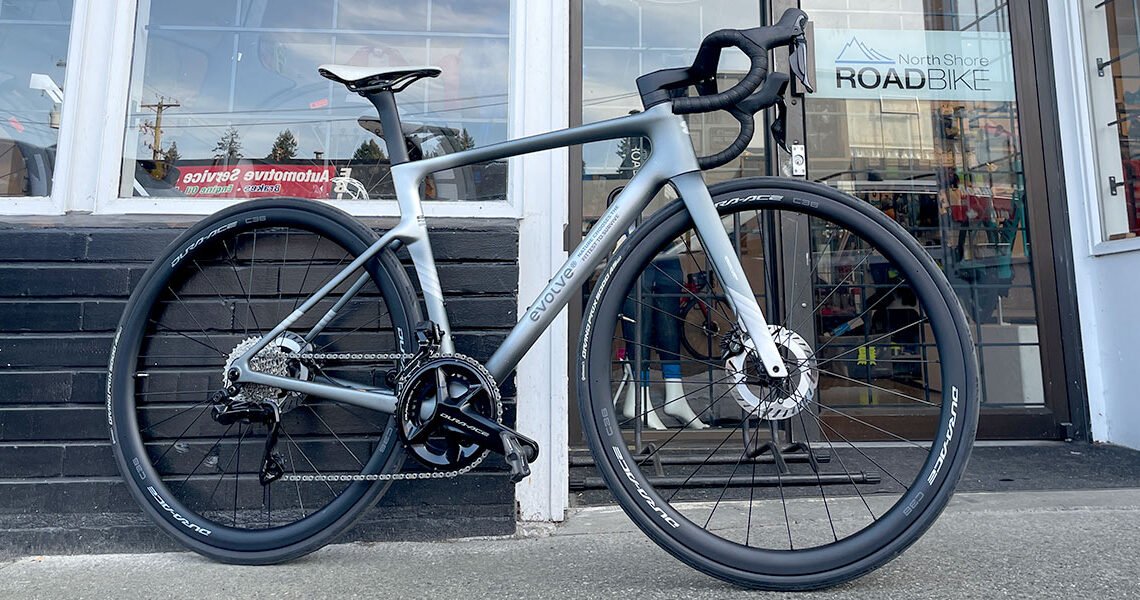

Can a Chinese carbon race bike really be this good? That was the question rolling around my head as I built up the new Evolve Cima, a featherweight road frame from a brand few North American riders have likely heard of—yet. Spec’d with Shimano Dura-Ace Di2, Shimano C36 wheels, Repente saddle and premium finishing kit, this build tipped the scales at under 16 pounds and immediately challenged my assumptions about where “premium” performance bikes come from. After my first real rides, one thing became clear: the conversation around Chinese cycling brands is about to change.
~ I’ve just logged my first ride on the Evolve Cima—my latest project bike— and the results have been nothing short of impressive. This is the first Chinese branded bike I’ve tested, and after seeing the increasing quality of cycling gear arriving from China, I was keen to try it myself.
 First shot of the new build – and thanks to the good folks at North Shore Road Bike for putting it all together.
I rolled out this brand-new build with thanks to Evolve, Shimano, Repente, Continental and Arundel for helping bring this project together. More on each of those as below.
But first rides are always telling – and having ridden dozens (hundreds?) of different bikes and brands since I started PEZ in 2002, I’ve learned that while fits can be dialled in – when things feel so good on the first ride, this is something special.

I ordered the Size Medium (54.3cm Top Tube), added a 110mm stem one piece integrated carbon bar from Kreuza (Evolve’s sister brand) – and only had to set the saddle height and setback, and voila – perfect fit.
There was instant connection – I was locked in. I know it’s hard to not feel fast on a well fitted bike, but when you actually go faster… that’s something. But let’s start with a little background on the brand…

Who Is Evolve? A Chinese Brand With Big Ambitions
I only discovered Evolve at Sea Otter 2025, after I’d received set of test wheels from their other sister company – Elite. Before that I’d not heard of either of these brands – not unusual since neither had done any marketing like the kind that we normally see here in North America.
But I was impressed by the Elite G45 Gravel wheels and wanted to know more. Evolve Bicycles was founded by two industry veterans with more than 20 years of experience in bicycle design, development, and manufacturing, combining global engineering expertise with advanced production capabilities in Xiamen, China. The company positions itself as a performance-focused cycling brand dedicated to delivering premium competition-level carbon framesets and components that balance lightweight design, aerodynamics, reliability, and rider value. Their philosophy centers on making high-end racing technology more accessible while maintaining a strong focus on rider experience, precision manufacturing, and real-world performance.
That experience got me thinking more seriously about the quality coming out of China—where most of the industry is already using the best factories, materials, and skilled engineering to manufacture anyway. Seeing the apparent quality of the frames, wheels, and handlebars on display at Sea Otter piqued my interest in actually riding the bike.
I connected with their marketing person, and followed the online ordering process to choose the frame size and handlebars, which were promptly shipped and arrived in a few days – as promised.
Outta the Box
The frameset arrived inside an impressive looking bike box, packed inside another cardboard shipping box. It was almost entirely free of plastic packaging, and that kind of attention to detail that suggests the same care went into the frame itself.
Upon further inspection…
My assessment of quality was supported by close inspection of the frame – the finish quality is excellent—smooth joints, clean lines, no rough edges anywhere, even inside the bottom bracket.
And the weight – picking it up, it feels as light as the claimed ~696 grams for my size Medium with the Gray Mist paint scheme. In fact – the whole bike weighed less than 16 lbs – my lightest ever build.
 The head tube is shaped to slice the wind – narrower in front and tapered between the top and bottom bearings, and seamlessly smooth around all the curves. Those tiny dots in the paint are supposed to be there as part of the Gray Mist paint scheme I chose.
And while we’re talking frame weights – another sign they have it dialed, is the amount of detail offered on the website. For example – frame weights are listed for each of the six frame sizes, organized by paint scheme. You read that right – depending on which colour you choose, paint adds anywhere from 45 g to 100 g to the overall frame weight.

But let’s take a closer look at this frame…

The frame shape is very current to modern standards – large head tube-downtube-bottom bracket-chain stays – the classic spine for stiffness through the drive train. The seat stays are narrow and short, which both add rigidity to the drive train, and intersect the seat tube at a mid-point that allows for enough seat tube flex to be comfortable – yet responsive.

 THE BUILD: PREMIUM BONES
The Cima starts life as a frameset-only proposition, and that’s exactly how it should be. This is a bike that rewards a thoughtful, high-end build.
- Frame: T1100 / T800 / M40 carbon blend
- Weight: ~650g (unpainted, M)
- Routing: Fully internal, electronic-only
- Bottom Bracket: Threaded BSA (mechanics rejoice)
- Tire Clearance: Up to 32mm
- Extras: CeramicSpeed SLT headset bearings
Evolve Cima Geometry


It’s clear that Evolve mean business with this frame. Even the inclusion of a threaded BB – rare at this level – shows Evolve understands real-world usability as much as performance. It should be noted that by Evolve choosing to NOT go with a press fit BB – they’ve taken the high road on quality – hands up if you’ve ever had a creaky press fit BB…? Yeah, thought so.

Virtually every part of this frameset feels custom – from choosing from 11 different paint schemes, to the integrated Kreuza Apex one-piece handlebar width and reach, to the aero-shaped seatpost…

…which comes in 3 setbacks – 25mm, 10mm, and -5mm

The saddle mount is straight forward and easy to adjust the saddle tilt by loosening the rear bolt, then dialling the tilt with the front bolt. I did it myself and was way quicker than I expected, or have experienced with some other modern seatposts.
 The seat clamp is a clever design that works well – and tucks away out of sight.
The Gruppo – Shimano Dura Ace
For years, Shimano’s Dura-Ace groupset has been the benchmark for pro-level road performance, and while I’ve ridden it many times before, this is the first time I’ve used it on a project bike. Built around a semi-wireless 12-speed platform, the Di2 system promises – and delivers industry-standard electronic shifting, refined ergonomics, braking, and drivetrain efficiency – all designed to increase your speed. Shimano calls it their “fastest shifting ever” – and my experience was no different.

I went with the 50/34 chain rings, and 11-34 x 12-speed cassette. I laugh nostalgically for the days when I used to ride a 26 tooth – then 28 tooth climbing gear – and now am thankful my ego allows me to run a 34T gear – and still pretty much ride up any grade that presents itself.
The R9200 series combines Shimano’s HYPERGLIDE+ cassette technology with wireless cockpit integration and updated hydraulic brakes that offer noticeably excellent modulation and control. The result is a groupset that feels polished, quiet, and incredibly precise at any speed. Weight remains impressively low, while expanded cassette compatibility makes the system more versatile for modern riding and climbing demands.

The groupset has been designed with aerodynamics in mind – with reduced frontal area on the derailleurs, and shaping of the mechanical parts on the rear mech to reduce frontal area and improve airflow around each part.

In addition to the smooth, perfectly modulated braking – you gotta love the cooling fins on the brake housing.

More than just a drivetrain, Dura-Ace Di2 represents Shimano’s vision of modern road cycling: integrated, customizable, aerodynamic, and connected through the E-Tube app ecosystem.
It’s expensive ( I saw prices ranging from $2500 – $6000), unapologetically elite, and pretty much considered the standard by which all other groupsets are measured.

The amount of electronics and engineering inside each of these levers is mind-boggling – and a very far cry from the god ol’ days of purely mechanized shifters and brakes. I may not have the skill level to set this up myself anymore, but more importantly – I still have the required skill to enjoy it and appreciate the difference on the bike.

Shimano Dura Ace C36 Wheels

We know how important wheels are to the overall ride quality, handling, and speed of the bike. So a huge tip of the hat goes to the Shimano Dura Ace C36 wheels I mounted up as part of this build.

My test set weighed in at 1407 grams for both – including tape and valves – before mounting the tires, sealant, brakes and cogset. These accelerate very quickly, as you’d expected from a wheel built for climbing. But the added bonus is how well these wheels both absorb road buzz, but remain stiff enough that I’ve yet to experience side flex or brake rub when when standing.

The internal rim width is 21mm – wide enough to handle today’s wider tires (I’m running 28mm on these but these will take 32mm no problem).

Again these are not cheap at around $2200 for the set, but then what price can you put on quality? One thing I really liked is Shimano’s Direct Drive cassette – designed for serious engagement – but also designed to run silent. There was none of that shrill annoying wheel buzz that some cassettes seem to revel in.
REPENTE Nomad 3D Printed Saddle

Selle Repente’s new Nomad 3D is a serious evolution of the brand’s 3D-printed saddle concept — not a reinvention, but a meaningful refinement aimed at riders chasing more comfort without sacrificing performance. Building on the success of the earlier Nomad, the updated version uses an evolved 3D-printed lattice structure designed to better distribute pressure and improve support across longer rides. According to Selle Repente, the goal was to make an already fast saddle more forgiving when the ride stretches into real-world hours.

Unlike other 3D printed saddles we’ve seen, Repente has done away with the exposed honeycomb structure, which can adversely grip your bibshorts – leading to premature wear and discomfort. Plus it’s just harder to keep clean.

What stands out is the more refined approach to the saddle’s pressure zones. The 3D-printed surface varies in density across different areas of the saddle, creating softer support where you sit and firmer structure where stability matters most. In theory — and likely in practice — this should help reduce pressure points while keeping that direct, race-bike feel performance riders want.
 The unidirectional carbon rails and shell can be removed and replaced separately.
The shape remains unmistakably Selle Repente: compact, performance-oriented and aimed squarely at riders who value efficient positioning on the bike. But the Nomad 3D seems to broaden its appeal beyond pure racers, making it potentially more suitable for long gran fondos, rough roads and endurance rides where comfort starts mattering as much as outright grams. I’ve ridden this now on several long rides and I find this really comfortable.

One more thing – It’s designed and produced in Italy’s hotbed of cycling production – the Veneto. I found pricing around US$450 on the internet, and you can get more info at SelleRepente.com.
If early impressions hold true, the Nomad 3D could represent the sweet spot many riders have been waiting for in the growing world of 3D-printed saddles — race-ready performance, but with a more livable level of comfort when the ride pushes past the three-hour mark.
Finally to complete this build with another of the finest parts available – I went with the Arundel Mandible carbon fibre cage as my preferred bottle holder.

The curved carbon “mandibles” grip bottles with reassuring force, while the understated UD carbon finish looks properly premium on high-end bikes. High-end kit like this isn’t cheap (US $79.95), but but if your priority is reliability over bargain hunting, the Mandible remains one of cycling’s benchmark bottle cages.

And finally – the good guys at Arundel have long been suppliers of PEZ – which I personally am grateful for. So do yourself a favor and support a small company worth supporting.

ON THE ROAD: LIGHT, FAST, DEMANDING
A promising start—and the ride backed it up.
I really hadn’t done much riding in the month prior to this review, so my fitness was at the usual pre-season low – and I was expecting to grind out the first kms of the year.
Instead, I found my old rhythm and cadence quickly, and easily refreshed my brain with the sensations of a nice spin. Rolling on Shimano’s Dura-Ace C36 wheelset skinned with Continental Grand Prix 5000 AS Tr tires required a lot less effort than I’d expected.
Add that this may be the lightest bike I’ve ridden (under 16 lbs – with 32mm tubeless tires mounted) and it’s a good 2 lbs lighter than the bike I’ve been riding. The difference is stunning – lighter really does equal faster.
For sure, the acceleration is noticeable — but what’s impressed me even more is how the bike rolls at virtually any speed. Even climbing somehow feels faster.
Yesterday, on a longer training ride, I was hammering along a stretch of SW Marine Drive with a tailwind at my back, tucked onto the wheel of an unwitting gregario who had rather audaciously passed — and dropped — me on the long grind up from Spanish Banks. I kept my cool, reeled back the couple hundred meters once we hit the flats, and settled in for a proper drag race down the long open stretch of road.

He tried a few times to shake me with some decent accelerations, but each time I was struck by how quickly the Evolve responded and matched his surge. The bike simply seems eager to hold speed — and when the pace lifts, it gets there fast.
Out of the saddle, it’s pure race bike:
- Climbing: Explosive, featherlight response
- Acceleration: Instant, no lag
- Sprint stiffness: Direct, efficient, borderline aggressive
HANDLING: SHARP BUT BALANCED
This setup delivers a balanced, performance-oriented ride that sits right between race bike sharpness and all-day usability. The 73° head angle and relatively short 978 mm wheelbase give the bike a quick, responsive feel, making it easy to steer and handle technical descents with confidence—without feeling nervous or twitchy. It tracks cleanly at speed but still reacts instantly when asked to change direction.
The slightly steeper 74° seat tube angle sets up a forward, efficient pedaling position, ideal for climbing and sustained efforts. Combined with a modern carbon frame design, the bike feels stiff and lively under power, rewarding hard efforts with strong acceleration while still damping road buzz enough for longer rides.
With Shimano C36 wheels and Continental GP5000 28mm tires, the overall ride is elevated further—fast and responsive from the lightweight wheels, while the wider 28s add grip, comfort, and cornering confidence. Even when I swapped wheels to the Elite Drive II’s with 32mm tires – it still felt just as fast. The result is a bike that feels fast, composed, and versatile, equally at home on punchy climbs, flowing descents, and long, training days in the saddle.
 THE TRADE-OFFS
The Cima’s focus is clear—and that means compromises:
- Comfort: Firm, race-oriented ride quality
- No mechanical compatibility: e-shift only
- Not an all-road bike: 32mm max keeps it road-focused
If you want plush endurance comfort, look elsewhere.
PEZ TAKEAWAYS
- One of the lightest race frames available today
- Combines climbing efficiency with aero awareness
- Sharp, responsive ride
- Premium finish and smart spec choices
- Built for racing, and fast riding
BOTTOM LINE
I set out to see just how good a Chinese branded bike could be, and I have been rewarded in the best way possible. The evolution of the brand makes perfect sense as the Chinese continue to lead the world’s manufacturing, and are able to offer a top quality frameset like this at only $2299USD. That is about HALF of what well known brand western brands are priced at.
That you can have a true lightweight race bike without sacrificing modern aero performance. That a newer brand can deliver a frame that feels every bit as sharp and purposeful as the established names.
And most importantly—that speed still comes down to how directly a bike connects rider to road.
I went ahead and built this up with top shelf components – partly to see if the frame would measure up – and I’m pleased to say it does. But the part I can’t stop telling my friends about is the price – again – at $2299US – this is a huge value, and as part of a growing trend of Chinese brands gaining acceptance here in North America – don’t be surprised when you finally had enough of paying too much for big brand name bike gear.
Thanks for reading –
Richard
The post Evolve Cima Review: High End Quality At a Price That May Shock You appeared first on PezCycling News.