
So. Much. Racing this time of year.
With the Vuelta commanding our attention (ish), the men’s and women’s pro pelotons are split between harvesting some late-season results and prepping for Worlds, either at altitude or in Canada. We run through several of those races in this Monday EuroTrash, and we dive deep into this week’s glories, courtesy of Mas and Dunbar, and tragedies: We’re so sorry Urska!
And meanwhile we’re prepping for Worlds — where Richard will be onsite!
TOP STORY
- The Vuelta Nobody Expected, Won By the Man Who Never Stopped Believing
RACE NEWS
- Nina Berton Sprints to First Pro Win on Brittany’s Dirt Roads
- Arvid de Kleijn Doubles Up in Fourmies
- Berthet Bests Fisher-Black at Faun Tour Femmes
- Wiebes Wins Again: Fourmies Falls to the Dutch Sprint Machine
RIDER, TEAM AND CYCLING NEWS
- Eddie Dunbar’s Long Road Back to Peñas Blancas
- Bad Luck Strikes Again: Žigart Refractures Jaw at Faun Tour Femmes
- Steven Kruijswijk: Winding Down a Career Spent Giving Everything
VIDEO
- Richard and PEZ are Headed to Worlds!

The Vuelta Nobody Expected, Won By the Man Who Never Stopped Believing

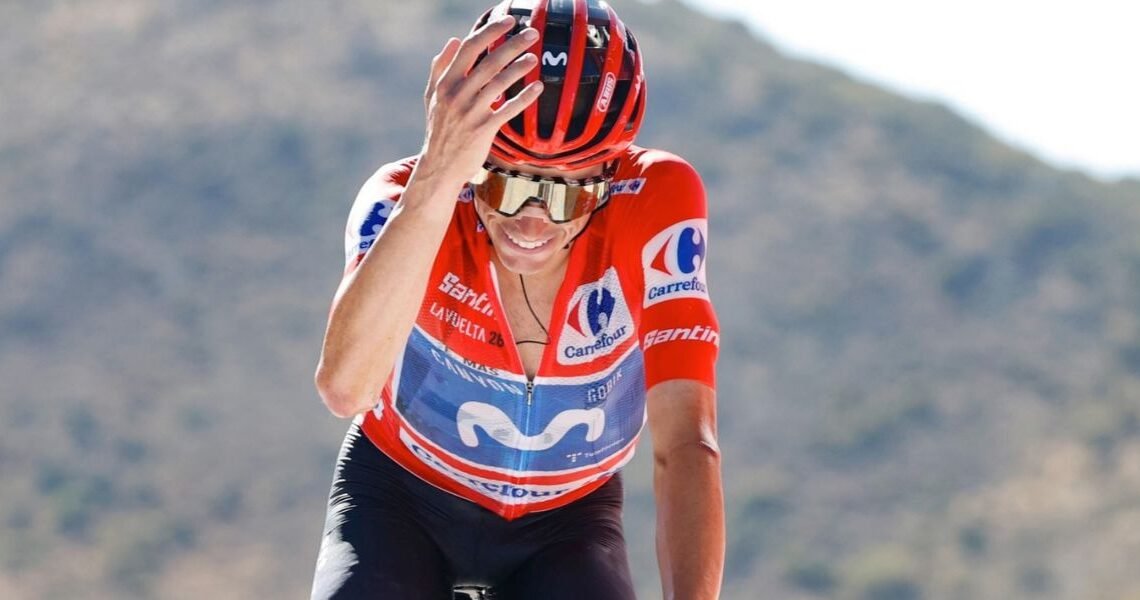
There’s a version of this Vuelta a España where none of this matters: Enric Mas spends three weeks doing what Enric Mas usually does, riding intelligently, finishing on the podium, and going home to read yet another retrospective of “close, but not close enough” by the Spanish press. In that version, Tadej Pogačar rides into Madrid (er, Granada) with the red jersey, a fourth different Grand Tour title to his name, and the cycling world nodding along and already turning towards Worlds in Montréal.
That version was well underway. Three stage wins, nearly four minutes in hand, a peloton that looked less like a field of competitors and more like a procession behind him. And then, on a stage to Xeraco that will now live forever in Vuelta folklore, a rock in the road did what no rider had managed all race: it stopped Pogačar.
It feels almost unfair to write a tribute to Enric Mas without first pausing on what was lost that day: not just a jersey, but a Grand Tour that was shaping up to be one of the great domination jobs of the season, another manifestation of “It’s great to be able to witness greatness,” that statement we fans make as we actually pine for more competitive bike racing. Pogačar didn’t get beaten; he got removed from the equation. And it’s worth saying plainly: on the evidence of those first seven stages, he would have won this race walking away.
But here’s the thing about “would have”: It doesn’t actually win bike races. In a sport where crashing is so prevalent that it’s practically accounted for, assumed, falling prey to a rock isn’t too far from showing up with insufficient fitness: It’s one of many reasons a rider doesn’t win a race. Not that the crash was Pogačar’s fault; I’ve always found the shame-and-blame game around crashing to be tiresome. But probabilistically it was likely to happen at some point, and when it did, Enric Mas was (finally) in a position to slot in.
Slotting certainly wasn’t easy: He still had to ride the next twelve stages, including several monster days in oppressive heat. He had to defend a jersey he didn’t ask for (and that he classily didn’t wear on the podium the first day), and hold off a determined group including Roglič, Gall, Onley and Carapaz, any one of whom would have happily inherited the chaos. Mas didn’t just survive the opportunity. He built on it: Aitana, Sierra de la Pandera, and then, of all things, a time trial performance that finally answered the one question that’s dogged his career.
And let’s not forget: before the rock, before the crash, before any of it, Mas was the rider on stage 7 who actually made Pogačar work for it, reeling the G.O.A.T. back in up a gnarly climb, and very nearly outsprinting him to win the stage. That wasn’t nothing.

Three runner-up finishes. A decade of “next year.” Spain hasn’t had a Vuelta winner since Contador in 2014. Mas didn’t inherit this one so much as refuse to let it slip through his fingers a fourth time. Pogačar will be back. Mas, finally, has his.

RACE NEWS
Nina Berton Sprints to First Pro Win on Brittany’s Dirt Roads

We’re reaching back a week for this one, as we didn’t want to miss an exciting debut victory: Nina Berton (EF Education-Oatly) won the Pointe du Raz Ladies Classic, a 130-kilometer race through Brittany featuring 13 dirt sectors and six finishing circuits around Plouhinec. The Luxembourger timed a late sprint to catch and pass a leading duo in the final kilometer, securing her first professional road race victory.
The race split apart on the dirt roads, with a group including Paula Blasy, Célia Géry, and Rosita Reijnhout attacking off the front. EF Education-Oatly’s Cédrine Kerbaol, Berton’s teammate and closest friend on the team, drove a prolonged chase to keep the gap manageable, having earlier crashed on one of the sectors and needed to fight back to the front group. Under the flamme rouge, only Blasy and Géry remained ahead; a momentary hesitation between the two let Kerbaol close in further, setting up Berton’s decisive move.
Berton launched from roughly 50 meters back, using the draft of the two leaders to recover before delivering a final kick to the line. She credited the entire EF Education-Oatly squad for controlling the chaotic race and setting up a two-leader strategy with Kerbaol.
The win is Berton’s second of the season, following her Luxembourg national time trial title, and marks her breakthrough road race victory against a strong field. She and Kerbaol embraced at the finish after Berton collapsed onto the grass, exhausted from the effort.
Arvid de Kleijn Doubles Up in Fourmies

Arvid de Kleijn (Tudor) claimed his second Grand Prix de Fourmies title, winning a chaotic mass sprint to secure his first victory of what has been a tough 2026 season. Tobias Müller (Unibet Rose Rockets) took second, with Ethan Vernon (NSN) rounding out the podium.
The race followed its usual script around Fourmies, tackling the Côte du Bocquet and the Sacré Coeur climbs, before funneling toward a bunch gallop. With sprinters like Paul Magnier, Olav Kooij, Sam Bennett, and Milan Fretin on the start list, a field sprint always looked likely.
A five-man breakaway didn’t form until roughly 80 kilometers in, and Noah Ramsay, Javier Serrano, Brem Deman, Léandre Huck, and Théo Delacroix never built more than a two-minute cushion before the bunch reeled them back in.
Heavy rain made for a nervous, crash-marred finale, as Kooij was among those to hit the deck. Repeated counterattacks eventually blew the peloton apart more than 20 kilometers from home, splitting off a lead group of about 20 riders that included Florian Sénéchal and Jonas Abrahamsen. Lionel Taminiaux (Lotto-Intermarché), fresh off a stage win at the ZLM Tour, then attacked alone from that group and very nearly stayed away, only to be caught in the closing kilometers.
That set up a frantic, train-swapping sprint that produced two more crashes. De Kleijn avoided the carnage, latched onto Müller’s wheel, and came around him in the final meters for the win.
The result means more than just a season-saving result for De Kleijn. He’s endured a hell of a stretch personally, ranging from becoming a father to losing his own father, being assaulted by a group of youths, and abandoning his first Tour de France. This repeat Fourmies win suggests things are on an upswing once again.
Arvid De Kleijn (Tudor) remporte au sprint le #GPFourmies dans un final qui a fait quelques dégâts… #LesRP pic.twitter.com/XD8yIvnUyl
— Eurosport France (@Eurosport_FR) September 13, 2026
Berthet Bests Fisher-Black at Faun Tour Femmes
The men’s tour spins through an array of races in the buildup to the World Championships; the women’s tour has its own rampup, including the Faun Tour Femmes.
The four-day race through the Ardèche and Drôme, formerly known as the Tour Cycliste Féminin International de l’Ardèche, wrapped up Sunday with Juliette Berthet completing a dominant showing for FDJ United-SUEZ. The Frenchwoman claimed the overall by the slimmest of margins, just two seconds ahead of Niamh Fisher-Black (Lidl-Trek), capping a race where her team simply never let go of the front.
Berthet, a 27-year-old from Besançon, built her winning cushion with back-to-back stage victories on days two and three, first outsprinting Fisher-Black in a two-up finish, then beating her again in a three-up drag race in Tournon-sur-Rhône that put her into the race lead. Those two stage wins turned out to be the difference, because the final day in Peyrus nearly flipped the script.
With the GC tied on time entering the last stage, Fisher-Black attacked on the final climb and briefly dropped both Berthet and her teammate Lauren Dickson. Dickson clawed her way back to the front group and then launched a solo move with 4km remaining, soloing to the biggest win of her young career and her first as a professional. Berthet crossed second on the stage, enough to seal the overall by those two precious seconds over Fisher-Black, who took the mountains jersey. Dickson rounded out the GC podium in third.
It’s FDJ United-SUEZ’s race to remember: three stage wins and the overall classification, a statement of strength heading toward the World Championships road race.
Wiebes Wins Again: Fourmies Falls to the Dutch Sprint Machine

Yet another women’s race in the Worlds runup, but this one taken by one of the sport’s greats, Lorena Wiebes.
The SD Worx-Protime rocket defended her title at La Choralis Fourmies Féminine on Sunday, sprinting to victory for the second year running in the 126.4km race through the rolling roads of the Avesnois. It was Wiebes’ 20th win of an already absurd 2026 season, a number most riders would be thrilled to reach across an entire career, let alone one campaign.
The race played out almost exactly as the pre-race script suggested it might. A breakaway pair of Zoé Bihan (Team Breizh Ladies) and Laura Poncet (Buffaz Gestion de Patrimoine) spent much of the day out front before being swept up with 46km remaining. Henrietta Christie (EF Education-Oatly) tried her luck with a 36km solo dig, but with a course selective enough to soften legs without ever threatening the sprinters outright, the move never had the legs to survive to Fourmies.
That set up exactly what SD Worx-Protime wanted: a bunch gallop. And when the front group came unglued in the finishing straight, Wiebes did what Wiebes does. Seemingly boxed in and buried in the sprint, she found the gap in the final few hundred meters and blew past the field to the line, holding off a fast-closing Nienke Veenhoven (Visma-Lease a Bike). Linda Zanetti (Uno-X Mobility) rounded out the podium, with Shari Bossuyt and Charlotte Kool, the rider many pegged as Wiebes’ biggest threat, settling for fourth and fifth.
It’s a result that fits the pattern of Fourmies’ short history: a race that gives attackers a puncher’s chance but, more often than not, comes down to whoever’s fastest when it matters. This year, as in 2025, that was Lorena Wiebes, closing out the Coupe de France Femmes Professionnelles calendar in trademark style heading into the Worlds. The only question left to be answered: Is the Montréal course too up-and-down for the versatile sprinter?
RIDER, TEAM AND CYCLING NEWS
Eddie Dunbar’s Long Road Back to Peñas Blancas

Say what you will about the Vuelta a España; as the final Grand Tour of the season, it’s a great one for redemption. Just ask Eddie Dunbar.
The Irishman’s 2026 campaign was supposed to be a fresh start. Instead, it nearly didn’t happen at all. Dunbar’s debut season with Pinarello Q36.5 was derailed when he was struck by a scooter while riding a city bike through the streets of Monte Carlo, an injury that cost him nearly four months of racing. By his own admission, there was a stretch where he didn’t touch a bike for three months straight, a brutal setback for a rider who’d arrived at his new team with real ambitions.
So when Dunbar rolled into the final week of the Vuelta, few were circling him as a threat. That changed on Stage 19’s brutal 210.8-kilometer haul from Vélez-Málaga to the summit finish at Peñas Blancas above Estepona. Dunbar didn’t even feel like a factor for most of the day; in fact, he radioed his team after 50 or 60 kilometers to say it simply wasn’t his day. Somehow, he still made the 16-rider breakaway, and having two Pinarello Q36.5 teammates, Thomas Gloag and Marcel Camprubí, in the move gave him the freedom to settle in and wait.
That patience paid off in spectacular fashion. Santiago Buitrago attacked with two kilometers to go and looked to have the stage won, but Dunbar clawed his way back inside the final 500 meters and blew past the Colombian to take the win. It was an emotional finish; Dunbar couldn’t hold back tears afterward. And it was a fitting exclamation point on a comeback few would have predicted after his injury-ravaged spring.
It’s Dunbar’s third career Vuelta stage win, following his double victory in 2024, and his first win of any kind in two years. Behind him, the GC picture stayed put, with Enric Mas safely retaining the red jersey ahead of the race’s final mountain showdown. For Dunbar, the result matters less as a GC footnote and more as proof that the season wasn’t lost. After months of rehab and doubt, Peñas Blancas was the answer.
Bad Luck Strikes Again: Žigart Refractures Jaw at Faun Tour Femmes

Urška Žigart’s brutal 2026 season took another cruel turn on Saturday when the Slovenian climber crashed out of third place overall on stage 3 of the Faun Tour Femmes in Tournon-sur-Rhône, refracturing the jaw she first broke back in June.
The AG Insurance-Soudal rider had been riding a strong comeback since her horror crash at the Tour de Suisse, where she struck a road surface irregularity in the closing kilometer of stage 2 into Locarno and was taken to hospital with a fractured jaw and concussion. That incident, which also brought down Sara Casasola, Ginia Caluori, and Maya Kingma, prompted CPA Women to call for a broader review of the SafeR safety framework.
Žigart had fought back impressively from that setback, racing the Tour de France Femmes just six weeks later. But medical examinations following Saturday’s fall confirmed a new fracture in the same spot. Her team said the repeated break likely spells an early end to her 2026 campaign, ruling her out of the World Championships in Montreal, where she’d been selected to ride for Slovenia, as well as the European Championships on home Slovenian roads.
The timing adds another layer of misfortune: her fiancé Tadej Pogačar is himself nursing a broken collarbone, fractured vertebrae, and a concussion after his own crash at the Vuelta a España, which ended his season and his hopes of defending his world title in Montreal, a race he’d planned to attend in support of Žigart instead.
Steven Kruijswijk: Winding Down a Career Spent Giving Everything

After 17 seasons at the top level of the sport, Steven Kruijswijk is riding into retirement — and true to form, he’s doing it the way he’s spent the last decade and a half: working for someone else.
The 39-year-old Dutchman, one of the most successful Grand Tour riders his country has produced, confirmed on the Dutch broadcast program De Avondetappe that 2026 will be his final professional season. The 2026 Vuelta a España is his 24th Grand Tour start, a tally bettered only by Mikel Landa in the current WorldTour peloton, and will be his last race as a professional.
It’s fitting that the send-off has a personal touch: Kruijswijk has lived in Monaco for roughly a decade, and this year’s Vuelta started there, with the opening time trial route passing within 500 meters of his front door.
Since turning professional in 2010, Kruijswijk’s career has been entirely bound to one team through all its name changes: Rabobank, Blanco, Belkin, LottoNL-Jumbo, Jumbo-Visma, and now Visma | Lease a Bike. Along the way he built a résumé most riders would envy: third overall at the 2019 Tour de France, six days in the Giro d’Italia’s Maglia Rosa in 2016 before a crash on the Colle dell’Agnello descent cost him the overall win, and a reputation as one of the most reliable road captains in the sport.

But rather than coast through a farewell season, Kruijswijk has spent it exactly as he’s spent his last several years: working. At this year’s Vuelta, with Visma chasing a historic haul of stage wins, Kruijswijk made his priorities clear before the race even started.
“I told the team, ‘You can squeeze me like a lemon until the last drop, and I will give it all this Vuelta for the boys,’” he said.
That’s not farewell-tour sentiment; it’s a job description he’s held for years, and one he’s kept up to the finish. On stage 16, that meant hours on the front controlling a breakaway so a teammate could win the sprint, rather than a ceremonial procession he could have coasted through instead.
Kruijswijk has described the buildup to this final Vuelta as feeling like a mirror image of his first Grand Tour, the 2010 Giro d’Italia. “It’s maybe with the same feeling as I had when I started as a professional,” he told Domestique. “You’re looking forward to the first race you do, and now it’s the other way around.”
He’ll also close out his career alongside Wout van Aert, a teammate since 2019, in what both riders know is a full-circle moment for a partnership that dates back to Van Aert’s Visma debut.
When the checkered flag falls on this Vuelta, Kruijswijk will step away from the peloton as a rider who spent his prime chasing his own ambitions and his twilight years quietly ensuring others could chase theirs. It’s both a career, and a farewell, built on the same principle: give it everything, right up until the last drop.

Headed to Worlds? Ontario’s New Cycling Corridor Is Worth the Detour

Headed to Montréal for Worlds? Ontario holds a real treat for visiting cyclists: an extensive cycling corridor linking several cities and attractions. It’s called the Cycle Ontario and Quebec Tourism Corridor, and it stitches together Ottawa, Montréal, Cornwall, and the Prescott-Russell region into one cross-provincial riding experience.
An exact total distance for the finished corridor hasn’t been published yet, but the scale gives a sense of what’s coming. The route runs the length of the Ottawa–Montréal axis, a stretch that covers roughly 200 km as the crow flies, with Cornwall and Prescott-Russell acting as anchor points along the way and rural spurs branching off from there. For context, similar existing routes stitching this same corridor of eastern Ontario and western Québec together run in the 600 km range once you account for the meandering along waterfronts and rail-trails rather than a straight shot up the highway. Expect the finished corridor to land somewhere in that territory once every link is signed and paved.
More Than a Bike Path
The tagline sums up the ambition: “Connecting Ottawa, Montreal, and Cornwall through scenic cycling routes that celebrate cultural heritage and natural beauty.” This isn’t just a strip of pavement between two cities; it’s being built as a scalable, four-season, culturally immersive experience, accessible enough for casual riders and sustainable enough to hold up under growing tourist traffic.
The corridor connects to UNESCO-designated waterways, agritourism stops, Indigenous cultural experiences, and a steady stream of local food, drink, and artisan shops — all built around the idea of low-impact, responsible travel. It’s the kind of route where the destination and the journey carry equal weight.
Why It Exists
The project sits under Destination Canada’s Tourism Corridor Strategy Program (TCSP), a national initiative helping communities and provinces build resilient, inclusive tourism economies from coast to coast to coast. The goal of each corridor under the program is the same: bring people, places, and industries together to strengthen local wellbeing and speed up sustainable destination development. Cycle Ontario and Quebec was one of the program’s flagship additions, developed with Destination Canada, RTO9, Vélo Québec, and the Prescott Russell Recreational Trail working alongside partners across both provinces.
VIDEO
- Richard and PEZ Are Headed to Worlds!
- Got a comment, thought or suggestion? Drop us a line at: Content@PezCyclingNews.com
- See PEZ FACEBOOK here
- Check out PEZ INSTAGRAM here
- And watch ALL of PEZ videos on our YouTube channel
The post EUROTRASH: Enric Mas Has Never Stopped Believing appeared first on PezCycling News.