
In last month’s toolbox, I revisited one of my first experiences with bonking and explained why glycogen depletion – and emerging research on blood glucose – matters so much for endurance performance. This month, I want to get more practical: how to actually get more carbs on the bike, why dual-source fuels are a game-changer, and how I’ve been experimenting with homemade snacks to keep my fueling sustainable & my wallet happy!

If you read last month’s article, you’ll know that I’ve really been rethinking my approach to my fueling on the bike. The “ride fasted & push through” mentality that I’d been carrying for a few years was very likely quietly limiting me – not on the easy days, but on my hardest training days. Since I’ve started fueling more deliberately, the difference has been noticeable: less heart rate drift on long, steady rides, less post-ride rummaging through the cupboards, and a better experience with hitting my actual training targets, even on hard days.
But, I can appreciate that knowing you should eat more on the bike & actually knowing what and how much to eat are two very different problems. There’s a reason that this question has been the focus for decades of sports nutrition research! So in this month’s article, I want to walk through three practical pieces of the puzzle: why dual-source carbs let you absorb more fuel, how to gradually train your gut to handle it, and how I’ve been making my own ride food rather than relying on an endless supply of pre-made gels.
Why One Carb Isn’t Enough
For a long time, conventional training wisdom told us that 60 g/hr was the upper limit of carb intake during exercise. I remember coming across this number as I started digging into the research after my first major bonk on the bike nearly a decade ago. There is a good reason for that number, and it doesn’t have anything to do with tradition – it’s simply a transporter problem.
Glucose (and maltodextrin, which is a chain of glucose molecules) is absorbed across the intestinal wall by a transporter called SGLT1. That transporter saturates at roughly 60 g/hr. Past that point, any additional glucose just sits in your gut – which is exactly where you don’t want it during a hard ride or race (Jeukendrup, 2008). The dreaded “gut rot” is basically a transporter The key insight coming from Asker Jeukendrup’s lab in the early 2000’s was that fructose uses a different transporter (GLUT5). When you co-ingest glucose and fructose, you’re effectively running two delivery trucks instead of one. The result? Total carbohydrate oxidation rates can climb to ~90 g/hr, and in some cases as high as ~105 g/hr (Jentjens & Jeukendrup, 2005). That’s nearly double the carb intake as what’s possible with glucose alone.
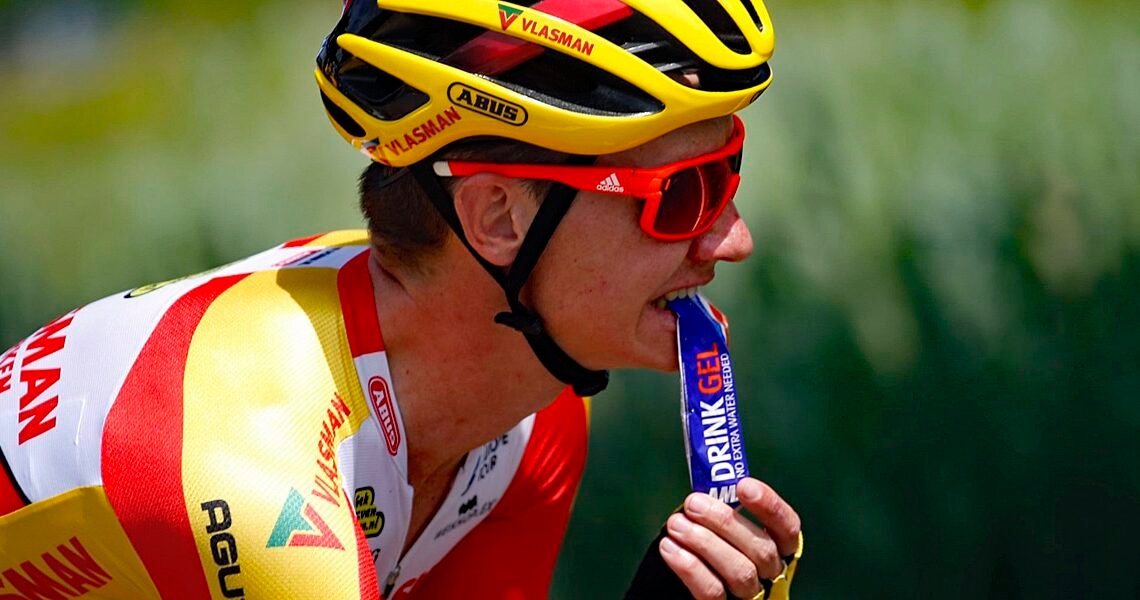
The original recommendation landed at a 2:1 glucose:fructose ratio, delivering up to 90 g/hr. More recent work suggests that highly trained athletes who have done specific gut training can tolerate even higher rates (up to 120 g/hr) – when the ratio shifts closer to 1:0.8 glucose:fructose (Rowlands et al., 2015; Viribay et al., 2020). This is some of the magic behind the modern “carb arms race” you’ve seen in the World Tour peloton & professional Ironman athletes, who have been known to take over 150 grams per hour of carbs!
It’s worth pausing here on something that often gets lost in the hype around the modern carb fueling: those 120+ g/hr numbers are coming from WorldTour pros pushing 350+ watts for five hours in a Grand Tour stage. The carb demand scales with the work being done. As an amateur racing on Zwift for an hour, or grinding out a 3-hour weekend ride at an endurance pace, most of us simply aren’t burning through fuel at the same rate. Chasing pro-level intake levels isn’t necessary – and for most of us, may not be useful.
A few practical takeaways:
- For most rides under 2 hours, 60g/hr from a single source is perfectly adequate
- For longer or harder rides (2+ hours, especially with intensity), dual-source fuels at 80-90 g/hr are where the real performance benefit will start to show up
- Going beyond 90 g/hr is possible, but it’s entering gut-training territory – not something new to try on race day.
Training the Gut
What many cyclists may not be aware of is that the gut is trainable, just like our legs. Suddenly upping your carb intake to 100+ g/hr on race day when you’ve been riding on a double-shot of espresso & a banana for the last 3 months is a recipe for disaster!
The good news is that the gut reportedly adapts reasonably quickly. The intestinal transporters (SGLT1 and GLUT5) up-regulate in response to repeated carbohydrate exposure, and the smooth muscle of the GI tract gets better at handling food while you’re working hard. A recent review article suggests that just a few weeks of progressively higher carb intake during training can reduce GI distress and increased absorption by around 50% (Martinez et al., 2023).
A simple progression might look something like this:
- Weeks 1-2: Focus on hitting ~45-50 g/hr on endurance rides. Focus on consistently fueling throughout your ride.
- Weeks 3-4: Increase intake to ~60-70 g/hr on your harder rides. Pay attention to how your stomach handles the fueling and intensity.
- Weeks 5-6: Increase to ~80-90 g/hr on longer/harder rides. By now, what felt like a lot of carbs on week 1 should feel pretty manageable.
My Homemade Experiment
Increasing your fueling to increase your performance sounds amazing and fantastic until you realise that most commercial products often cost around $3-4 for a ~30g serving of carbs. If you’re taking 90-120 g/hr for a 3-4 hr weekend long ride, you’re easily looking at $30+ just to fuel each long ride – and that’s before any drink mixes/electrolytes! Multiply that across a wider training block and a summer of outdoor riding and that gets expensive fast!
So for the past couple of months, I’ve been focused on experimenting with homemade ride fuels. Specifically, I’ve been making my own Rice Krispie treats & Rice Cakes. Both are relatively quick & easy to make, easy to portion, and pretty easy on the stomach. Rice is one of the most well-tolerated carb sources I’ve found, which is why you’ll see it served as a staple in many Pro Tour feed zones. I use a standard base recipe and then use different toppings to keep the flavours interesting and seasonal – I enjoyed my Cadbury mini-egg rice krispies around Easter (see photo below)!

My homemade Cadburry Mini-Egg rice krispies treats fueling me on an easy/endurance ride! I use a standard “base” recipe of ~60g melted butter (coconut oil would also work), ~300g marshmallows, & ~200g Rice Krispies, then add some mix-in for flavour (oreos, dark chocolate, etc.) I can whip up a batch of these in an evening after dinner and have homemade treats for the next week of riding! The base recipe (cut into ~15 squares) delivers ~30g carbs per serving.
I’ve also been experimenting on the liquid side, using plain table sugar in my bottles. I promise it’s not as crazy as it sounds: table sugar (sucrose) is just glucose and fructose bonded together in a 1:1 ratio, which means once your gut enzymes split it, you’ve got a built-in dual-source fuel for pennies. A squeeze of lemon juice helps with flavor & cuts the sweetness (since fructose is really sweet), and the result is a bottle that delivers a meaningful chunk of my hourly carb target without an expensive bag of premium drink mix. Fair warning: even with the lemon, it’s still a sweeter drink than most commercial mixes – not everyone will love the taste, and I’d recommend trying it on a training ride before committing to it for a long event.
That said, I do know that simple sugar water has a ceiling. It works great for endurance rides, but for higher carb targets I want something a little less sweet and a little more concentrated. So my plan for this summer is to start experimenting with maltodextrin-based homemade gels – a maltodextrin/fructose blend that mirrors what’s in commercial products, but at a fraction of the price. I’ll report back in a future Toolbox once I’ve put it through some real-world testing!
I know for a fact that my homemade snacks likely aren’t as precise as a commercial gel, but they’re often close enough for my needs as an amateur athlete and honestly, they’ve been working great for me!
Here’s my approach for now:
- Endurance rides: This is where my homemade food has shined. The intensity is moderate, the carb target is lower (~45-60 g/hr), and the gut has plenty of time to handle real food. I can experiment with new flavours to keep things fresh!
- Hard intervals & Zwift races: This is where I tend to lean more heavily on my cheap sugar water solutions to hit higher carb rates. I plan to continue experimenting with a homemade maltodextrin gel this summer.
This approach has served me well in my winter training. I haven’t been spending a fortune on commercial products, but I have significantly improved my on-bike fueling!
For anyone interested in trying this, there are some great resources available! Some of my go-to places for inspiration are “Pock-it Fuel” on Instagram (https://www.instagram.com/pockitfuel/) as well as EF Pro Cycling Team’s official Rice Cakes recipe (https://www.efprocycling.com/tips-recipes/team-recipe-on-the-bike-rice-cakes/).
Where This Leaves Me
Two months into being more deliberate about my carb intake, the ride-to-ride differences are no longer subtle. Heart rate drift on long endurance rides has been markedly reduced. Recovery the next day is genuinely better – on most days anyways! And I’m not finishing rides feeling completely hollowed out, scrambling for whatever’s closest in the kitchen after each ride.
Thanks for reading! I hope you found the information helpful and/or interesting. That’s all for this month – stay fueled, ride fast, and I’ll see you next time!
References
Jentjens, R. L. P. G., & Jeukendrup, A. E. (2005). High rates of exogenous carbohydrate oxidation from a mixture of glucose and fructose ingested during prolonged cycling exercise. British Journal of Nutrition, 93(4), 485–492.
Jeukendrup, A. E. (2008). Carbohydrate feeding during exercise. European Journal of Sport Science, 8(2), 77–86.
Rowlands, D. S., Houltham, S., Musa-Veloso, K., Brown, F., Paulionis, L., & Bailey, D. (2015). Fructose–glucose composite carbohydrates and endurance performance: critical review and future perspectives. Sports Medicine, 45(11), 1561–1576.
Viribay, A., Arribalzaga, S., Mielgo-Ayuso, J., Castañeda-Babarro, A., Seco-Calvo, J., & Urdampilleta, A. (2020). Effects of 120 g/h of Carbohydrates Intake during a Mountain Marathon on Exercise-Induced Muscle Damage in Elite Runners. Nutrients, 12(5), 1367.
Martinez IG, Mika AS, Biesiekierski JR, Costa RJS. The Effect of Gut-Training and Feeding-Challenge on Markers of Gastrointestinal Status in Response to Endurance Exercise: A Systematic Literature Review. Sports Med. 2023 Jun;53(6):1175-1200.
The post Avoiding Bonking and Simple Homemade Recipes appeared first on PezCycling News.