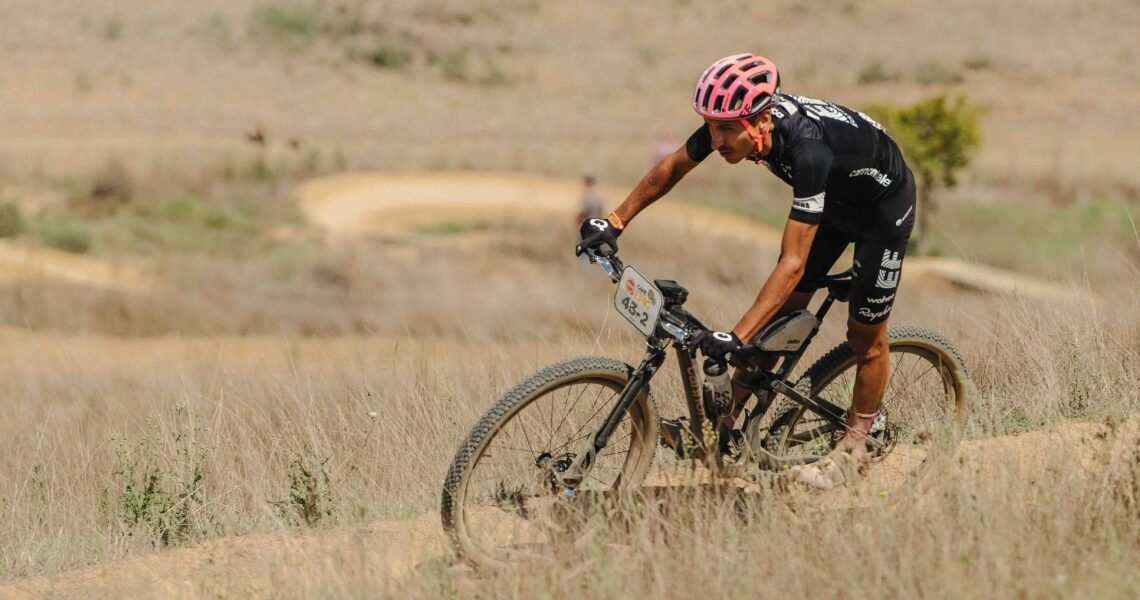

The Leadville Trail 100 MTB presents a challenge few mountain bike races can match: 100 miles of demanding terrain at elevations reaching more than 12,000 feet. Successful Leadville 100 preparation requires more than training and race-day fueling—it also means understanding how altitude affects hydration, iron requirements and exercise performance.
After supporting athletes earlier this season at Unbound Gravel—where he shared lessons about making cycling nutrition and meal preparation easier—sports dietitian and private chef Alex Winnicki took on a similar role at the Leadville 100 MTB, feeding two houses of athletes throughout race week.
Having also worked with several of those riders through his sports nutrition practice, Alex saw a clear difference between athletes who had prepared for the altitude months in advance and those who had not. Here are three important Leadville altitude strategies many riders overlook.

~ Two weeks ago I had the pleasure of supporting two houses full of athletes at the Leadville 100 MTB race. My job: keeping folks fed. Just like at Unbound, I was contracted as a private chef for the week to make sure everyone was fueled and ready to go. This race was unique in that I had several athletes racing who I also work with through my private practice as a sports dietitian, Second Arrow Nutrition Consulting. So while I was on the ground making sure people were well fed, I’d already been thinking through this race with many of my clients for months.
There was a stark contrast between the athletes I supported in my culinary role and the ones I’d worked with in the months prior as their sports dietitian — especially when it came to handling the altitude (10,000 ft / 3,000 m).
I wanted to share a few things I wish I could’ve told more of the athletes on the ground in Leadville. As you’ll see, most of these needed to be in place well before race day — some as early as when the acclimatization process started.
Three Altitude Preparation Strategies Riders Often Miss
- Check iron stores if you’re arriving early
- Manage hydration deliberately
- Test a few proven supplements
1. Check Your Iron Stores Before Arriving at Altitude
Many of the athletes I spoke with spent several days — sometimes weeks — at altitude, moving up from sea level to Durango or Denver before heading up to Leadville. When you spend a prolonged period at altitude, your body helps you adapt by increasing something called HIF (hypoxia-inducible factor) from kidney cells. This triggers EPO release, which signals your bone marrow to ramp up red blood cell production so you can get more oxygen into your body. It’s a slow process, but if you’re there for a few weeks, you’re likely getting some of that benefit. In fact, it’s estimated that for every 100 hours spent above 2,500m, you could see roughly a 1% increase in hemoglobin mass.
However, if your iron stores (ferritin) are low and you’re not supplementing with iron (~100-200 mg/day), you may not respond to altitude the way you’d hope. For this reason, I recommend checking your ferritin — you can literally order this test for $5 from Quest or Labcorp yourself in most states. Aim to be above 30 ng/mL (women) and 40 ng/mL (men) to get those adaptations, and work with your dietitian to decide whether iron supplementation makes sense for you. Blind supplementation can be dangerous and isn’t recommended.

2. Manage Hydration Deliberately at Altitude
At altitude, appetite and thirst can both get blunted — pair that with increased urine losses, and it’s easy to get dehydrated fast, which makes your time at 10,000 ft that much harder. The elevated dehydration risk comes from two places: increased respiratory losses from higher ventilation rate, and increased urine output.
At sea level, a baseline recommendation is about half your body weight in ounces, or 35-40 mL/kg, if you’re not exercising and you’re in cool conditions. If you can track your body weight and feel comfortable doing so, I’d recommend it — any short-term changes are likely fluid shifts, and it’s a simple way to see how you’re managing the hydration battle.
Keep a bottle in sight (not out of mind), filled, cool, and sometimes flavored to make fluids more palatable. A bit of salt helps with this too, but no need to go crazy — most of us already get plenty of sodium through diet. Adding a moderate sodium packet once or twice a day may help, but downing 3-4 of the really salty ones isn’t necessary.

3. Test Proven Performance Supplements Before Race Day
Buffers and beet juice. Beta-alanine and sodium bicarbonate both act as buffers against the acid that accumulates during hard, prolonged exercise — and Leadville is both hard and prolonged. Your effort on the bike is going to shift up a zone while your power output does the opposite, which means you’ll likely be tapping into the high end of your aerobic capacity up on Columbine. Buffers may help mitigate some of that aerobic deficit. Test these out before race day — and in the case of beta-alanine, ideally weeks out, since it takes a substantial amount of time to load.
Beet juice can increase the bioavailability of nitric oxide, which improves muscle oxygenation, mitochondrial efficiency, and contractile function. This can come from powders, shots, or plain beet juice. For our purposes, I’d suggest drinking 500 mL of beet juice in the two days leading up to race day, then taking a shot that gets you close to ~500 mg of nitrates 2-3 hours before the race. One note: don’t brush your teeth within 2 hours of taking these — the bacteria in your mouth actually plays an important role in converting nitrate to nitric oxide.
There’s a lot more to it, but I think this is a good starting point for most of us, assuming you’ve already got the basics down. If not, we’ve got just under a year until the next one. See you in Leadville!

References
- Burtscher, M., Niedermeier, M., Burtscher, J., Pesta, D., Suchy, J., & Strasser, B. (2018). Preparation for Endurance Competitions at Altitude: Physiological, Psychological, Dietary and Coaching Aspects. A Narrative Review. Frontiers in physiology, 9, 1504. https://doi.org/10.3389/fphys.2018.01504
- Cheung, S., Stellingwerff, T., Stanley, J., Mujika, I., Nybo, L., & Girard, O. (2026). UCI Sports Nutrition Project: Special Environments. International Journal of Sport Nutrition and Exercise Metabolism, 36(3), 382-391. Retrieved Aug 28, 2026, from https://doi.org/10.1123/ijsnem.2025-0101
- Stellingwerff, T., Peeling, P., Garvican-Lewis, L. A., Hall, R., Koivisto, A. E., Heikura, I. A., & Burke, L. M. (2019). Nutrition and Altitude: Strategies to Enhance Adaptation, Improve Performance and Maintain Health: A Narrative Review. Sports medicine (Auckland, N.Z.), 49(Suppl 2), 169–184. https://doi.org/10.1007/s40279-019-01159-w
The post Leadville 100 Altitude Nutrition: 3 Things Riders Often Miss appeared first on PezCycling News.