
This week’s EuroTrash opens with a hard look at cycling’s habit of romanticizing crashes and recoveries, arguing the sport’s rising injury toll — laid bare by the Vuelta’s brutal eighth stage — deserves a culture shift, not more thumbs-up-from-the-hospital-bed photos. On the racing side: Lewis Askey wins Tour of Britain’s opening stage in Lincoln; Enric Mas holds a 1:18 Vuelta lead over Roglič heading into a decisive final week built around a Jerez time trial; Mads Pedersen exits the Vuelta with illness, boosting van Aert’s green jersey hopes; and Mathias Vacek takes the ZLM Tour’s opening TT. Plus Mike’s brutal “Egan Ride,” and a POVEC sunglasses video.
TOP STORY
- Cycling’s Glorification of Crashing (and Recovering)
RACE NEWS
- Askey Powers to Stage 1 Win at Tour of Britain in Lincoln
- Vuelta’s Sting in the Tail: Can Anyone Take Red Off Enric Mas?
- Vacek Times It Right to Open ZLM Tour
TEAM, RIDER AND CYCLING NEWS
- Pedersen Out of Vuelta with Illness
MIKE’S RIDE OF THE WEEK
- The Egan Ride
VIDEO
- The Changing Lenses of POVEC’s C1 Sunglasses

Cycling’s Glorification of Crashing (and Recovering)
I recalled it while toggling between World Cup coverage and the Tour de France: that classic meme, the one illustrating cyclists’ toughness, vs. footballers’ flopping.

I love that one. It shows how tough we cyclists are. Our lore is peppered with examples of cyclists crashing and recovering, back on the bike within days — or even immediately, finishing the day’s race, bandaged and battered.
Johnny Hoogerland’s barbed-wire buttocks; Laurens Ten Dam’s wrapped face; Tyler Hamilton’s worn-down teeth, the victims of hours of grinding as he rode stage after stage with a fractured collarbone.

This year alone we’ve seen Tadej Pogačar crash, bounce back and win at Milan-Sanremo — and as I write admiringly below, Wout van Aert fracture his ankle and win Paris-Roubaix barely three months later.
The thumbs-up-from-the-hospital-bed photo is practically standard. It’s a show of defiance and determination.

We value suffering above practically all else in cycling, and while that typically refers to lactic acid-style suffering, pushing through that sizzle in your legs and lungs, we clearly also admire persevering through fractures, lacerations, even concussions.
Maybe it’s time to end this fascination.
I’m not suggesting that there’s some unconscious determination by riders to crash, nudged by our collective glorification of the rider who gets knocked down and gets back up again. Hitting the pavement is far too painful and potentially catastrophic for even a millimeter of unwitting tendency to creep in.
But by celebrating crash-and-recover, we normalize it. And to be clear: this isn’t normal, not in sport, really not anywhere, save…war.
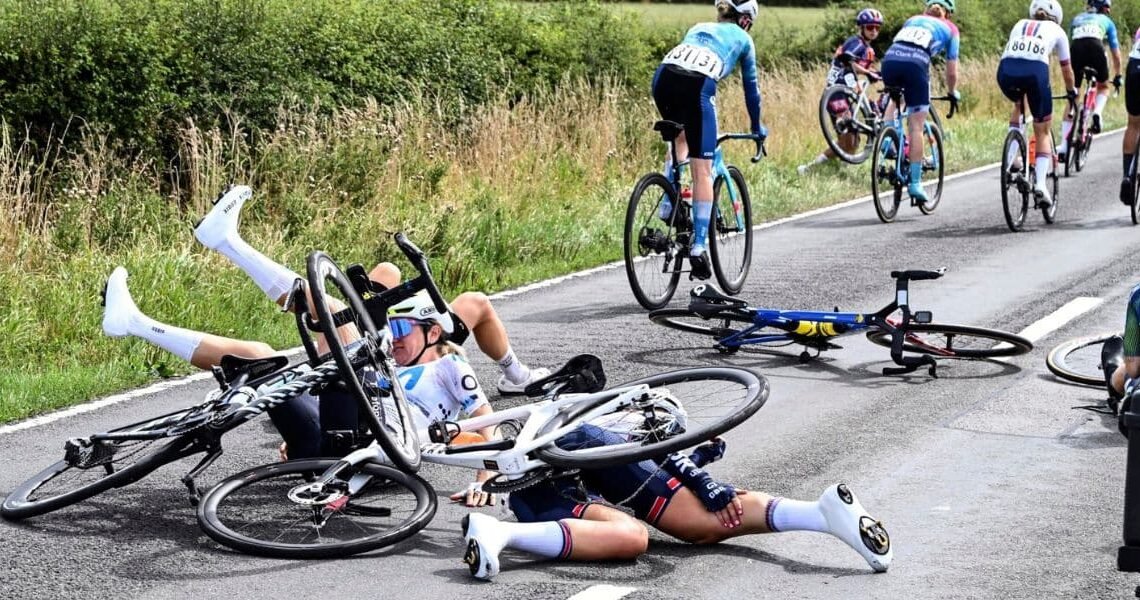
Imagine if 42 NFL players were taken away in ambulances on a given Sunday; we’d have congressional hearings. But proportionally, that’s what happened in the Vuelta’s eighth stage: Over 2% of all the riders went down hard enough that they couldn’t finish, and had to be driven away — in a single day of racing, out of 21.
Two percent of all the riders including, of course, one of the greatest riders ever. So among those 42 football players, one is Tom Brady (or…take your G.O.A.T. pick), his season likely over.
Also, a couple of players — proportionally — die after suffering injuries on the field. Because that’s roughly our rate in the pro ranks.
Cycling has always been a dangerous sport, but it has unambiguously become more dangerous in recent years. Want evidence? The statistics bear it out, but for a more vivid case, consider this famous photo:

Kelly, LeMond and Konyshev streaking madly to the World Championships finish line in 1989. By this time they’d surely hit at least 80 kph at some point during the race; now they’re sprinting in the rain — without helmets.
We’ve collectively gotten much smarter about helmets in the last few decades — the UCI included — but had there been a single crash in the 80s like Pogačar’s last Saturday, when he smacked his head hard enough to suffer a concussion with a helmet on, the helmet revolution would have occurred much earlier and much more quickly.
There’s no single remedy for this plague of accidents in the pro ranks; rendering this dangerous sport even a bit less risky — just returning to the rate of a few decades ago — could entail entering fewer riders in races, routing courses with less “road furniture,” considering eliminating radios (to cut down on distractions), testing airbag-style technology, and simply holding races to higher safety standards, including revoking licenses for those that fail to meet essential standards (such as controlling traffic — a measure that might have prevented Fin Tarling’s death).
All that, and a culture shift too: no more glorification of crash-and-recover. Don’t expect smiling hospital bed photos, or days-long recovery periods. In the face of this sport’s danger, we need defiance and demands, not acquiescence.
Where some saw clowning in this photo, I saw frustration and defiance: F*** crashing, and for a little while, f*** this sport that took down me and my partner. Don’t rush me.
RACE NEWS
Askey Powers to Stage 1 Win at Tour of Britain in Lincoln

Lewis Askey (NSN Cycling Team) delivered a home victory on stage one of the 2026 Lloyds Tour of Britain Men in Lincoln, countering a late attack from Florian Vermeersch (UAE-Emirates XRG) on the Michaelgate climb to solo to the win and claim the leader’s green jersey.
A six-man breakaway — Adam Lewis, Michal Schuran, Oscar Schempp, Asger Røjbek Sørensen, Jonah Killy, and Simen Evertsen-Hegreberg — animated the early race, contesting the day’s KOM climbs and intermediate sprint. Schuran’s strong climbing secured him the mountains jersey. The move stayed clear until Netcompany-Ineos drove the pace on the first Michaelgate ascent, catching the last survivors with 41km remaining.

A 12-rider group then formed to fight for the win. Jasper Stuyven and Matteo Trentin tried late attacks in the final kilometers without success, before Vermeersch broke away with just over 2km left. Askey caught and passed him on the final climb for a comfortable victory, his third professional win. Filippo Ganna (Netcompany-Ineos) finished second, two seconds back, with Tim Wellens (UAE-Emirates XRG) third. Elliot Rowe (Great Britain Cycling Team) took eighth and the young rider’s white jersey.

Askey said the win validated his GC ambitions, noting he expected big time gaps on the stage and needed to prove himself capable of riding for the overall. Rowe reflected on his team’s plan and the thrill of racing alongside riders he grew up watching.
The race continues Thursday with a Boston-to-Skegness stage, followed by two Yorkshire stages (Hull–Beverley and Helmsley–Leyburn), before concluding in the Scottish Borders on Sunday, with Earlston hosting a stage for the first time as the GC is decided.
Vuelta’s Sting in the Tail: Can Anyone Take Red Off Enric Mas?

Enric Mas has ridden into the final third of his home Grand Tour wearing red and (thanks to Tadej Pogačar’s departure) looking less like the perennial nearly-man and more like a rider who actually believes he can finish the job. After Stage 11’s bunch gallop into Lorca kept the general classification frozen, Mas holds 1:18 over Primož Roglič, with Felix Gall a further 21 seconds back at 1:39, Oscar Onley at 2:20, and Richard Carapaz distant at 3:26. Comfortable, but not remotely safe, considering the route still to come.
The race doesn’t stay polite for long. Stage 12 to the Calar Alto Observatory brings the Alto de Velefique before a punishing 16.9km drag to the line, the first real test since Mas seized control (er, was granted the race lead). Stage 14’s finish atop the Sierra de la Pandera has long been a Vuelta gut-check, but would seem to be the kind of stage that favors Mas.
But then comes the stretch that could decide everything: Stage 18’s 32km time trial along the Cádiz coast into Jerez, followed within 48 hours by Stage 19’s brutal run to Peñas Blancas and Stage 20’s queen stage through the Sierra Nevada, nearly 4,850 vertical meters, finishing atop what the peloton has taken to calling the Angliru of the south.
That time trial is the stage to circle. Roglič remains one of the best riders against the clock in the sport, and a flat, fast 32km is exactly the terrain where he could claw back a chunk of that 1:18, especially from Enric Mas. If he rolls into Jerez within striking distance, the final weekend in the mountains becomes a genuine shootout rather than a procession, and Roglič, four times a Vuelta champion, has made a career out eking out time bonuses when they matter most.

Gall continues to lurk, though Mas’ evident invulnerability and Roglič’s time trial superiority combine to make his emergence unlikely. Onley, on the other hand, appears stronger every day, though again: he would need to prove stronger than Mas and Roglic both in the mountains and in the TT. Unlikely.

So yes, pressure is coming for Mas. He has built a genuine cushion, but between an ITT built for his closest rival and two summit finishes saved for the very end, this Vuelta has been designed to be decided in its final week, not before it (at least, not if Pogačar’s not there.)
Vacek Times It Right to Open ZLM Tour

Mathias Vacek gave Lidl-Trek an ideal start to the ZLM Tour, winning Tuesday’s opening time trial around Kapelle to pull on the race’s first leader’s jersey.
The 21.1km test was pancake-flat by design, with vertical gain barely registered, turning the stage into a pure power contest along Zeeland’s exposed roads. Vacek, part of a Lidl-Trek squad also carrying Jakob Söderqvist, put down the fastest time on the circuit that started and finished in the same town, a hallmark of the race’s compact, wind-exposed geography.
Niklas Larsen and Söderqvist rounded out the podium behind Vacek, giving the young Czech rider an early buffer atop the general classification as the peloton heads into four more stages across the Netherlands’ southwest.
The ZLM Tour has built a reputation as a proving ground for sprinters and all-rounders comfortable riding in crosswinds, and this year’s start list reflects that pedigree. Anthony Turgis, Söderqvist, Tim van Dijke, Gerben Thijssen, Jason Tesson, Arne Marit, Danny van Poppel, Max Walscheid and Frits Biesterbos all figure among the names to watch as the race unfolds, with Team Visma | Lease a Bike, Alpecin-Premier Tech, Picnic PostNL and Red Bull-BORA-hansgrohe among the WorldTour outfits represented.
The route stays true to the race’s flat, wind-hunting identity. Stage 2 runs from Westkapelle to Heinkenszand over 193.8km, followed by a 201.2km stage from Roosendaal to Bergen op Zoom, a 210.2km loop starting and finishing in Schijndel, and a closing 182.7km stage around Waalwijk. None of these stages offers more than a few hundred meters of vertical gain, keeping the emphasis squarely on positioning, teamwork, and crosswind survival rather than climbing legs.
For Vacek, the job now is defense: a slim ITT margin rarely survives five days of Dutch wind unscathed.
RIDER, TEAM AND CYCLING NEWS
Pedersen Out of Vuelta with Illness

Mads Pedersen has pulled out of the 2026 Vuelta a España, skipping Stage 11 from Cartagena to Lorca after illness affected him through the race’s first half. The former world champion had already hinted he might not continue following a rough Stage 10 to Elche de la Sierra, where he was dropped early and finished near the back. Lidl-Trek confirmed the withdrawal Wednesday, saying Pedersen would prioritize recovering fully before targeting other goals later in the season.
Pedersen came into the Vuelta off a superb Tour de France, where he claimed the green jersey with one of his most consistent points campaigns. Spain proved far tougher: aside from a runner-up finish behind Bryan Coquard in Xeraco on Stage 8, he never found the consistency needed to seriously contend with Wout van Aert for the points title. His form unraveled further on Stage 10, a transitional day with heavy climbing that a fit Pedersen would typically handle, but he was distanced well before the finish and later admitted something felt off.
His exit costs him a stage well-suited to his strengths, as Lorca’s route has just one modest climb before a long flat run-in. The absence boosts Matthew Brennan, Jordi Meeus, and Coquard, while Thibau Nys likely becomes Lidl-Trek’s go-to option on selective finishes. Meanwhile, with his teammate Brennan his closest rival, Wout van Aert is beginning to look like a lock for the Green Jersey (knock, knock).
La Vuelta a España Green Jersey Standings through Stage 11, courtesy of ProCyclingStats
MIKE’S RIDE OF THE WEEK: THE EGAN RIDE

Most every fast group ride follows something like a familiar pattern: Steady warmup, speeds increase, then surges, sprints, hills — and sometimes a regroup or two.
Every fast group ride, that is, except the Egan Ride. This brutally odd ride through the hills above Silicon Valley is all-or-nothing, a quad-busting, lung-searing interval workout.

I’ve taken on Egan four times, and while every route has been new, the approach has been the same: steady, even slow pace for 5, maybe 10 minutes — be sure to show up warmed up! — and then all out up a nearby hill. The group actually stops at the top, collecting the last few riders, and then proceeds to the next hill. Rinse and repeat. It’s a big enough ride — I counted more than 50 riders at the start — that they’ve split into three subgroups. One pleasant surprise: at least a quarter of the riders were women, a real rarity.

This week’s version ran us up ten segments of thirty seconds to three minutes, and after the first of the ten I was hypoxic. I wasn’t as close to the front as I was a few years ago, but I’m pretty sure I was the first of the gray-hairs.

If you’re somewhere near the San Francisco Peninsula on a Tuesday, looking for a ride that’s sure to boost your fitness, join Egan (but sign the waiver first!). You won’t regret it (once you’re finished; I regretted it pretty much the entire time I was out there). The ride runs through daylight savings (and as the sun set as the ride wound down, I was happy to be able to switch lenses on my cool new POVEC C1s).
Oh — once you get up the hills, the views are pretty sweet.

VIDEO: POVEC’s Changing Lenses
The PEZ featured video is a short one this week, but pretty fun: Check out how the POVEC C1 sunglasses changes lenses with the swipe of a finger (and check me out trying to hold them steady while swiping).
- Got a comment, thought or suggestion? Drop us a line at: Content@PezCyclingNews.com
- See PEZ FACEBOOK here
- Check out PEZ INSTAGRAM here
- And watch ALL of PEZ’ videos on your YouTube channel
The post EUROTRASH: Let’s Talk About Crashing appeared first on PezCycling News.