
In this Monday cycling news update: Is the ASO doing enough to mitigate the effects of extreme heat? (Mike says…NO!) But this remains a Tour worth watching, especially as a four-rider Green Jersey competition heats up (and the temps likely cool down). Elsewhere, Mathieu van der Poel powered through same-said heat to win Stage 9 in Ussel, Gregor Mühlberger dominated his home Tour of Austria, the 2026 Women’s Tour of Britain route was unveiled, and Dame Sarah Storey capped a historic Paralympic career with retirement. Just one more sleep until Rest Day is over!
TOP STORY
- ASO’s Planning Fizzles as the Tour Sizzles: Tour de France Battles Record Heat
RACE NEWS
- Don’t Give Up on the Tour: Why the Green Jersey Is Where the Real Racing Is
- Racing Beyond Le Tour: Gregor Mühlberger Rules the Roost at Home in Austria
- Stages Announced for 2026 Women’s Tour of Britain
TEAM, RIDER AND CYCLING NEWS
- Ussel Or Bust: Van der Poel Turns Suffering Into Stage Glory
- A Storey for the Ages: Dame Sarah Storey Ends Stella Career
MIKE’S RIDE OF THE WEEK: THE CASCADE LAKES LOOP
VIDEO
- Richard’s Stage Five Video Review

ASO’s Planning Fizzles as the Tour Sizzles: Tour de France Battles Record Heat
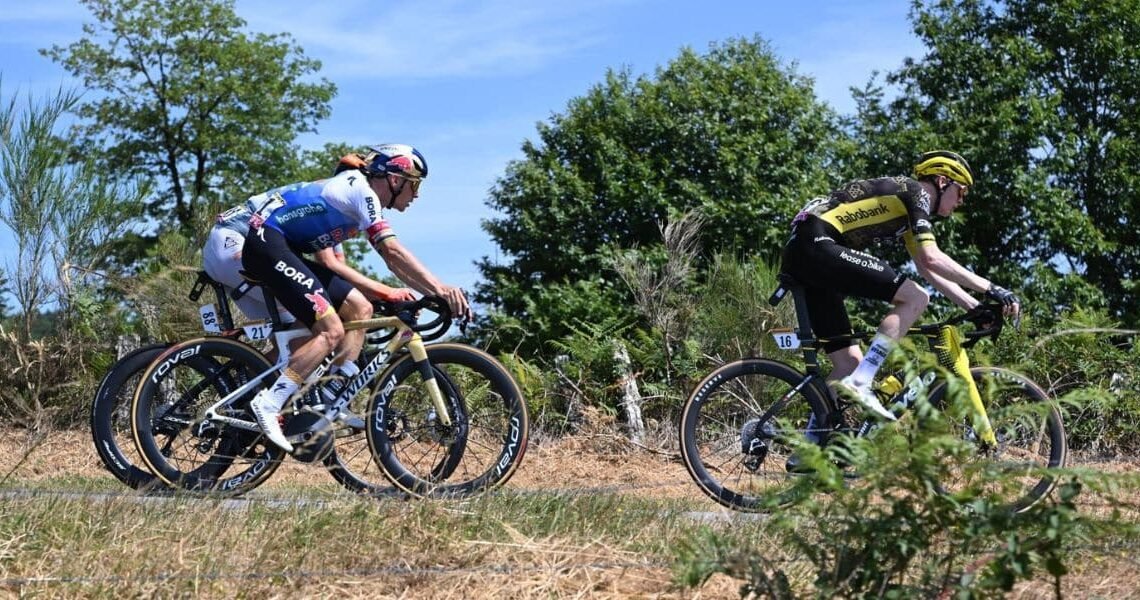
Sunday’s Tour coverage followed GC contender Florian Lipowitz as he floated back to the team car and was handed one, then two, then a third bottle…plus an ice sock, which he stuffed into the top of his jersey, and then two gels — which I bet were frozen.
This isn’t a comment on Team Red Bull leadership dynamics (though that could be a good topic as well); it’s about the measures that riders and teams are taking to mitigate the effects of record-breaking heat.

Consider the following:
- With temperatures consistently exceeding 38 degrees (sorry U.S. compatriots; we’re speaking Celsius here at Pez), teams are routinely blasting through 100 bottles in a stage. Riders are visiting teams more often; the UCI has modified feed rules to accommodate the need for more fluids.
- Teams are also going through hundreds of pounds of ice per day. Keep in mind, this is France, not the U.S.; ice isn’t nearly as readily procured. Soigneurs and even directors have been spotted running into local gas stations along transfer routes, clearing out their commercial ice freezers before the stage start.
- Slurries — or slushies, as we call them here in the U.S. (or Slurpees when we’re violating 7-11’s IP restrictions) are standard fare. Chugging them before a stage and even mid-stage, in the form of frozen gels.
- Before and after stages riders sport ice vests and plunge their arms into cold water while “warming up.”

- And after stages they retreat immediately to air-conditioned buses — and frequently now to cooling makeshift baths.

And yet…cycling’s organizers aren’t keeping up. The UCI prohibited Visma | Lease a Bike riders (and thus every rider) from wearing ice socks during the Barcelona team time trial. And — presuming that ASO sets daily schedules — stages consistently ride through the hottest stretch of every day. Consider the temps in Sunday’s start town of Malemort; with the stage’s rough start and finish times bracketed in red:

It’s like the Tour goes out of its way to put riders on the road in the most potentially harmful part of the day.
Here’s what it would look like if Stage 9 had run during hours that are similar to…Well, to those of the amateur races I enter in the U.S.

ASO did take change the stage, in light of the extreme temperatures, shortening it by…30 kilometers. Eighteen whole miles.
Every little bit helps, I suppose.
I’m certain there are reasons why European bike races happen in the most scorching hours, and I’m quite certain those reasons are somehow economic; people don’t watch sports early in the morning — or here in the U.S., what would be the middle of the night.
But in dealing with climate change, our society has collectively decided to enact mitigating measures, often rather than preventative ones; surely dampening the effects of ever-higher temperatures by shifting to earlier, shorter stages is worth considering?
After all, here on the West Coast, we’re all watching recorded versions anyway.
Note: According to Wielerflits, the CPA — the riders’ union — is indeed speaking with ASO about shifting at least some stages to an earlier window in 2027.
Check out all of Pez’ Tour coverage, including…
- Van der Poel’s Powerful Win on Stage 9
- PEZ at the Movies: 23 Days in July
- Ed Hood’s Interview with Alex Stieda — the First North American to wear the Yellow Jersey
RACE NEWS

Don’t Give Up on the Tour: Why the Green Jersey Is Where the Real Racing Is

Let’s be honest, Pezzers: the yellow jersey battle isn’t officially over, but it’s getting there in a hurry. Tadej Pogačar’s ride into the mountains on Stage 6 didn’t just put time into Jonas Vingegaard; it put a lid on the GC storyline for anyone hoping this Tour would go the distance as a genuine two-horse race. Anything could happen and all that, but…Barring a crash (heaven forbid) or un jour sans (which seems to be a thing of the past for a disciplined Pogačar, we likely already know roughly how this one ends in Paris.
Which is exactly why the points classification is the competition actually worth your viewing this week, and hopefully next.

Turns out ASO can change with shifting conditions: The points scale got a proper overhaul for 2026, with flat stages now paying out a fat 70 points to the winner instead of 50, intermediate sprints jumping from 20 to 25. Moreover, a new “very flat” category was created specifically to reward pure speed over pure survival. Call it a coincidence if you like, but the timing, one year after Pogačar himself went and won the points classification almost by accident, says otherwise. The cynical view here: When it comes to keeping fans watching, ASO will adapt; when it comes to rider safety, though…

But give credit where it’s due: the new points regime is working Mads Pedersen currently wears green, and his margin expanded when he crossed Sunday’s intermediate sprint line first, but Biniam Girmay had been chipping away stage by stage. Meanwhile, Tim Merlier keeps finding ways into the mix, and Jasper Philipsen has never needed much invitation to crash a green jersey party. Four genuinely different riders, four different ways of hunting points, ranging from pure finishing speed to climbing durability, all makes for an exciting race to follow.

So while the yellow jersey story is winding down early, green is just heating up. That — for now — is the race to watch.
Racing Beyond Le Tour: Gregor Mühlberger Rules the Roost at Home in Austria

In case your race-following schedule isn’t full enough, there’s been racing going on outside of France. The Tour of Austria may not feature the sport’s top-tier riders, but the racing has been spirited — and worth following.
The 75th edition of the Lidl Tour of Austria wrapped up in Vienna, and the home fans got exactly what they came for: Lower Austrian rider Gregor Mühlberger claimed victory in front of thousands of spectators in Gamlitz to open the race, and he never let go from there. Mühlberger attacked with 11km to go on stage 1 to seal a solo win, and he was just getting started. L
Stage 2 up the iconic Grossglockner brought more of the same. Mühlberger attacked with 4km to go and held on for a solo victory amid a tense scrap for the minor placings behind him. That made it two wins in two days on home roads, the kind of dominant, crowd-pleasing performance a national hero is supposed to deliver.
The race wasn’t a total procession, though. Stage 3 into St. Johann Alpendorf saw the break stick: Neilson Powless and Igor Arrieta escaped on the descent and Powless comfortably won the sprint for the stage, with Jan Christen rounding out the podium. Stage 4 in Steyr went the way of Andrea Bagioli, giving Lidl-Trek a stage to celebrate. The final stage into Vienna came down to a bunch gallop, with Sam Watson taking the field sprint, but the overall was already decided.
Mühlberger sealed the overall victory ahead of Kevin Vermaerke and Bauke Mollema, giving Austria’s own a well-earned home Tour title in the race’s anniversary year. It’s not the Tour de France, but for five days in the Alps, it didn’t need to be.
Top Ten, General Classification — 75th Tour of Austria, courtesy of Pro Cycling Stats
| # | Rider | Team | Time |
|---|---|---|---|
| 1 | MÜHLBERGER Gregor | Austria | 19:26:11 |
| 2 | VERMAERKE Kevin | UAE Team Emirates – XRG | 1:25 |
| 3 | MOLLEMA Bauke | Lidl – Trek | 1:40 |
| 4 | RODRÍGUEZ Carlos | Netcompany INEOS | 1:47 |
| 5 | DOUBLE Paul | Team Jayco AlUla | 1:51 |
| 6 | AUGUST Andrew | Netcompany INEOS | ,, |
| 7 | SHAW James | EF Education – EasyPost | 2:31 |
| 8 | MARTINSEN Toralf Rydningen | Team Drali – Repsol | 3:28 |
| 9 | PICKERING Finlay | Team Jayco AlUla | 3:42 |
| 10 | HELLEMOSE Asbjørn | Team Jayco AlUla | 4:42 |

Stages Announced for 2026 Women’s Tour of Britain
The 2026 Lloyds Tour of Britain Women will be the longest in the race’s history — 635.8km across five stages with 8,895m of climbing, running from Cumbria to Warwickshire between August 19-23.
Stage 1 (Cockermouth-Cockermouth, 158.9km): The longest stage debuts Cockermouth as host town, tracing Cumbria’s Energy Coast through Whitehaven, Workington and Maryport before a cobbled section in Silloth and a finishing circuit near Clints Crags.
Stage 2 (Clitheroe-Blackpool, 110.5km): Riders tackle the Forest of Bowland’s climbs, including the famous Nick o’ Pendle ascent of Pendle Hill, before a flat run to a sprint finish on Blackpool’s promenade.
Stage 3 (Mold-Great Orme, 104.7km): The shortest but steepest stage (1,927m of climbing) heads through the Clwydian Range and past Conwy Castle before finishing atop the Great Orme via the brutal Saint Tudno’s Road — scene of Van Aert vs. Alaphilippe in 2021.
Stage 4 (Llanidloes-Hay-on-Wye, 138km): The hilliest stage (2,484m) winds through the Elan Valley and Cambrian Mountains before a rolling finish into the book-town of Hay-on-Wye.
Stage 5 (Royal Leamington Spa-Royal Leamington Spa, 123.8km): The flattest stage passes Kenilworth Castle and climbs Sun Rising Hill and Burton Dassett before a sprint finish decides the overall winner near Jephson Gardens.
Race director Jonathan Day said the route provides opportunities for a range of different rider types to challenge for the title, with every stage having the potential to shape the overall outcome.
TEAM, RIDER AND CYCLING NEWS
Ussel Or Bust: Van der Poel Turns Suffering Into Stage Glory

As a “‘tweener” — neither a climber nor a sprinter — and with a star sprinter on his squad to look after, Mathieu van der Poel’s chances for Tour de France stage victory are few and far between. Yet even after expending the most watts in driving Sunday’s breakaway, he emerged as the victor, a result that he chalks up to the grueling training sessions that he endured this year.
The shortened, heat-battered and undulating stage to Ussel arrived after a Tour where Alpecin-Premier Tech had thus far gone strangely quiet, at least by their own standards. No wins in the first eight days is practically a drought for a team that’s opened with fireworks in four of its five previous Tours. Philipsen had banged on the door three times without cracking it; Van der Poel had one near-miss in the derailed Foix breakaway.
Then came stage nine, and the version of Van der Poel who’s been living near Alicante, embracing brutal 40-minute heat sessions on the rollers under a pile of clothing since last year, showed up ready for the Corrèze furnace. Temperatures topped 40°C in the finale, and Van der Poel was both prepped and determined.
It’s Tour stage win number three for Van der Poel, and it comes after a spring campaign that, by the former World Champ’s standards, has been disappointing. One look at the resolute manner in which he pursued this win — both in the month leading up to the Tour and throughout the stage — and ‘tweener though he may be, it would have been surprising if he hadn’t emerged victorious.
Thanks to Wielerflits for this content.

A Storey for the Ages: Dame Sarah Storey Ends Stella Career

Dame Sarah Storey has retired after a remarkable 21-year cycling career, closing out her run as Great Britain’s most decorated Paralympian ever. Born without a functioning left hand, she began as a swimmer, winning 16 Paralympic medals (five gold) before an ear infection pushed her toward cycling in 2005. Within a year she’d broken the world record in the 3km individual pursuit.
Storey went on to win 14 Paralympic cycling golds across five Games, all of them gold—no other colors. She took two at Beijing 2008 (time trial and individual pursuit), four at her home London 2012 Games (adding the road race and 500m time trial while defending her existing titles), and then defended her time trial, pursuit, and road race titles at both Rio 2016 and the delayed Tokyo 2021 Games—the latter making her Britain’s most decorated Paralympian outright. She capped her Paralympic career at Paris 2024 with road race and time trial wins.
Beyond the Paralympics, she’s amassed 18 track and 20 road world titles, including two on home soil in Dumfries and Galloway in 2023. She also broke barriers by winning UK national titles against able-bodied competitors (individual pursuit, 2008 and 2009) and became the first para-cyclist to represent England at a Commonwealth Games, finishing sixth in Delhi in 2010.
British Cycling’s interim chair Andy Cook praised her tenacity and her commitment to grassroots cycling, while Performance Director Stephen Park called her career historic and noted her influence on the next generation of female and para-athletes. Storey herself reflected on the privilege of 35 years as an international athlete across nine Paralympic Games.
She plans to now focus full-time on advocating for disabled access to cycling, especially for women.
PEZ VIDEO
Take another break from Tour coverage with this glimpse of inspiration from the Global Relay Gastown Grand Prix in Richard’s own Vancouver, Canada.
Gotta Comment, thought or suggestion? Drop us a line at Content@PezCyclingNews.com
The post EUROTRASH: ASO’s Planning Fizzles as the Tour Sizzles appeared first on PezCycling News.