
This week in racing – Remco Evenepoel reminded everyone of his one-day pedigree at the Amstel Gold Race, while young American Matthew Riccitello quietly built momentum as a legitimate Grand Tour prospect. Meanwhile, shifting Middle East investment, youth development shakeups, and disruptive tech at the Sea Otter Classic hint at deeper changes coming to the sport. Here’s what matters from this week’s AIRmail analysis.
Analysis, Insight, and Reflections from The Outer Line.
# Catch up on pro cycling – and its context within the broader world of sports – with AIRmail … Analysis, Insight and Reflections from The Outer Line. You can subscribe to AIRmail here, and check out The Outer Line’s extensive library of articles on the governance and economics of cycling here. #
Key Takeaways:
● Remco Wins Amstel Gold, in a Thin Field
● Take Note of Matthew Riccitello
● Will the Gulf States Back Away From Cycling?
● Impact of the Kula Sports Performance – ETS Deal
● Sea Otter Overview

The Spring Classics marched on last weekend though many of the top stars took a break – between the brutality of Paris-Roubaix last week and next weekend’s Liège-Bastogne-Liège. Remco Evenepoel won the Amstel Gold race, claiming the biggest win of his 2026 campaign so far, and exacting revenge on defending champion Mattias Skjelmose. Coming on the heels of Wout van Aert’s Paris-Roubaix victory, Evenepoel’s performance serves to remind us of one other person on the list of major one-day winners not named Pogačar or Van der Poel. However, on the flip side, like Van Aert, Evenepoel is far from an underdog winner, with two Monuments, an Olympic and World road race title already to his name. Still, the win raises the question of whether Evenepoel or even newcomer Paul Seixas could potentially challenge Pogačar next week at Liège. Even if the answer is probably “not,” the fact that Sunday’s performance has us even asking the question is good for the sport and is creating excitement for LBL – a race that hasn’t really served up a true battle for the win since 2021.
 Matthew Riccitello at Volta a Algarve ’26
Top U.S. riders struggled at Amstel, with Matteo Jorgenson crashing out of the lead group and Quinn Simmons failing to make the selection entirely. However, 24-year-old American climber Matthew Riccitello quietly put together one of the more impressive performances of his young career, soloing to victory atop the steep Mont Poupet finish at the Tour du Jura over in eastern France. Riccitello has continued to step up since transferring to France’s Decathlon team over the off-season, winning three races so far in 2026 and grabbing the lead in select races. Interestingly, even as Decathlon clearly looks to prioritize its younger French stars like Léo Bisiaux and Seixas, Riccitello still gets chances for himself as he builds on his fifth-place overall at last year’s Vuelta a España. His decision to run into the fire by joining a French squad rather than seeking the comfort of an Anglophone team flies in the face of conventional wisdom. However, it shows adaptability, which is an extremely underrated trait in up-and-coming riders, and is exactly why he may bypass more hyped talents to emerge as the next true American Grand Tour contender.
The LIV Golf tournament series is rolling towards uncertainty as the Middle East situation devolves further into turmoil, and potentially a long conflict that is forcing its nation states to reappraise priorities. The prior wave of sports-focused investing – which began with the sovereign Saudi Arabian Public Investment Fund marketing arrangement with UEFA premier teams and stadium naming rights, up to and including the UAE’s sponsorship of the world’s best cycling team – has started to crash. The PIF announced its next five-year plan last Wednesday that emphasizes domestic projects – a widely expected move given that national defense and events of national importance on home soil, including the 2030 World Expo and 2034 FIFA World Cup, will have greater impact on the national economic strategy. According to PIF’s governor, it “will continue to support Saudi Vision 2030 objectives by delivering competitive domestic ecosystems. The 2026-2030 strategy is a natural next step in PIF’s growth journey.” According to golf insiders, this will essentially pull the plug on its LIV support, in which the PIF has already spent upwards of $5 billion since 2022.
 Middle eastern money is going fast towards defense spending.
In a larger sense, the region’s investments in pro cycling may come into focus sooner than later. There is already speculation that Gerry Ryan’s public statements concerning the end of his sponsorship for the Jayco-Alula WT team is not just due to his desire to preserve generational wealth for his family. Rather, the impending loss of co-sponsor Alula in 2028 – or potentially earlier – and potential loss of other future Saudi co-investment in his team would force him to front the burden of an ever-escalating spending race to remain competitive and relevant in the UCI WorldTour. The entirety of the region is realigning its investment strategy and messaging. Gone, at least for now, are the days where places like Abu Dhabi, Doha, Kuwait City, and even Riyadh could be marketed as safe havens for wealth, investment, safety, and recreation within the world’s most profitable petro-economy hub. On one hand, the amount these countries spend in professional cycling is a drop in the seemingly bottomless bucket of sovereign dollars; on the other hand, the central purpose of deriving soft political value from that investment has been shattered, and may be a moot point for the foreseeable future. At the onset of the current hostilities, UAE was spending roughly $1 billion per day to monitor for and shoot down drones to protect its petrochemical infrastructure and this is poised to exponentially increase its military spending. The writing for cycling, as the saying goes, could be on the wall.
The recent acquisition of Kula Sports Performance by ETS (Englebert Training Systems) has quietly – but immediately – assembled the largest private pool of U.S. youth athlete development participants. The new company has upwards of 50,000 members engaged in high value strength, agility, skills, and team building programs focused on youth sports. So, the question is: could such a privatized and investment-driven approach uproot the traditional “high-performance” programs built into U.S. and other national Olympic organizations in the future? Pro cycling has already been overtaken by such youth-focused movements, with several teams investing heavily in talent development models that are in part segregated from the national team development models; this allows team management to “own” two options with their athlete portfolios: to develop the athlete into WT-ready riders with a somewhat locked-in early career contract commitment, or “sell” the athlete’s contract on the transfer market to sustain the team’s finances with a revenue source. Should a company like ETS expand into cycling and recreate the model at a more accessible regional scale, that monopoly enjoyed by a scant few WT teams could quickly evaporate. And, at the very least, it could create a new avenue to replace the under-supported club models – which used to be the main source of talent identification and participation. It could also bolster the number of young riders participating in competitive cycling, especially as the NICA High School model doesn’t have great market penetration outside of the western United States. Nor does NICA have a coaching pool deep enough to support its full rider potential. This development could be something to watch.

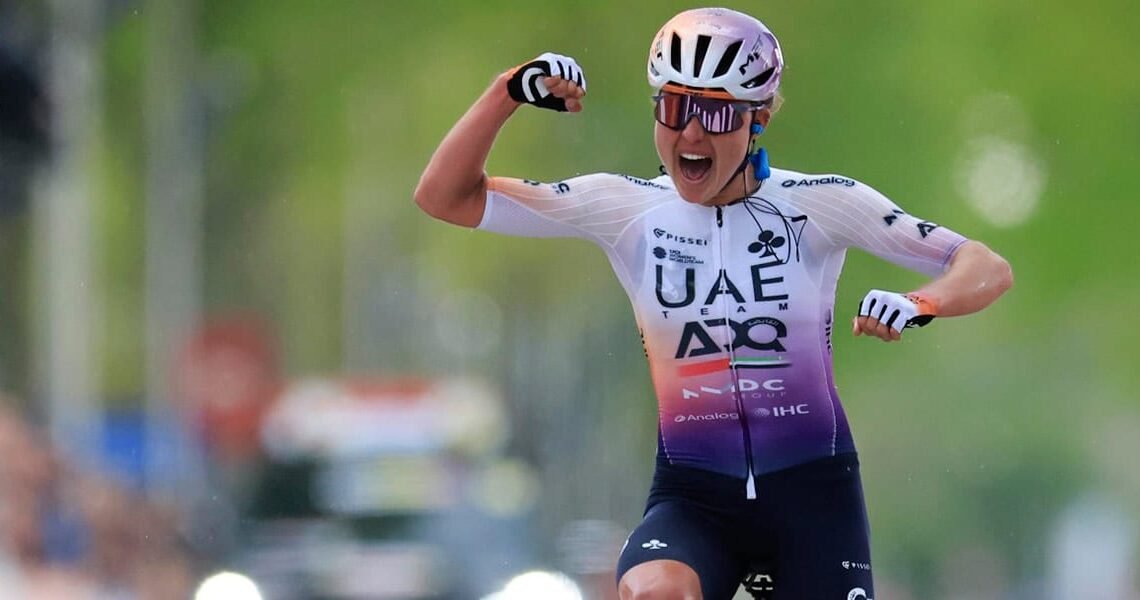
Paula Blasi’s (UAE) surprise victory at the Amstel Gold Race demonstrated that there’s room for tactically intrepid, strong, and determined riders to shake up the top tier in the UCI Women’s WorldTour – on any given day. Her breakaway win was earned with two laps to go on what is arguably one of the sport’s most tactically demanding circuits – traditionally marked with narrow sharp climbs, technically challenging descents and transitional roads. The 23 year-old Blasi beat the favorites to the “Cauberg” punch, forging almost a minute’s lead and forcing the favorites into a stalemate in which commitment to the chase was blunted by the need to conserve energy for the final push. Favorites Kasia Niewiadoma-Phinney and Demi Vollering took the hotly contested sprint to round out the podium, respectively. Aside from the fact that Blasi will never have to pay for a beer in Limburg ever again, her win, coupled with that of 20 year-old Célia Gery’s (FDJ) triumph in Flèche Brabançonne earlier in the week, shows that there is a next-gen capability in the women’s peloton, despite the sport still lacking the development depth and investment of the men’s WT environment.
And that is a conundrum – the women’s peloton should no longer be lacking such focus. Viewership numbers for the women’s Tour of Flanders earned a 78% share in its home market of Belgium – roughly a million viewers, though slightly off the peak in 2023 when Belgian Lotte Kopecky won. The Paris-Roubaix Femmes beat Flander’s numbers with a peak in excess of a million viewers – a 70% increase over the prior edition – but critics have already pointed out that the shift to broadcast the same day after the men (with poorer coordination and delivery) likely damaged its full potential and highlighted poor management strategy by ASO. Reinvesting in the racing product and allocating the right focus, in line with the investment and growth in other women’s sports, could sustain the talent pipeline beyond the occasional emergence of a Blasi or Gery in the future.

First held in 1991, the Sea Otter Classic has become the largest bike festival in the United States. Held at the Laguna Seca Raceway in Monterey, CA, this year’s event featured 1,100 brands and 70,000 participants and fans. One of the many bike races that took place was the first stop of the highly popular LifeTime Grand Prix gravel series – which were won by Sofia Gomez Villafañe and Bradyn Lange. The expo, which has largely replaced the former Interbike tradeshow, provides the forum for many businesses to launch new products and services. This year, the buzz around the event was completely dominated by two innovative Chinese brands: Amflow electric mountain bikes and X-Lab bikes. Amflow was launched by Chinese drone giant DJI and features a motor that is more powerful than any competitor, at a far lighter weight and much lower price. X-Lab is part of manufacturing powerhouse XDS, which makes 8 million bikes per year and sponsors the Astana World Tour team. With a stated intention to “reset the economics of the bike business” the vertically integrated X-Lab is taking high-quality bikes to the market that are often 40% less expensive than established competitors. Both of these technically sophisticated brands are potentially hugely disruptive to the global bike market.
Written and Edited by Steve Maxwell / Joe Harris / Spencer Martin
THE OUTER LINE
www.theouterline.com
@theouterline
Visit our website for our latest articles and commentary. And check out our extensive Article Library for hundreds of in-depth articles about the economics, governance, structure and competition of pro cycling, organized by subject. (Advisory Group: Peter Abraham, Luke Beatty, Brian Cookson OBE, Nicola Cranmer, Prof. Roger Pielke, Jr., Dr. Bill Apollo and Prof. Daam Van Reeth.)
The post AIRmail: Evenepoel’s Amstel Win, Riccitello Rising & Cycling’s Shifting Power Base appeared first on PezCycling News.